 Ashraf AboArafe ✍️
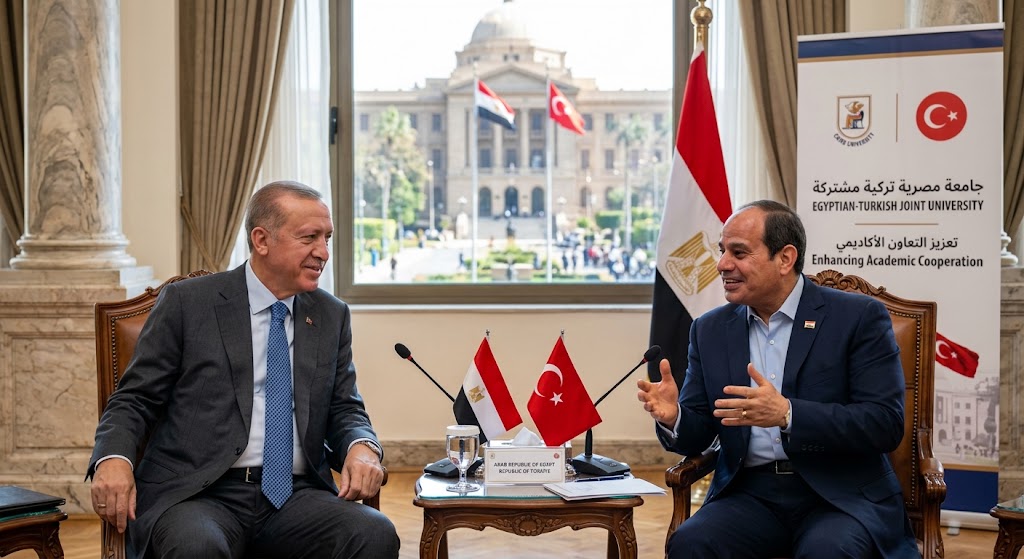
IN recent times, Egyptian-Turkish relations have witnessed a remarkable strategic transformation, expanding beyond traditional diplomacy into developmental and academic cooperation. At the heart of this shift is the proposed “Egyptian-Turkish Joint University” in Cairo—a high-profile, sovereign project aimed at transferring technology, advancing applied education, and bridging the gap between academia and industry.
1. The “Independent Turkish Model” (Foreign University Scenario)
As stakeholders evaluate practical mechanisms to bypass administrative delays in joint government projects, the scenario of establishing the university as a fully independent foreign institution under direct Turkish investment (similar to the American or British University models in Egypt) gains significant analytical relevance:
-
Advantages & Speed of Execution: Total administrative autonomy frees the project from dual-government bureaucratic procedures. It allows for the direct transfer of accredited Turkish curricula (authorized by Turkey’s Council of Higher Education, YÖK) and enables direct financial backing from Turkish corporate alliances and industrial zones operating in Egypt.
-
Challenges & Implications: Tuition costs would rise significantly compared to a state-subsidized joint model, catering to a different student demographic. Additionally, the institution would need to navigate a separate regulatory pathway to secure degree equivalence from Egypt’s Supreme Council of Universities, while forfeiting its symbolic stature as an official bilateral state agreement.
2. Chronological Timeline and Official Framework
Despite alternative investment models, the primary state-backed initiative has progressed through key diplomatic milestones:
-
September 2024: Official signing of the framework Memorandum of Understanding (MoU) during the presidential visit to Ankara.
-
November 2024: Announcement by Turkey’s Council of Higher Education (YÖK) confirming full alignment with Egypt’s Ministry of Higher Education and Scientific Research to initiate foundation plans in Cairo.
-
Early 2025 – 2026: Formation of a joint bilateral committee comprising roughly 20 academics and officials from both nations to draft executive bylaws.
-
Current Status (August 2026): The project remains focused on operational frameworks, accreditation standards, and finalizing inter-committee coordination to transition onto the ground.
3. Field Challenges and Execution Bottlenecks
Despite strong political backing, several operational hurdles slow implementation:
-
Administrative & Bureaucratic Delays: Scheduling and aligning executive meetings between the bilateral committee members to resolve field logistics.
-
Accreditation & Equivalence Discrepancies: Navigating structural differences in credit transfer and degree recognition between Egypt’s Supreme Council of Universities and Turkey’s YÖK.
-
Language Strategy & Curriculum Design: Striking a balanced balance between English, Turkish, and Arabic to match market demands.
-
Financial Commitments & Campus Infrastructure: Finalizing permanent land allocation and joint funding mechanisms for advanced technological laboratories.
4. Proposed Solutions and Strategic Recommendations
To accelerate project delivery under either governance model, the following actionable measures can be implemented:
-
Intensified Virtual Coordination: Hosting regular virtual sessions for the joint committee to expedite the drafting of internal bylaws.
-
Integration with Turkish Industrial Clusters: Aligning academic majors directly with Turkish industrial zones in Egypt (e.g., manufacturing and engineering hubs) to secure private funding and guarantee graduate employment.
-
Transitional Technological Colleges: Launching joint technical institutes in partnership with regional universities (e.g., Zagazig University) as a fast-track first phase.
-
English-First Fast Track: Adopting English as the primary language of instruction in initial phases, supplemented by elective Turkish language tracks.
Conclusion
The Turkish University project in Egypt represents a strategic opportunity to anchor the rapprochement between Cairo and Ankara within a sustainable educational and technological framework. Whether realized as an official joint-state project or as an independent foreign educational investment, it stands to enrich Egypt’s higher education landscape and deepen industrial knowledge exchange.