 Ashraf AboArafe writes
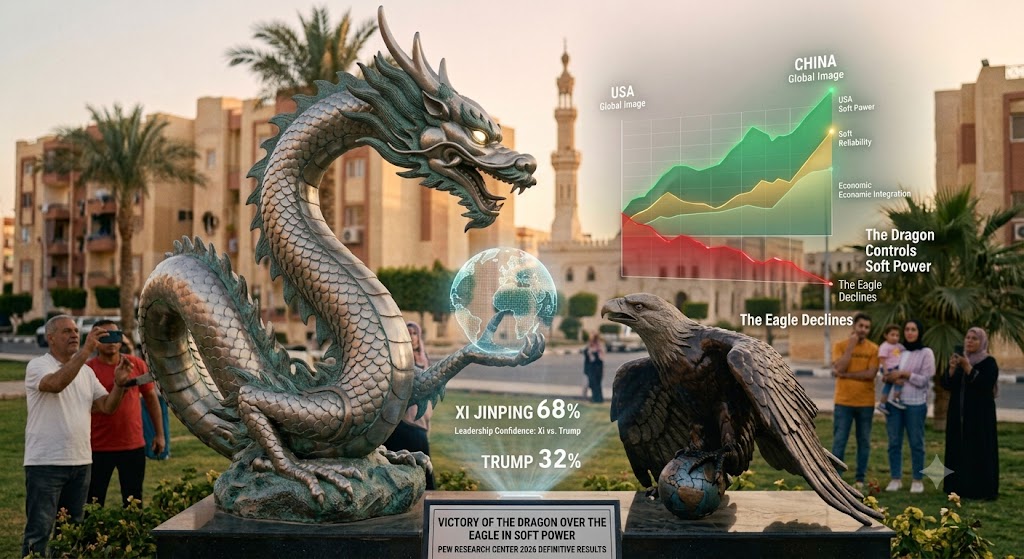
THE equation of international influence is no longer measured solely by the size of naval fleets or direct military budgets; soft power and public trust in a country’s political and economic model have become the decisive factor in shaping the new global landscape. In this context, the July 2026 report from the Pew Research Center represents a major turning point, signaling that global public perceptions have shifted. The long-standing image of American dominance is giving way to a steady rise in Chinese influence.
Shift in Global Sentiment: From Exception to Reality
For the first time in recent polling history, comprehensive surveys spanning dozens of nations reveal a clear shift in public preference: a majority of respondents across the 36 countries surveyed now view China more favorably than the United States.
This reversal is not driven solely by Beijing’s economic and diplomatic momentum, but equally by declining global approval of current U.S. policy. Even in immediate U.S. neighbors—such as Canada (44% favorable toward China vs. 33% toward the U.S.) and Mexico—public opinion favors China, demonstrating that international skepticism of Washington is no longer confined to traditional geopolitical flashpoints.
Erosion of Moral Authority and the Freedoms Gap
Perception of respect for “personal freedoms” long served as a pillar of Washington’s global narrative. However, the latest survey reflects a sharp erosion in this area, with the percentage of people who believe the U.S. government respects domestic personal freedoms falling significantly across key European and allied nations.
In Sweden, for example, this figure dropped from 61% in 2021 to 27% in 2026, alongside drops exceeding 25 percentage points in Canada, France, Germany, Italy, the Netherlands, Spain, and South Korea. This decline has narrowed the gap between the two superpowers on personal freedoms, leaving international audiences increasingly skeptical of both nations’ commitment to individual rights and eroding a core pillar of U.S. moral standing abroad.
The Global South: Interventionism vs. Economic Engagement
Across 17 middle-income nations—the primary arena of competition in Africa, Latin America, Southeast Asia, and the Middle East—the contrast in public perception is stark:
-
Perception of Intervention: A median of 75% view U.S. foreign policy as interfering a great deal or a fair amount in the affairs of other countries, compared to 45% who say the same about China.
-
Perception of Partnership: Conversely, China is increasingly viewed as a reliable economic partner that contributes more to global peace and stability. In South Africa, for instance, 72% see China as a reliable partner, compared to 46% for the U.S.
This divergence illustrates how Beijing’s focus on infrastructure projects and economic partnerships is yielding tangible political and public goodwill across the Global South.
A Multipolar World Order
The latest Pew data reflects a structural shift toward a multipolar world order in which international publics are less bound to single-power narratives. While Washington maintains traditional alliances in specific strategic contexts centered on defense ties (such as India, Japan, the Philippines, South Korea, and Israel), much of the world is hedging its options and seeking partners perceived as more stable and less interventionist.
Ultimately, soft power is not sustained by assertion, but earned by convincing international societies of the credibility of a nation’s development model and global posture.