Ashraf AboArafe writes
COMMENTING on an insightful article by Sadriddin Suyarov, Journalist, titled “ ‘Mustaqillik’ Generation: New Navigators of the Silk Road,” one is drawn to a profound question: what does 35 years of independence mean when an entire generation has grown up knowing no other Uzbekistan?
The answer may be found not only in the country’s political reforms, economic transformation or expanding international partnerships, but in the aspirations of its young people.
Uzbekistan’s 35th anniversary of independence is therefore more than a milestone on a national calendar. It represents a generational threshold. Those who are approximately 35 today were born around the same time as the independent Uzbek state. They did not experience the Soviet Union as adults; they did not personally live through the restrictions, shortages and closed horizons associated with that era. Their formative experience has instead been shaped by an increasingly connected world.
This is the significance of what Suyarov calls the “Mustaqillik Generation.”
It is a generation that increasingly sees the world not as a distant space beyond Uzbekistan’s borders, but as an arena in which Uzbekistan itself can participate, compete and contribute.
From Caravan Routes to Digital Routes
Few metaphors capture Uzbekistan’s transformation more powerfully than the Silk Road.
For centuries, Samarkand, Bukhara, Khiva and other historic centers stood at the crossroads of civilizations. Merchants carried silk and spices, but caravans also carried languages, philosophies, technologies, artistic traditions and ideas.
Today, the physical caravans may have disappeared, but the principle of connectivity remains.
The new Silk Road is digital.
Fiber-optic networks have replaced caravan trails. Technology parks are emerging where merchants once gathered. Data, innovation, artificial intelligence, digital services and human capital are becoming the new instruments of international exchange.
This transformation is particularly important because it changes the traditional image of Uzbekistan from a consumer of global technology into an increasingly capable producer and exporter of digital services.
The stories of young Uzbek entrepreneurs operating internationally from Tashkent illustrate something larger than individual success. They demonstrate that geographical distance no longer necessarily determines economic opportunity.
A young programmer sitting in Tashkent can develop a service for an American company. A designer can bring Uzbek patterns to international fashion. An artist can interpret the ecological tragedy of the Aral Sea for a global audience.
This is globalization experienced not as something that happens to Uzbekistan, but increasingly as something in which Uzbekistan actively participates.
Openness as a New National Asset
The Silk Road flourished because movement was possible.
People traveled. Goods moved. Ideas crossed borders.
In that sense, Uzbekistan’s increasing openness represents more than an administrative or economic reform. It can be understood as a revival of one of the deepest historical characteristics of Central Asia: connectivity.
Visa liberalization, educational exchanges, international investment, tourism and expanding diplomatic engagement are gradually creating a country that is more accessible to the outside world and more confident in engaging with it.
But openness carries a deeper meaning.
It changes the mentality of society.
A young Uzbek who studies abroad, communicates in several languages, works with international colleagues and launches a company serving foreign markets develops a different understanding of national identity. Patriotism does not necessarily require isolation. On the contrary, confidence in one’s national identity can make openness possible.
Uzbekistan’s challenge now is to ensure that this openness remains accompanied by institutional development, educational opportunity, social inclusion and sustainable economic growth.
A Generation Rewriting Central Asia
Perhaps the most consequential aspect of the Mustaqillik Generation is not simply what it means for Uzbekistan, but what it could mean for Central Asia as a whole.
For decades, the region was frequently viewed through the prism of borders, strategic competition and geopolitical rivalry.
A younger generation appears increasingly capable of seeing something different: a shared Central Asian space of opportunity.
Young people from Uzbekistan, Kazakhstan, Kyrgyzstan, Tajikistan and Turkmenistan increasingly encounter one another through education, business, environmental initiatives, culture, technology and social networks.
For them, cooperation does not always require a diplomatic declaration.
It can begin with a joint startup, an environmental project, a university exchange, a cultural festival or a simple conversation across borders.
That may ultimately prove more powerful than political rhetoric.
Regional integration becomes sustainable when cooperation becomes a habit before it becomes a doctrine.
This is why youth initiatives across Central Asia deserve attention. They represent the early foundations of a regional consciousness in which Central Asia is understood not merely as a collection of neighboring states, but as a community connected by geography, history, culture and increasingly common interests.
When Heritage Meets Innovation
There is another remarkable dimension to this transformation: Uzbekistan is not abandoning its past in order to modernize.
It is increasingly modernizing through its heritage.
Traditional ikat textiles, adras, khan-atlas, ceramics, embroidery, architecture and craftsmanship are being rediscovered and reinterpreted by younger generations.
This is cultural diplomacy in one of its most attractive forms.
The message is not: “Look at Uzbekistan because it has an ancient history.”
The message is increasingly:
“Look at Uzbekistan because its ancient heritage is creating something contemporary.”
That distinction matters.
A nation becomes culturally influential not simply by preserving its heritage behind glass, but by allowing each generation to reinterpret it.
The young Uzbek designer who transforms traditional patterns into contemporary fashion, or the artist who translates the story of the Aral Sea into modern visual language, is doing more than preserving culture.
They are renewing it.
And in doing so, they are giving Uzbekistan a voice that does not depend exclusively on official diplomacy.
The Aral Sea and the New Language of Responsibility
The international cultural representation of Uzbekistan also reveals another important development: the willingness to transform national challenges into global conversations.
The Aral Sea is not merely an Uzbek environmental tragedy. It is a symbol of the consequences of ecological mismanagement and a reminder that environmental problems rarely respect national borders.
When young Uzbek artists and creatives address the Aral Sea through international platforms, they turn a painful chapter of national history into an instrument of global dialogue.
That is the essence of modern cultural diplomacy:
not merely displaying what a country has, but sharing what it has learned.
The Real Test Begins Now
Thirty-five years of independence is an achievement, but anniversaries are ultimately less important than what comes next.
The most important question is not whether Uzbekistan has changed.
It clearly has.
The deeper question is whether the transformation can become institutional, inclusive and generationally sustainable.
The Mustaqillik Generation will face challenges that cannot be solved by symbolism alone: creating high-quality employment for a young population, maintaining educational momentum, narrowing digital inequalities, strengthening institutions, encouraging innovation and ensuring that economic opportunity reaches beyond the major urban centers.
This is where the maturity of a nation is truly tested.
For a person, 35 can represent the moment when youthful ambition meets experience and responsibility.
For Uzbekistan, the symbolism is striking.
The country has reached an age at which the question is no longer simply what independence has delivered, but what the generation born with independence will build upon it.
A New Chapter on an Ancient Road
The genius of the Silk Road was never simply that it connected places.
It connected people, ideas and civilizations.
That legacy remains profoundly relevant.
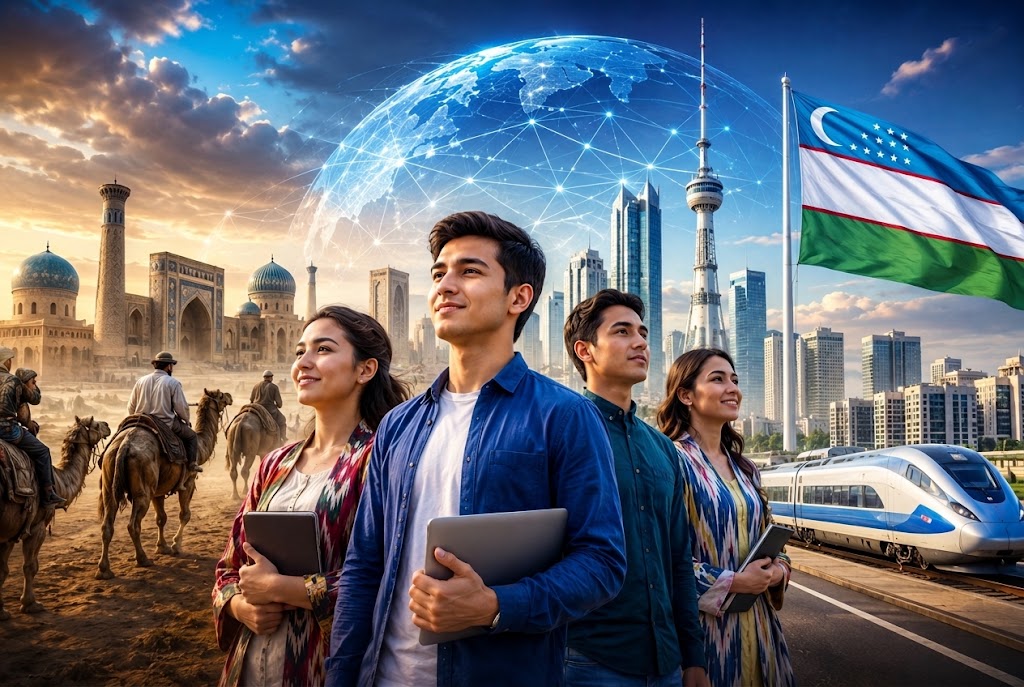
The Mustaqillik Generation is now carrying that legacy into a new century—not on camels, but through smartphones and fiber-optic cables; not through caravanserais, but through universities, technology parks and international institutions; not merely through trade, but through entrepreneurship, culture, science and diplomacy.
This is why Uzbekistan’s 35th anniversary deserves to be viewed not only as a celebration of independence, but as a celebration of possibility.
The country is standing between two images of itself: the Uzbekistan inherited from history and the Uzbekistan being created by its younger generation.
The first gave the country its place on the ancient Silk Road.
The second may determine its place on the Silk Road of the future.
And perhaps the most poetic truth is this:
The old Silk Road carried treasures across continents. The new Silk Road is carrying the dreams of a generation.
That generation may ultimately become Uzbekistan’s most valuable bridge between its magnificent past and its unfolding future.