 Ashraf AboArafe writes
IN response to concerns that the direct involvement of Pakistan’s military establishment in mediation between the United States and Iran means that Islamabad is acting on Washington’s behalf—or is indirectly joining a U.S.-Israeli camp against Tehran—a closer reading of the available evidence points to a far more complex picture.
It would be inaccurate to reduce Pakistan’s role to a “U.S. mission,” just as it would be premature to ignore the fact that Washington increasingly views Islamabad—and particularly Army Chief Field Marshal Asim Munir—as an influential channel to Tehran.
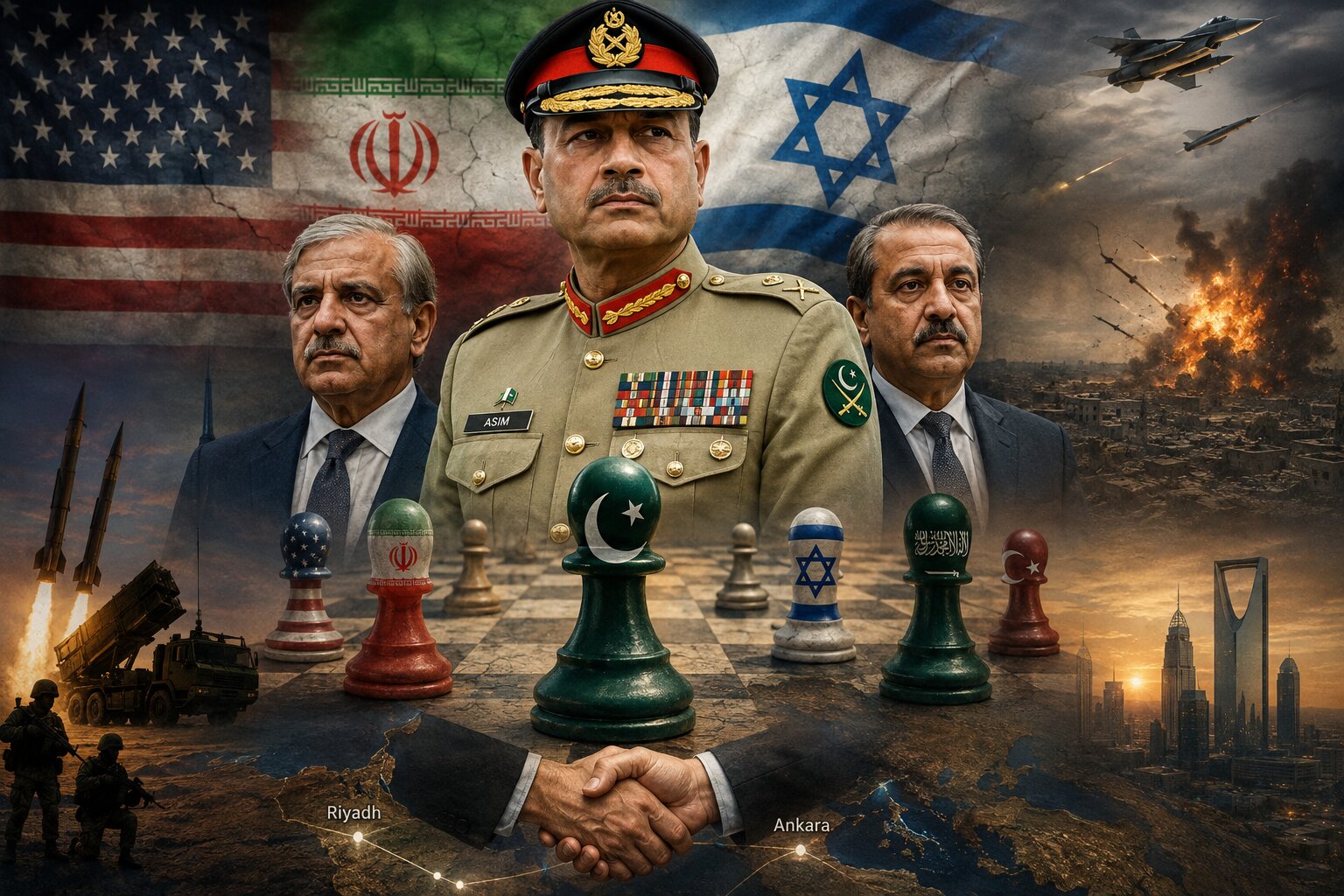
At its core, this appears to be a strategic repositioning by Pakistan: an attempt to transform its position between Washington, Tehran, Riyadh, and Ankara into an independent source of political and security influence.
The clearest indication is that Pakistan has not placed only its foreign minister at the center of the crisis. It has brought the military establishment directly into the foreground.
In May 2026, Field Marshal Asim Munir traveled to Tehran as part of Pakistan’s mediation efforts and held meetings with Iranian President Masoud Pezeshkian, Parliament Speaker Mohammad Bagher Ghalibaf, Foreign Minister Abbas Araghchi, and Interior Minister Eskandar Momeni. Pakistan’s military said the visit made progress toward a “final understanding.” (radio.gov.pk)
And this is where the real question begins:
Why does a diplomatic mediation effort require the army chief?
Why is Pakistan’s most powerful military figure among the principal actors in a process that, under conventional diplomatic practice, would normally be led by foreign ministries?
There is an even more intriguing detail: when Field Marshal Asim Munir arrived in Tehran, he was received by Iranian Interior Minister Eskandar Momeni, in the presence of Pakistan’s Interior Minister Mohsin Naqvi, alongside Iranian civilian and military officials, rather than by his Iranian military counterpart at the forefront of the reception. (aljazeera.com)
This protocol detail, while insufficient by itself to establish Iranian reservations, deserves strategic attention: Tehran accepted Munir as a high-level strategic mediator, but did not give the visit the appearance of an Iranian-Pakistani military-to-military negotiation.
And this is where the broader picture begins to make sense.
I. Why Is the Pakistani Military at the Heart of the Mediation?
Because this is no longer a conventional diplomatic crisis.
It is a crisis involving war, deterrence, missiles, nuclear facilities, maritime routes, energy, and regional security.
A mediator capable of speaking credibly to both sides therefore needs not only diplomatic expertise but also an understanding of the language of military power.
This is where Asim Munir’s role becomes significant.
According to Axios, Munir became a key intermediary between the United States and Iran during the conflict, and his trip to Tehran was aimed at advancing an agreement that could end the war and open the way for broader negotiations. (axios.com)
His presence was therefore not merely protocol.
It was a message in itself.
To Washington, the message was:
Pakistan can speak to Tehran at a level that Washington cannot directly reach.
To Tehran, the message was:
The mediator before you understands military calculations, not merely diplomatic language.
II. But Why Was He Not Received by His Iranian Military Counterpart?
This point requires precision.
There is not enough evidence to conclude that Iran deliberately sidelined Munir’s military counterpart or that Tehran distrusts Pakistan’s military establishment.
On the contrary, Munir held meetings during his visit with senior Iranian political leadership, the foreign minister and interior minister, and met both the president and parliament speaker. Pakistan described the visit as “positive and constructive.” (radio.gov.pk)
However, the choice of the Iranian interior minister to receive Munir, rather than placing a senior Iranian military commander at the forefront of the reception, can cautiously be interpreted as an effort to keep the visit within the political-security framework of mediation, rather than presenting it as an Iranian-Pakistani military negotiation.
That distinction matters.
Tehran wants to benefit from Munir’s channel while avoiding the impression that it is entering into a military partnership with Pakistan to manage the conflict with the United States and Israel.
In simpler terms:
Iran accepts “Munir the mediator,” but does not necessarily want to present “Munir the military ally.”
That is one of the most important signals in the entire episode.
III. Is Pakistan Acting on Trump’s Behalf?
There is clearly an overlap of interests—but that does not amount to subordination.
Trump needs a political exit from a costly and complicated conflict.
Pakistan needs to restore its strategic importance in Washington.
Trump wants to prevent the war from expanding.
Pakistan wants to prevent the conflict from spilling across its borders.
Washington needs a channel to Tehran.
Islamabad has direct relations with Iran.
These interests intersect.
But calling Pakistan a “U.S. instrument” would require considerably stronger evidence than cooperation in mediation.
The more plausible interpretation is that Pakistan is trying to use its rapprochement with Trump to expand its own strategic room for maneuver.
IV. Saudi Arabia Enters the Equation
This is where the picture becomes even more complicated.
In September 2025, Saudi Arabia and Pakistan signed a Strategic Mutual Defense Agreement. Then, on August 7, 2026, came the Mecca Joint Defense Agreement among Saudi Arabia, Türkiye, and Pakistan, based on the principle that aggression against one of the three would be treated as aggression against all three. (reuters.com)
This development cannot be separated from Pakistan’s expanding role in the Iranian-American crisis.
Saudi Arabia needs additional defense capabilities.
Pakistan possesses substantial military and nuclear capabilities.
Türkiye possesses a powerful military and an increasingly sophisticated defense industry.
A new security triangle is therefore emerging.
But it would be premature to immediately describe it as an “Islamic NATO.”
Turkish Foreign Minister Hakan Fidan himself said the agreement is technically similar to NATO’s Article 5, while stressing that it is defensive and not directed against any particular country. (reuters.com)
V. So Where Does Pakistan Stand?
This is where the sophistication of Pakistani policy becomes apparent.
Islamabad talks to Washington, mediates with Iran, and simultaneously enters defense arrangements with Saudi Arabia and Türkiye.
This means Pakistan is not necessarily operating according to:
“Either the American camp or the Iranian camp.”
Instead, it appears to be pursuing:
“Become a bridge between competing camps—and turn that position into influence.”
This is what makes Asim Munir’s role so significant.
He is simultaneously:
Army Chief, national-security actor, channel to Washington, mediator with Tehran, and partner in an emerging defense framework with Riyadh and Ankara.
That is an unusual combination in contemporary diplomacy.
VI. The Message to Washington
Washington views Munir through a different lens.
For the United States, the presence of Pakistan’s army chief in mediation means that one individual can communicate with:
American political leadership, the Iranian military establishment, and Iran’s political leadership.
Munir is therefore no longer merely the commander of Pakistan’s army.
He has become part of the unofficial architecture of communication between Washington and Tehran.
This helps explain why Pakistan has become an actor that cannot easily be excluded from the crisis.
VII. The Iranian Message
Tehran, meanwhile, is sending a different signal:
We accept Pakistani mediation, but we retain full control over our own strategic decisions.
That is why the visit involved meetings with the president, parliament, foreign minister and interior minister.
Iran did not reject the Pakistani military mediator; rather, it placed him within the broader political framework of the Iranian state.
That is a significant distinction.
VIII. The Broader Message to the Region
The entire picture suggests that the Middle East is entering a new phase:
the diversification of security and sources of power.
The United States is not necessarily disappearing as the region’s principal security actor.
Pakistan is not replacing America.
Türkiye is not becoming the dominant regional power.
Rather, regional states are constructing a network of overlapping security arrangements.
Saudi Arabia with Pakistan.
Saudi Arabia with Türkiye.
Türkiye with Pakistan.
And Pakistan, simultaneously, maintaining channels with Iran and Washington.
This means the region may not be moving toward one single alliance, but toward a web of overlapping alliances and interests.
Conclusion
In response to concerns, there is currently insufficient evidence to conclude that Pakistan has become part of a U.S.-Israeli coalition against Iran.
There is, however, strong evidence of something more consequential:
Islamabad is redefining its position within the regional order.
It is using its military capabilities, its relationships with Saudi Arabia and Türkiye, its channels with Iran, and its growing rapprochement with Washington to move from being a state that merely reacts to regional balances into a state that participates in shaping them.
This explains why Pakistan’s foreign minister is not the only figure at the heart of the mediation.
For Islamabad, the issue is not merely diplomacy; it is a matter of national security and strategic status.
It also explains why Asim Munir traveled to Tehran.
Why Iran received him, but kept the visit within a political-security rather than purely military framework.
And why Saudi Arabia and Türkiye are simultaneously moving toward a trilateral defense arrangement with Pakistan.
The ultimate message is not that Pakistan has chosen America against Iran; it is that Pakistan is attempting to make Washington, Tehran, Riyadh, and Ankara all need its role.
That is the real strength of Pakistan’s strategy:
to move from being a party within the balance of power to becoming a pivotal actor in the new balance of power.