 Editor -in-chief writes
Hijab restrictions in public schools, different rules for private institutions and universities, Aliyev’s absence from the Ankara summit followed by Erdoğan’s Victory Day visit, and AldiploMasy’s questions awaiting answers from Baku
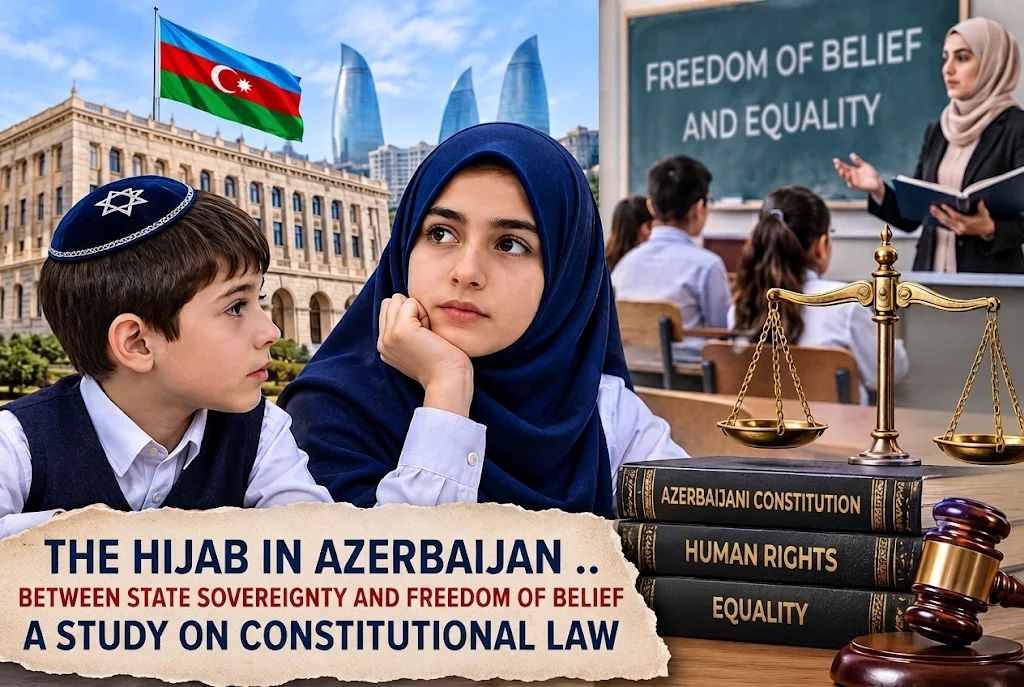
BETWEEN constitutional provisions guaranteeing freedom of belief and equality before the law, and new government decisions regulating the dress of students and staff in public schools, Azerbaijan finds itself facing a debate that goes far beyond school uniforms. At its heart lies the relationship between state secularism, religious freedom, the right to education, and protection against discrimination.
Restrictions on wearing the hijab in a number of Azerbaijani public schools have sparked widespread controversy, following reports that hijab-wearing students were prevented from entering classrooms and that similar measures affected female teachers wearing the Islamic headscarf. Meanwhile, the announced rules differ between public and private schools, and the new regulations do not currently extend to higher education institutions, according to official statements.
This raises a fundamental question: Are school dress regulations being applied equally to everyone, or does their practical implementation restrict the expression of a particular religious identity? How can the secular character of public education be reconciled with the constitutional rights guaranteed to citizens? And where does the Jewish skullcap, known as the kippah, stand under these regulations?
Azerbaijan’s Constitution: Secularism and Freedom of Belief in the Balance
The Azerbaijani Constitution establishes several principles that must be considered together when examining this issue, rather than treating one as overriding the others.
Article 18 provides for the separation of religion and state, equality among religions, and the secular character of the public education system. Article 25 guarantees equality before the law and prohibits discrimination. Article 42 protects the right to education, while Article 48 guarantees freedom of conscience and religious belief.
The issue, therefore, cannot be examined solely through the principle of state secularism. It must also take into account constitutional guarantees of freedom of belief, equality, and access to education. Constitutional secularism does not automatically invalidate other constitutional rights, just as freedom of belief does not exempt regulatory restrictions from scrutiny regarding their legality, necessity, and proportionality.
The constitutional provisions under discussion do not establish a specific rule stating that the Jewish kippah is permitted while the Islamic hijab is prohibited. Accordingly, any claim of direct legal discrimination between the two requires specific evidence rather than assumption or an unsupported conclusion.
Decision No. 309: School Uniform Regulations or a Practical Ban on the Hijab?
On September 21, 2026, Azerbaijan’s Cabinet of Ministers issued Decision No. 309, concerning school uniform requirements for students in public general education institutions. The decision does not explicitly mention the hijab, but it establishes rules concerning standardized school attire and the secular character of public education.
However, media and human rights reports stated that several schools began, as of October 12, preventing hijab-wearing students from entering classrooms or demanding that they remove their headscarves. This highlights the gap between a regulatory text that does not explicitly name the hijab and its practical implementation, which reportedly affected female students and disrupted their access to education.
Human Rights Watch documented cases of girls being prevented from entering schools because they wore the hijab in a report published on October 27, 2026. The organization also referred to protests and arrests associated with the new restrictions. It argued that denying girls access to education because of their religious head coverings affects the rights to education and freedom of religion or belief, while raising serious concerns about discrimination.
Human Rights Watch report – October 27, 2026.
Decision No. 325: Female Teachers Also Affected
The controversy has not been limited to students. On October 6, 2026, Decision No. 325 was issued concerning dress requirements for teachers and employees in public general education institutions.
Reports indicated that hijab-wearing female teachers faced restrictions on entering their schools or continuing their professional duties because of their headscarves. These reports add another dimension to the debate, moving it beyond students’ appearance to women’s right to work and protection against employment discrimination based on religious belief or appearance.
In its coverage published on October 14, 2026, Al Jazeera presented accounts from teachers and students who said they had been prevented from entering schools. The report also conveyed official positions maintaining that the purpose of the regulations was to preserve standardized dress requirements and the secular character of educational institutions.
Al Jazeera report – October 14, 2026.
Private Schools and Universities: Different Scopes of Application
The issue becomes more significant when comparing public schools with private schools and higher education institutions. On November 2, 2026, the Azerbaijani news agency APA quoted Deputy Minister of Science and Education Firudin Gurbanov as saying that the new mandatory uniform rules apply to public general education institutions, while private schools may establish their own dress codes in accordance with their founding regulations.
The official also explained that the government does not currently intend to extend the new uniform requirements to universities, colleges, and other higher education institutions.
This means that the disputed restrictions are not a uniform rule covering every educational institution in the country. Their announced scope differs between public schools, private schools, and universities. However, this distinction alone does not establish that the hijab is permitted in every private school or university, since each institution’s internal regulations may still play a role.
This raises a further question: what is the legal basis for applying different rules concerning religious appearance across different types and levels of educational institutions, and how does this approach align with equality and the right to education?
Hijab and the Jewish Kippah: A Question of Equality, Not an Assumption of Discrimination
One of the most sensitive questions in this debate concerns the Jewish skullcap, known as the kippah. Are Jewish students permitted to wear it inside Azerbaijani public schools while Muslim girls are prevented from wearing the hijab? Are there official instructions or exemptions concerning religious symbols under school dress regulations?
So far, the publicly available material reviewed for this investigation does not provide documented evidence of a specific legislative exemption for the kippah, nor does it establish a verified case involving a Jewish student wearing a kippah and a Muslim girl wearing a hijab in the same school and under identical rules.
It would therefore be premature to present discrimination between the hijab and the kippah as an established legal fact without official clarification and verifiable evidence. Nevertheless, the question remains legitimate as a test of equality: Are dress regulations applied to all religious symbols according to the same standard, or does their application differ depending on the symbol or the person wearing it?
Human Rights Organizations Criticize the Restrictions as Baku Defends Secular Education
On October 16, 2026, Amnesty International issued a statement calling on the Azerbaijani authorities to end restrictions preventing students from accessing education because of the hijab and to release individuals detained solely for exercising their right to peaceful protest.
The organization argued that preventing girls from entering classrooms because they wear the hijab constitutes discrimination and affects their rights to education, freedom of religion, and freedom of expression. It maintained that the secular character of public education does not, in itself, justify a blanket prohibition on religious clothing.
Amnesty International statement – October 16, 2026.
On the other hand, Azerbaijani official positions maintain that the dress regulations are intended to standardize appearance in public educational institutions and preserve the secular character of education, rather than target any particular religion. Media reports have quoted Azerbaijani officials as saying that wearing head coverings outside schools is not prohibited and that the dispute concerns dress requirements within educational institutions.
Between these positions, the central legal question remains whether the restrictions are being applied proportionately and without discrimination, and whether the objectives of regulating school attire can be achieved without depriving a student of her education or a teacher of her employment because of a headscarf.
From the Hijab Debate to Ankara: Has the “One Nation, Two States” Partnership Been Tested?
The controversy over the hijab did not remain confined to Azerbaijan. It extended into relations with Türkiye, Baku’s closest ally, prompting an unusual debate about the limits of agreement between the two countries, which frequently describe their relationship through the slogan “One Nation, Two States.”
Turkish officials and public figures criticized the restrictions on the hijab in Azerbaijani schools. Reports quoted Oktay Saral, an adviser to Turkish President Recep Tayyip Erdoğan, as objecting to the prevention of hijab-wearing students from entering schools and calling on the Azerbaijani authorities to reconsider the measures. Criticism also came from Turkish politicians and members of parliament, while protests were reported outside Azerbaijani diplomatic premises in Türkiye.
In response, Azerbaijan’s ruling New Azerbaijan Party rejected what it regarded as Turkish interference in the country’s internal affairs. It emphasized that the close relationship between the two states does not give either side the right to impose its political or ideological preferences on the other. Thus, a dispute initially concerning education and human rights evolved into a broader discussion about national sovereignty and the limits of solidarity between allies.
Further reading: Al Jazeera – October 14, 2026, and Eurasianet – October 15, 2026.
On October 30, 2026, Azerbaijani President Ilham Aliyev did not attend the 12th Summit of the Organization of Turkic States, hosted by Ankara, despite receiving a personal invitation from President Erdoğan. Azerbaijan was represented by Foreign Minister Jeyhun Bayramov.
Aliyev’s absence prompted speculation about the possible impact of recent disagreements on bilateral relations, particularly following the hijab controversy. However, Azerbaijani media reports referred to prior commitments as a reason for his absence, and no definitive official explanation established that the hijab issue was the cause. Any direct connection between the two developments must therefore remain within the realm of political analysis and media interpretation, rather than being presented as a confirmed official fact.
Another development followed on November 8, 2026, when Erdoğan visited Azerbaijan at Aliyev’s invitation to participate in the country’s Victory Day celebrations, marking the sixth anniversary of Azerbaijan’s victory in the 2020 Nagorno-Karabakh war. Aliyev received his Turkish counterpart, and the two presidents held talks in Shusha, reaffirming the strategic strength of relations between their countries.
The visit demonstrated that the disagreement had not developed into a diplomatic rupture and that both sides were keen to emphasize the continuity of their partnership. However, the visit alone does not establish that the hijab controversy has ended or that either side has changed its position. Reaffirming the strength of bilateral relations is one matter; addressing the legal and human rights questions surrounding the restrictions is another.
Anadolu Agency – November 8, 2026, Official website of the President of Azerbaijan – Statements by the two presidents in Shusha, and Associated Press – November 8, 2026.
The hijab controversy has therefore tested not only the relationship between the state and society, but also the Turkish-Azerbaijani partnership. It raises a difficult question: How can strategic cooperation and respect for national sovereignty be maintained while legitimate discussions about constitutional freedoms and citizens’ rights remain open?
AldiploMasy’s Commentary: Internal Affairs Do Not Eliminate the Right to Stand in Solidarity with Freedom of Belief
In this context, AldiploMasy offers a perspective that goes beyond the political disagreement between Baku and Ankara. While fully respecting Azerbaijan’s sovereignty and its right to regulate its domestic affairs, describing the hijab issue in schools as an “internal matter” should not mean closing the door to public expression or solidarity with members of a faith whose rights may be affected by such decisions. When freedom to practice one’s religion and express one’s beliefs is at stake, the issue acquires a human rights dimension that extends beyond national borders.
From this perspective, individuals and relevant religious and intellectual institutions, representing the concerns of millions of believers, have the right to express their positions on measures they believe may affect freedom of belief or raise questions about religious equality. Among these institutions are Al-Azhar Al-Sharif and the Organization of Islamic Cooperation, alongside other relevant religious and human rights bodies.
This does not mean granting any state or institution the right to impose its preferences on another country or undermine its sovereignty. Rather, it recognizes that expressing solidarity with freedom of belief and voicing a peaceful opinion about it do not, in themselves, constitute interference in another country’s internal affairs.
The distinction is fundamental: there is a difference between interference intended to impose a political decision on a sovereign state and a peaceful religious or human rights position calling for respect for freedom of belief and for ensuring that no student is denied education, or no teacher is denied employment, because of religious appearance. State sovereignty is a fundamental right, and freedom of belief is also a fundamental right; neither should be invoked to cancel the other.
Accordingly, the question we raise is not why Türkiye or any other country has expressed a position, but how a responsible dialogue can be opened with the participation of relevant institutions, particularly Al-Azhar Al-Sharif and the Organization of Islamic Cooperation, in a manner that respects Azerbaijan’s sovereignty while safeguarding the constitutional and human rights of female students and teachers.
AldiploMasy’s Questions to the Azerbaijani Embassy in Cairo: Awaiting Answers
In the interest of the public’s right to know and to ensure that Azerbaijan’s official position is fully represented, AldiploMasy addresses the following questions to the Embassy of the Republic of Azerbaijan in Cairo. The Embassy is welcome to provide its answers and clarifications, which the website is prepared to publish in full in a separate second installment of this investigation.
- Are there any official instructions or legal provisions allowing Jewish students to wear the kippah inside Azerbaijani public schools, while hijab-wearing Muslim girls are prevented from entering classrooms? If so, what is the legal basis for this distinction?
- Does Decision No. 309 apply to all religiously significant symbols and clothing without exception? How do the authorities ensure that it is implemented according to the same standard for students from different religions and beliefs?
- If private schools are entitled to establish their own dress regulations and universities are currently outside the scope of the new rules, what is the legal justification for applying different restrictions to these institutions and public schools?
- What is the Azerbaijani government’s position regarding reports that hijab-wearing female teachers were prevented from entering their schools or continuing their professional duties? Is there an appeals mechanism to protect their employment rights?
- Do the Azerbaijani authorities consider wearing the hijab, in itself, a violation of school dress regulations? Or, according to the official interpretation, do violations concern other specific elements of school attire? We would appreciate clarification of the relevant legal text or instructions.
- What measures has the Ministry of Science and Education taken to ensure that no female student is deprived of her right to education because of her religious appearance? Are arrangements in place to compensate students for missed lessons and examinations?
- How does the Azerbaijani government reconcile the secular character of public education with the constitutional provisions guaranteeing equality, freedom of conscience and belief, and the right to education? Have the authorities conducted an assessment of the impact of the new decisions on these rights?
The Right of Reply: The Second Installment Remains Open to the Embassy
AldiploMasy emphasizes that publishing these questions does not constitute a pre-judgment of the Azerbaijani government’s intentions, nor does it challenge the state’s right to regulate its educational institutions. Rather, it is part of professional journalistic accountability, respect for the right of reply, and the search for clear answers grounded in official laws and their practical implementation.
The website welcomes any clarifications, documents, or official responses submitted by the Embassy of Azerbaijan in Cairo and undertakes to publish the Embassy’s response in full in a separate second installment, allowing readers to examine the Azerbaijani perspective without omission or distortion.
At its core, this issue is not a conflict between religion and the state, nor is it a comparison intended to accuse a society or undermine its sovereignty. It is a test of whether legal regulations can protect equality, freedom of belief, and the rights to education and employment, while respecting public order and the institutional character of education.
The central question facing Baku remains: Can a public school be a place of learning, discipline, and citizenship without allowing differences in religious appearance to become a closed door in the face of a student or a teacher?