Editor -in-chief writes
THE growing partnership between Uzbekistan and Oman reflects a strategic vision that goes beyond conventional bilateral trade. It represents an emerging economic corridor connecting Central Asia with the Gulf and East Africa, bringing together investment, industrial production, modern logistics and access to international markets.
At the heart of this partnership lies a shared understanding: economic cooperation is strongest when investment is transformed into productive capacity, and production is connected to reliable routes leading to consumers and international markets. Uzbekistan brings its industrial potential, natural resources and strategic geographical position, while Oman offers capital, maritime infrastructure and access to major international shipping routes.
Political Will: The Foundation of Economic Ambition
The development of Uzbek–Omani relations demonstrates the importance of high-level political engagement in translating shared ambitions into practical economic projects.
The discussions between President Shavkat Mirziyoyev and Sultan Haitham bin Tarik Al Said in March 2026, followed by economic consultations during the Tashkent International Investment Forum in June, established clear priorities for cooperation.
Transport and logistics, geology, e-commerce and digital infrastructure emerged as important areas of mutual interest. Subsequent discussions in Muscat in September, led by Uzbekistan’s Minister of Investment, Industry and Trade, Laziz Kudratov, helped move the agenda from political understanding toward commercial implementation.
This continuity of dialogue sends an important message: the relationship is evolving from diplomatic goodwill into a structured economic partnership.
Investment: From Financial Commitments to Industrial Production
One of the strongest foundations of this relationship is the Uzbek–Oman Investment Company, established through a decision taken in 2009.
With charter capital of $266 million, the company represents an established financial mechanism for bilateral cooperation.
The results are significant:
- 12 completed projects with a combined value of $510.8 million.
- 16 ongoing projects worth approximately $936.3 million.
These figures illustrate the scale of the economic opportunities already identified. More importantly, they demonstrate the potential to expand cooperation beyond individual investments into a broader industrial ecosystem.
The proposed agrochemical manufacturing facility in the Tashkent region, involving Türkiye’s Hektaş and an investment of approximately $75 million, is particularly noteworthy. It illustrates how Uzbek–Omani cooperation can also attract third-country industrial expertise and capital.
Meanwhile, the interest of Suhail Bahwan Group in Max Copper and OQ Group in battery energy storage systems points toward further opportunities in copper processing, chemical industries and energy infrastructure.
The strategic significance of these projects lies not merely in attracting foreign capital, but in strengthening Uzbekistan’s domestic production capabilities, industrial diversification and technological base.
Logistics: Oman Opens a Maritime Gateway for Central Asia
Perhaps the most strategically consequential development is the entry of Oman’s Asyad Group into Uzbekistan’s logistics sector.
Its acquisition, alongside Uzbek partners, of controlling stakes in Universal Logistics Services and Highway Logistics Center in Tashkent represents more than a commercial transaction.
These facilities handle approximately one-quarter of Uzbekistan’s rail container traffic, making their integration into Asyad’s international network particularly important.
The proposed connections with the Omani ports of Sohar, Duqm and Salalah could provide Uzbek exporters with more efficient access to maritime shipping routes serving the Gulf, East Africa and wider international markets.
This is where geography becomes an economic advantage.
Uzbekistan, as a double-landlocked country, faces particular challenges in reaching global maritime trade networks. Oman, with its strategic position overlooking important international sea lanes, offers an opportunity to address part of that challenge through integrated rail, road and maritime logistics.
The partnership therefore has the potential to transform geographical distance into commercial connectivity, linking Uzbek manufacturers directly with international shipping networks.
Trade Growth: A Promising Signal, Not the Final Destination
The increase in bilateral trade provides another encouraging indicator.
During January–September 2026, trade turnover reached 3.4 times the level recorded during the corresponding period of 2025.
This remarkable growth reflects increasing commercial interest on both sides.
Uzbekistan is seeking to expand exports of electrical equipment, textiles and dried fruits, while Omani companies see opportunities in food products and polymers.
However, the real test of this expansion will be its sustainability.
Moving from occasional transactions to long-term supply contracts, diversified product portfolios and regular shipments will determine whether the current growth becomes a lasting economic trend.
This requires more than commercial enthusiasm. It requires competitive pricing, reliable quality, efficient customs procedures and predictable delivery schedules.
Agreements and Connectivity: Building the Rules of a New Economic Corridor
The proposed preferential trade agreement, the updating of investment protection arrangements, the establishment of a bilateral business council and the next meeting of the intergovernmental commission are all essential elements of the emerging partnership.
Such arrangements can reduce uncertainty for investors and exporters while creating a more predictable framework for commercial activity.
The direct Muscat–Tashkent flights, operating since July 2026, add another dimension to this connectivity.
Economic corridors are not built through infrastructure alone; they also depend on the movement of people, expertise, information and business opportunities.
The Strategic Dimension: A Bridge Between Central Asia and the Indian Ocean
The broader significance of Uzbek–Omani cooperation extends beyond the economic interests of the two countries.
For Uzbekistan, Oman offers an opportunity to diversify export routes, attract investment and strengthen access to markets beyond its immediate geographical neighbourhood.
For Oman, the partnership reinforces its ambition to expand its role as a regional logistics and investment hub, strengthening commercial connections with Central Asia.
There is also a wider regional dimension. The integration of Uzbek production facilities with Omani ports could contribute to more diversified trade networks linking Central Asia, the Arabian Peninsula, East Africa and international markets.
Nevertheless, realizing this vision will depend on the practical execution of announced projects, the competitiveness of transport costs, the reliability of supply chains and the ability to convert investment commitments into operational facilities.
Conclusion: When Capital Meets Geography, New Horizons Open
The Uzbek–Omani partnership offers an instructive example of how modern economic diplomacy can connect political vision with tangible development.
Its strength lies in bringing together three complementary pillars: capital to finance growth, manufacturing to create value, and logistics to deliver products to international markets.
The investment company provides the financial foundation. Industrial projects offer opportunities for production and technological development. Asyad’s logistics network creates a potential gateway to maritime markets.
Together, these elements point toward a partnership that could reshape the economic geography of both countries.
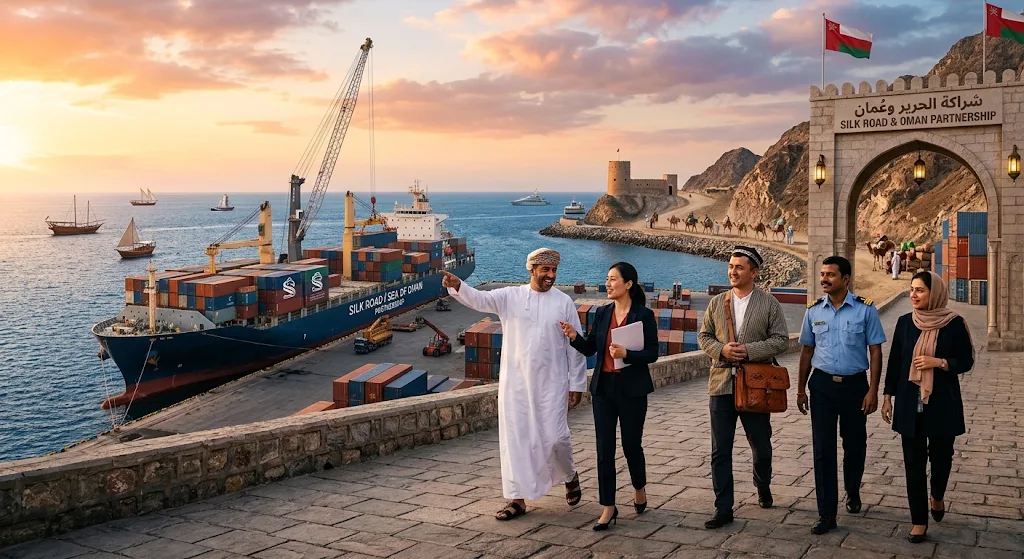
From the historic trading traditions of the Silk Road to the maritime horizons of the Sea of Oman, a new bridge is taking shape — one built not only on geographical routes, but on investment, production, mutual interests and a shared vision of prosperity.