Ashraf AboArafe
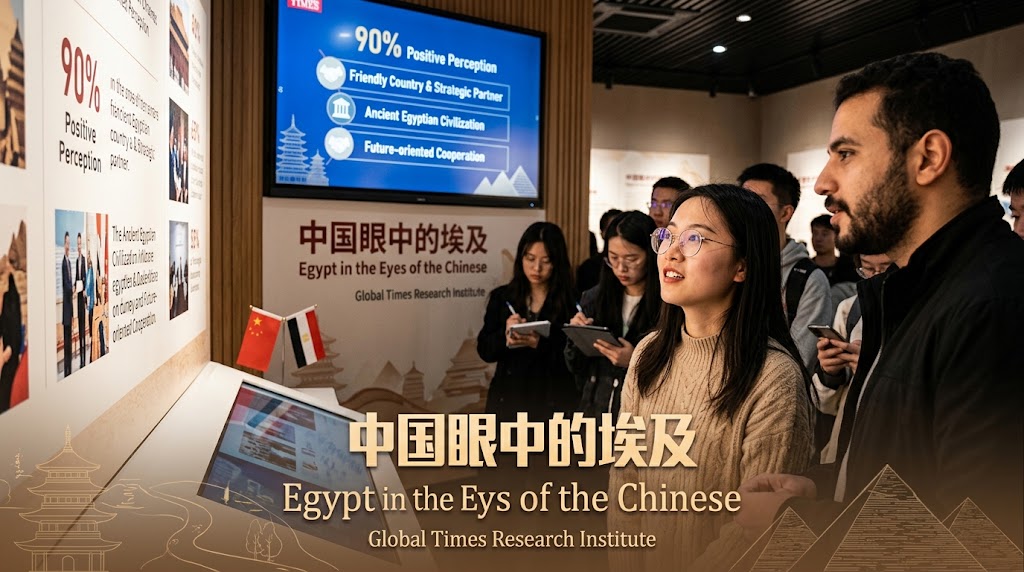
Global Times Research Institute Releases Public Opinion Survey, “Egypt in the Eyes of the Chinese
Global Times Research Institute
Huang Peizhao, Global Times special correspondent in Egypt; Yi Jia and Zhao Shuang, Global Times correspondents
The year 2026 marks the 70th anniversary of the establishment of diplomatic relations between China and Egypt, as well as seven decades of diplomatic relations between China and the Arab world. Against this historic backdrop, a recent public opinion survey conducted by the Global Times Research Institute, titled “Egypt in the Eyes of the Chinese,” offers a revealing portrait of how Egypt is perceived by the Chinese public.
The findings show that ancient Egyptian civilization has left a profound impression on Chinese society, while a clear majority of respondents regard Egypt as a friendly country or strategic cooperation partner. Expectations for the future of China-Egypt relations are overwhelmingly positive, and there is broad public support for deepening cooperation between the two countries.
Chinese and Egyptian experts commenting on the survey emphasized that this high level of goodwill has both historical and contemporary foundations. Mutual respect and admiration for each other’s civilizations and cultures, combined with decades of practical cooperation across numerous fields, have helped propel bilateral relations forward and consolidate a positive image of Egypt among the Chinese public.
The survey was conducted from July 16 to 28, 2026, among members of the general public aged 18 to 69 across 31 provincial-level administrative regions in mainland China. A total of 1,845 valid questionnaires were collected. The data were weighted according to the gender and age composition of Chinese internet users reported in the 57th Statistical Report on Internet Development in China, issued by the China Internet Network Information Center in February 2026.
Ancient Egypt: A Civilization That Still Speaks Across Millennia
The survey indicates that 85 percent of Chinese respondents have some degree of knowledge about Egypt. Approximately four in ten said they knew Egypt “very well” or “relatively well,” while more than another four in ten said they possessed a certain level of knowledge.
When Egypt was mentioned, 66 percent of respondents immediately associated it with the pyramids, pharaohs, mummies, the Sphinx and other iconic symbols of ancient Egyptian civilization. Another 39 percent identified Egypt as the cradle of an ancient civilization.
Natural landmarks also featured prominently. Thirty percent mentioned the Nile, while 20 percent referred to the Suez Canal and 8 percent cited the Red Sea and Mediterranean Sea. Overall, more than nine in ten respondents expressed either a positive (60 percent) or neutral (31 percent) view of Egypt.
Egypt’s international importance is also reflected in its multiple regional and global identities. Beyond its membership in the African Union, Egypt is a founding member of the United Nations and formally joined the BRICS cooperation mechanism in 2024. Approximately 78 percent of respondents were able to identify at least one correct aspect of Egypt’s international role.
As a founding member of the Arab League, Egypt has in recent years played an active role in efforts involving ceasefires, humanitarian assistance, dialogue and communication concerning Gaza and other major issues in the Middle East. More than 60 percent of respondents recognized Egypt’s positive role in this regard. Twenty-four percent described its role as “very positive, helping ease conflicts and advance peace,” while 37 percent considered its role “largely positive,” with a degree of influence in regional communication and coordination.
Mira Ahmed, an Egyptian literature translator and member of the World Council of Sinologists, told Global Times that the high level of Chinese awareness of ancient Egyptian civilization reflects the depth of the historical and cultural links between Egypt and China.
Both countries possess civilizations extending back thousands of years and have made major contributions to the development of human civilization. Egyptians and Chinese have long been familiar with each other’s ancient heritage, making the two civilizations a shared cultural language and an important window through which each people can understand the other’s history and culture.
For Chinese people, therefore, associating Egypt with an “ancient civilization” is not merely an historical reference. It reflects a deep sense of respect, admiration and cultural recognition.
From Friendship to Strategic Partnership
China and Egypt established diplomatic relations in 1956, with Egypt becoming the first Arab and African country to establish diplomatic relations with the People’s Republic of China.
Around nine in ten respondents assessed current China-Egypt relations positively or neutrally, while 63 percent described them as “very good” or “relatively good.”
How, then, does the Chinese public perceive Egypt’s position in relation to China?
The answer is striking: 71 percent of respondents regard Egypt as either a “friendly country” or a “strategic cooperation partner.”
In December 2014, China and Egypt formally established a comprehensive strategic partnership, and 88 percent of respondents consider this partnership important to China.
At the same time, 82 percent agree that Egypt is an important cooperation partner for China in both the Arab world and Africa.
Looking ahead, nearly seven in ten respondents expressed optimism about the future of China-Egypt relations, choosing either “very optimistic” or “relatively optimistic,” while more than one-fifth expected bilateral relations to maintain their current level.
The message conveyed by these figures is clear: Egypt occupies a distinctive place in the Chinese public imagination—not only as an ancient civilization, but as a contemporary partner with strategic value.
When Strategic Ties Become Practical Cooperation
Liu Zhongmin, professor at the Institute of Middle East Studies at Shanghai International Studies University, told Global Times that the positive Chinese perception of Egypt has both historical and contemporary roots.
Historically, he noted, extensive interaction between Chinese Premier Zhou Enlai and Egyptian leader Gamal Abdel Nasser during the 1955 Bandung Conference helped dispel misunderstandings about China in the Arab world. This paved the way for Egypt to become the first Arab country to establish diplomatic relations with the People’s Republic of China in 1956, triggering the first major wave of diplomatic relations between China and Arab states.
China also provided important support to Egypt in its struggle to restore its rights over the Suez Canal, as well as in its pursuit of national independence, liberation and the protection of its national interests.
During the 1950s and 1960s, the historical interaction between the two countries left a lasting impression on both peoples—whether through their shared opposition to imperialism, colonialism and hegemony, or through their efforts to promote the rise of the developing world as a new force in international politics.
These experiences helped lay the foundations for a deep and enduring friendship.
In contemporary terms, Liu emphasized that since the beginning of China’s reform and opening-up—and particularly in the new era—practical cooperation between China and Egypt across multiple sectors has continued to strengthen bilateral relations and shape a positive perception of Egypt among Chinese citizens.
This includes the deepening of the comprehensive strategic partnership politically, extensive economic cooperation, and increasingly diverse cultural and people-to-people exchanges.
Mira Ahmed similarly argued that the positive Chinese perception of Egypt broadly mirrors the positive trajectory of China-Egypt relations. The relationship now extends well beyond politics and economics to encompass culture, education, tourism and people-to-people exchanges.
Most importantly, she said, the two sides share mutual respect and appreciation for each other’s civilizations and cultures, providing a strong foundation for the relationship’s continued development.
From the Belt and Road to New Energy: A Partnership in Motion
Since the beginning of this year, China and Egypt have signed and begun implementing a number of industrial-cluster projects, while cooperation in new energy has accelerated.
The two countries have also achieved tangible results in automobiles, finance and monetary cooperation, urban infrastructure, people-to-people exchanges and archaeological projects.
The survey shows that 85 percent of respondents have some knowledge of China-Egypt cooperation.
Among the various frameworks and projects, 52 percent are familiar with Egypt’s participation in the Belt and Road Initiative, while 32 percent know about Chinese infrastructure projects in Egypt, including the Light Rail Transit system and road projects.
Some respondents were also familiar with Confucius Institutes, as well as Chinese-Egyptian cooperation involving mobile phones, household appliances and Chinese automobiles manufactured or sold in Egypt.
An impressive 85 percent believe that cooperation between the two countries has achieved notable results since the establishment of diplomatic relations.
When asked to assess current cooperation in the fields of economy, trade, infrastructure and industrial capacity, 60 percent said that clear results had been achieved.
Most strikingly, 99 percent believe China and Egypt should continue deepening cooperation in the future, particularly in tourism and people-to-people exchanges, green development and new energy, agricultural products and food-supply chains, as well as trade, investment and other areas.
People-to-People Ties: The Next Bridge Between Two Civilizations
People-to-people exchange emerged as one of the strongest areas of future cooperation, with 94 percent of respondents expressing support for greater China-Egypt cooperation in this field.
More than half—52 percent—want stronger tourism cooperation and improved local payment arrangements in Egypt. Another 50 percent support continued cooperation in joint archaeological excavation, heritage preservation and museum exhibitions.
Forty percent expressed interest in cooperation involving the translation and presentation of contemporary films and television productions, digital literature and digital cultural products from both countries.
Another 32 percent called for expanded exchanges among young researchers, think tanks and university students.
Between 60 and 70 percent of respondents said they would be willing to participate in Egyptian cultural exhibitions, tourism promotion events or Egyptian film weeks held in China.
The appetite for direct engagement is even stronger: 87 percent said that, if circumstances permit, they would be willing to travel to Egypt for tourism, study or business. Tourism was by far the strongest motivation, at 73 percent.
More than seven in ten respondents also welcomed more Egyptians coming to China for tourism, education or business.
Mira Ahmed noted that Egypt has taken several measures in recent years to facilitate travel by Chinese tourists, including simplifying visa procedures, expanding digital services, strengthening Egypt’s promotion as a tourism destination in China and cooperating with Chinese tourism companies. Egypt is also working to improve tourism services and infrastructure to provide a safer and more comfortable environment for visitors.
From Egyptian Cotton to the Chinese Market
Agricultural products and food-supply chains also emerged as major areas of potential cooperation.
When respondents were asked whether they would be interested in trying and purchasing distinctive Egyptian products if more of them became available in the Chinese market—including fruits, agricultural products, cotton and linen goods, and handicrafts—89 percent expressed willingness to buy them.
Thirty percent said they were “very willing,” while 59 percent were “relatively willing.”
According to Mira Ahmed, these findings demonstrate that China-Egypt cooperation has become increasingly practical, diversified and people-centered, extending well beyond traditional political and diplomatic relations.
It also reflects the two countries’ shared interests and development aspirations, as well as their desire to unlock greater potential in trade, investment, agriculture and food security.
“The complementarity of the two sides is one of the most important characteristics of this cooperation,” she said. “Egypt and China possess capabilities and expertise that can complement each other, opening broad prospects for deeper and more sustainable cooperation in the future.”
The Nile and the Silk Road in the Architecture of Global Governance
The survey also reveals that Chinese public expectations for China-Egypt cooperation extend beyond bilateral relations to the broader architecture of global governance.
The international environment has undergone rapid changes in recent years, marked by conflicts in the Middle East and disruptions to global supply chains. As a country located in a region experiencing conflict, Egypt has actively engaged in mediation efforts aimed at easing tensions. China, meanwhile, has consistently promoted peace, dialogue, negotiation and global development.
More than 93 percent of respondents believe China and Egypt should cooperate in global governance in the future.
The strongest expectation—cited by 37 percent—is that the two countries should work together to safeguard freedom and security of navigation in the Red Sea and the Suez Canal.
Another 35 percent hope China and Egypt will cooperate to preserve peace and stability in the Middle East and promote peaceful solutions to the Palestinian issue and Iran-Israel conflicts.
Thirty-three percent want the two countries to speak together for the Global South through platforms such as BRICS and the United Nations, while 31 percent look forward to joint efforts to reduce poverty worldwide.
Liu Zhongmin argues that China and Egypt, as members of the Global South, have considerable room for cooperation in global governance at multiple levels.
First is cooperation between China and the Arab world. China and Egypt have particularly broad prospects for cooperation through the China-Arab States Cooperation Forum, encompassing political, economic and cultural fields, whether in defending the common interests of the Global South or advancing China-Arab cooperation to a deeper level.
Second is cooperation among China and Middle Eastern members of BRICS, including Egypt, the United Arab Emirates and Iran, which have joined the mechanism in recent years.
Third is cooperation through multilateral mechanisms, particularly the United Nations. Egypt can serve as an important partner for China in translating major global initiatives into more concrete and substantive outcomes.
The prospects are equally significant in peace, security, development and governance in the Middle East. Whether concerning Palestine or recent tensions involving the United States, Israel and Iran, Egypt has played an important mediating role.
China and Egypt can therefore strengthen communication and coordination on Middle Eastern hot spots, working together to address the region’s security and development challenges.
A Partnership Written in Two Ancient Languages
The “Egypt in the Eyes of the Chinese” survey ultimately reveals something deeper than a collection of statistics.
It captures the meeting of two ancient civilizations that have transformed historical familiarity into contemporary partnership.
For Chinese respondents, Egypt is at once the land of the pyramids and the pharaohs, the country of the Nile and the Suez Canal, an Arab and African power, a partner in the Global South, and an increasingly important participant in China’s network of international cooperation.
For Egypt, the Chinese perception revealed by this survey represents a valuable reservoir of cultural goodwill, strategic confidence and popular interest.
The challenge now is to transform that goodwill into even stronger bridges: more tourists crossing the distance between the Nile and China, more students and researchers exchanging knowledge, more Egyptian products reaching Chinese consumers, more joint archaeological and cultural projects, and more coordination on regional and global challenges.
Seventy years after Cairo and Beijing first opened the diplomatic door, the relationship is no longer simply a story of two governments. It is increasingly a story written by two peoples—one beside the Nile, the other along the ancient Silk Road—discovering that the distance between their civilizations is far smaller than the distance on the map.