Ashraf AboArafe
EUROPEAN Union Ambassador to Egypt Angelina Eichhorst has underscored the importance of strengthening Egyptian-European cooperation to address mounting water challenges through youth-led innovation, entrepreneurship, sustainable financing and regional partnerships. These priorities are at the heart of Cairo Water Week 2026, which brings together initiatives designed to transform innovative ideas into viable projects, expand investment in the water sector and strengthen resilience to climate change.
The EU’s engagement follows two complementary tracks. The first empowers young Egyptians to develop technological solutions and entrepreneurial ventures in the water sector. The second seeks to mobilise public and private financing for sustainable projects spanning water, energy, food and ecosystems, strengthening cooperation between Egypt, the European Union and their Mediterranean partners.
1. Young People at the Heart of Water’s Future: From Ideas to Markets
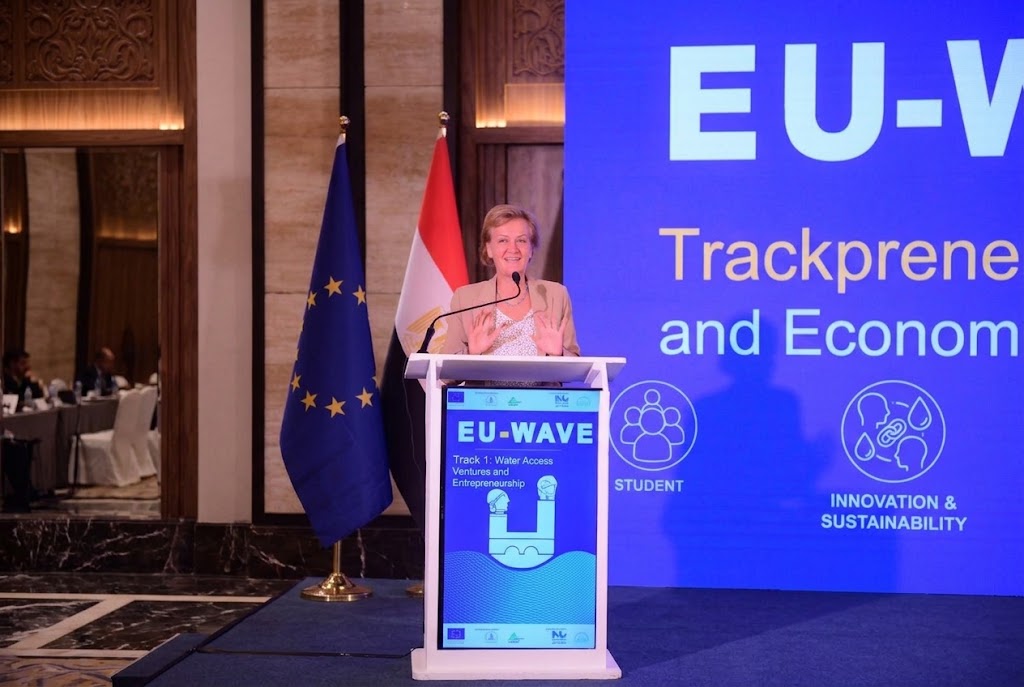
On 27 October, Cairo Water Week hosted EU-WAVE, the first of three days dedicated by the European Union to young Egyptians working on water and innovation. The programme continues on 28 and 29 October with EU-LEAP and EU-VOICE.
The initiatives were selected in cooperation with partner universities following consultations in August 2026. The participating institutions include Nile University, through its Innovation, Entrepreneurship and Competitiveness Centre, Zewail City of Science and Technology, and the Arab Academy for Science, Technology and Maritime Transport.
Addressing young people and innovators, Ambassador Eichhorst emphasised that the EU’s commitment extends beyond supporting individual projects to investing in the capabilities of Egypt’s younger generation.
“You are the future of water in Egypt,” was the central message delivered to participants, alongside the recognition that young people are not only the future of the sector but also an essential part of its present.
Water companies in Egypt, across the region and in Europe need more engineers, technicians and entrepreneurs who can turn ideas into practical services, she noted. Egypt needs professionals who can build water treatment plants and networks, as well as companies capable of developing, operating and financing solutions.
The address also referred to a September visit to the Bahr El-Baqar wastewater treatment plant in Kafr El Sheikh, highlighting the scale of investment required in the sector. The success of treatment plants, water networks, pumping stations and irrigation canals, she stressed, depends not only on construction but also on the skilled people who operate, maintain and improve them over decades.
Aqua Tank: Ten Youth-Led Ventures Face the Market and Financing Test
The Aqua Tank event brought together ten youth-led ventures that have progressed beyond theoretical concepts to proof of concept, prototypes or pilot projects.
The programme featured two rounds of presentations. Teams demonstrated their projects before engaging in dialogue with a jury, followed by interactive audience ratings.
The second round included a specialised finance jury comprising representatives of international financial institutions and banks. Its role was to assess the ventures’ financing prospects and identify promising projects for follow-on mentoring and development. All ten teams received certificates.
Ambassador Eichhorst highlighted the transition from prototype to market as one of the most challenging stages for entrepreneurs, particularly in the water sector, where procurement cycles can be lengthy, public authorities often represent major customers, and long-term operation and maintenance must be secured.
Questions about customers, revenue streams, operating costs, repayment capacity and the ability to maintain services five years from now are not barriers to innovation, she explained. They are essential tests of whether a venture can become a sustainable business.
The solutions required extend beyond large treatment plants to include smart irrigation, decentralised treatment, water reuse, leak detection and services that reach underserved communities.
Every major company in the water sector began with a small team and a single idea, the address noted. The ventures presented at Aqua Tank could eventually become Egyptian companies serving the domestic market, expanding across the region and exporting their technologies.
Investing in People: Turning Knowledge into Jobs
The European Union’s support for water extends beyond infrastructure financing to education, research and entrepreneurship. Programmes such as Erasmus+ and partnerships with universities and businesses help connect young people with opportunities.
The ambition is to turn knowledge into solutions, solutions into businesses, and businesses into sustainable jobs. This approach can strengthen Egypt’s capacity to manufacture water technologies locally to European standards, serve domestic and regional demand, and develop export opportunities.
Local production of pumps, water meters and treatment membranes can also create domestic supply chains involving installation, maintenance and technical service companies, opening new opportunities for engineers, technicians and entrepreneurs.
Figures presented by the EU representative indicate that the Egyptian-European water partnership, since 2007, has reached approximately 25 million people across 16 Egyptian governorates, while generating nearly 25,000 permanent job opportunities and around 600,000 short-term job opportunities, mainly in rural areas.
European water grants in Egypt have also helped mobilise approximately €3.5 billion in investment since 2007, illustrating how grant financing can support projects and attract additional resources from financial institutions and partners.
The continued success of these investments depends on a new generation capable of operating projects, improving their performance and developing sustainable financing models. Investing in innovation, the EU emphasised, is ultimately an investment in people and their ability to build a more sustainable future.
Women in Water: From Carrying the Burden to Shaping Decisions
The first EU youth day continues with Women in Water, a programme led by Zewail City that combines participatory workshops with discussions on the challenges facing women in the water sector and ways to strengthen their role in decision-making.
The programme addresses the additional burdens experienced by women and girls when water is unsafe, distant or unaffordable. It also examines the barriers that limit women’s access to leadership and positions of influence in the sector.
Activities include collective identification of challenges, assessments of empowerment across different dimensions, and the development of action plans and shared commitments.
The initiative underlines a central principle: water security cannot be separated from equality of opportunity, and the participation of women and men in shaping solutions is essential to building a more inclusive and sustainable water sector.
The launch of the Waterpreneurs Community will also help maintain connections among participating teams, ensuring that the event becomes the beginning of a longer process of mentoring, cooperation and venture development.
2. From the Gift of the Nile to Mediterranean Water Security: Financing a Sustainable Future
Alongside youth empowerment, Cairo Water Week hosted the high-level conference of MED-RISE, organised by the European Union in cooperation with the Union for the Mediterranean, the Global Water Partnership–Mediterranean and the WES-BCA project.
The platform aims to mobilise private investment and develop bankable projects across water, energy, food and ecosystems.
In her address, Ambassador Angelina Eichhorst highlighted the importance of turning regional cooperation into practical projects capable of addressing water scarcity. The challenge, she noted, is no longer confined to the southern Mediterranean: Europe is experiencing its effects as well.
The address began by recalling the historical description attributed to Herodotus of Egypt as “the gift of the Nile.” For thousands of years, Egyptians measured river levels to assess floods, anticipate agricultural conditions and estimate the resources available to the state.
Water knowledge and public finance have long been interconnected. Today, however, the challenges are more complex and extend well beyond the Nile Basin and the southern Mediterranean.
The address cited recent changes affecting European rivers and glaciers. During the past summer, the Rhine at Kaub fell to its lowest recorded level since records began in 1880. Low water levels on the Danube also left a nuclear power plant without sufficient cooling water, forcing it to shut down. Swiss glaciers reportedly lost approximately 5.5% of their ice during the year, bringing cumulative losses since 2021 to nearly one-fifth of their mass.
These developments illustrate that water scarcity is a shared challenge for Europe, Egypt, Jordan and North Africa, requiring cross-border cooperation and long-term financing.
The Hardest Question: Who Will Finance Water Security?
Ambassador Eichhorst highlighted the central question facing countries on both shores of the Mediterranean: how to finance the water security they need.
At a Union for the Mediterranean ministerial meeting in Rome four weeks earlier, participating ministers had committed to water plans that are financially realistic and fully funded, with contributions from public and private partners.
Public budgets and grants remain essential, but they cannot close the financing gap alone. Additional instruments are needed to attract private capital, share risks and prepare projects that meet the requirements of financial institutions.
MED-RISE seeks to expand the role of private capital in financing interconnected projects across water, energy, food and ecosystems, adopting an integrated approach that considers the entire water cycle, from source to sea.
The dialogue began at the national level through the EU-Egypt FLOW roundtable, which brought together Egyptian banks, European financing institutions and the Egyptian government. The conference extends that discussion to the wider Mediterranean region.
The address also recalled the launch of the Euro-Mediterranean Partnership in Barcelona in 1995, presenting the Pact for the Mediterranean as a renewed framework for cooperation, with water resilience among its central priorities.
Three European Priorities for Mobilising Investment
The European Union outlined three main pillars for strengthening water financing across the region.
First: A strategic compass. The Pact for the Mediterranean and the European Water Resilience Strategy provide a policy framework, while the EU’s Global Gateway initiative supports cooperation with international partners.
Second: Financial instruments that share risk. Guarantees, blended finance and project preparation can help transform promising projects in Alexandria, Amman, Agadir and other cities into investment opportunities capable of attracting banks and institutional financiers.
Third: A record of partnership and results. European water grants in Egypt have helped mobilise approximately €3.5 billion in investment since 2007.
Although an EU grant may represent only a relatively small share of a project’s overall financing, it can play a decisive role in attracting the remaining investment by improving economic viability, reducing risks and strengthening investor confidence.
MED-RISE, the EU stressed, is not simply another conference. It is an open platform for partners prepared to contribute bankable projects, financial guarantees or innovative ideas that can be transformed into tangible investments.
From Cairo to Abu Dhabi: Turning Commitments into Projects
The conference programme includes presentations of four cases demonstrating how bankable projects can be developed across the water cycle, from source to sea. These will be followed by a closed-door roundtable and an investment clinic designed to test real projects and identify their technical and financing requirements.
The discussions are expected to contribute to the Cairo Messages on Private Investment in the Water-Energy-Food-Ecosystems Nexus, which will be carried forward to the United Nations Water Conference in Abu Dhabi in December 2026.
The objective is to move beyond exchanging views and making commitments towards building a portfolio of finance-ready projects, clarifying the roles of governments, financial institutions and the private sector, and strengthening resilience to climate risks and growing pressure on water resources.
Egypt: A Bridge Between Innovation and Investment
Cairo Water Week highlights the close connection between youth-led innovation and sustainable investment. One track seeks the talent and ideas needed to develop new solutions; the other works to mobilise the financial instruments and resources required to turn those solutions into lasting projects.
Treatment plants and water networks alone cannot guarantee water security. Nor can innovative ideas achieve their full potential without financing, markets and institutional partnerships. What is needed is an integrated ecosystem connecting universities, entrepreneurs, banks, governments and businesses.
The future of water in Egypt and the wider region will be shaped neither by investment alone nor by innovation alone, but by partnerships that connect knowledge with finance, young talent with experience, and policy with implementation.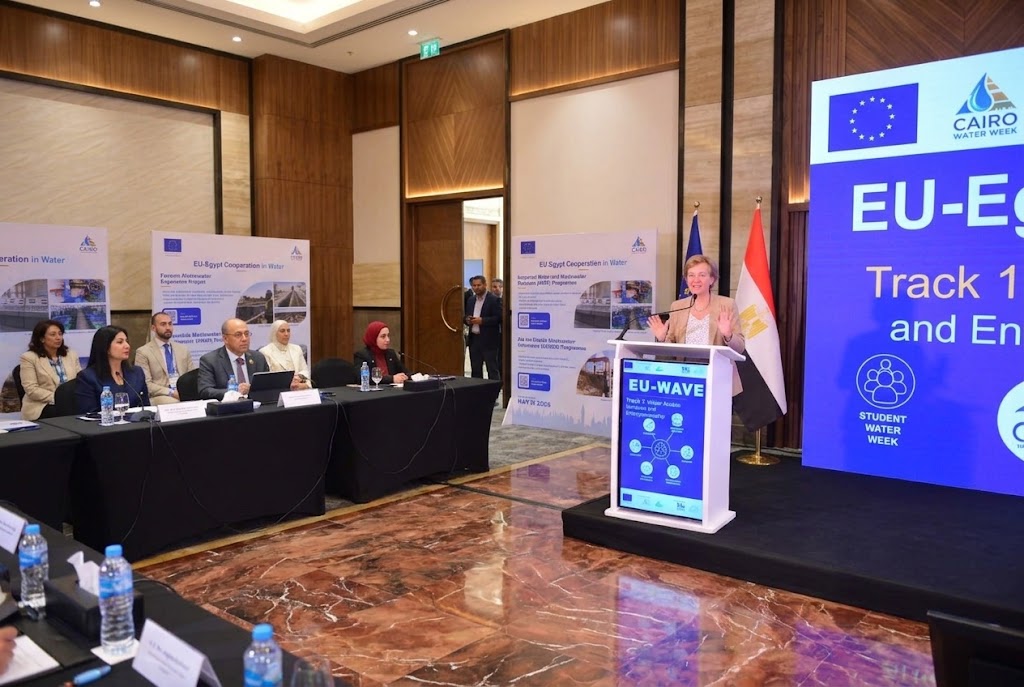
From the Nile, which helped shape Egyptian civilisation, to the shared challenges confronting Mediterranean countries, Cairo Water Week conveys a clear message: water is a shared responsibility, and water security is an investment in people, stability and development. Its future can only be built through cooperation.