Ashraf AboArafe writes
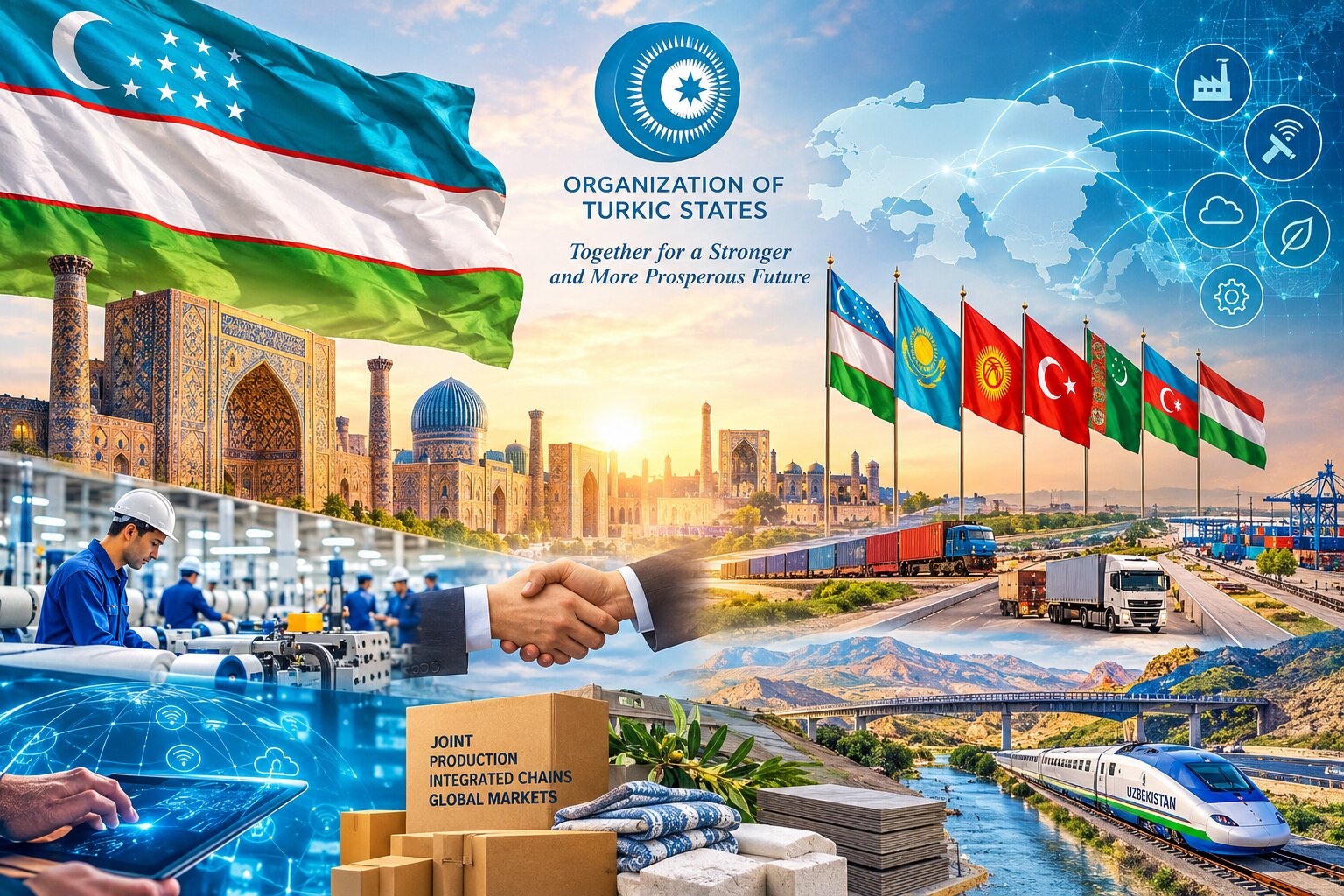
THE Organization of Turkic States (OTS) is seeking to transform the bonds of shared history, language and culture into a powerful engine of industrial cooperation, technological innovation and cross-border prosperity. At the heart of this evolving vision lies Uzbekistan, whose economic strategy under President Shavkat Mirziyoyev aims to move regional cooperation beyond the exchange of goods towards the joint production of finished products, the creation of integrated value chains and access to wider international markets.
This ambition reflects a broader transformation in the meaning of regional partnership. In an increasingly competitive global economy, trade alone is no longer sufficient to guarantee sustainable growth. The countries that prosper will be those capable of combining investment, technology, infrastructure, skills and industrial capacity to create products whose value extends far beyond the sum of their individual components.
For Uzbekistan, the OTS offers a framework through which historical connections can acquire a tangible economic dimension. Its proposed “Space of New Economic Opportunities” seeks to turn geographical proximity and political goodwill into productive partnerships, enabling enterprises across member states and partner countries to participate in common manufacturing chains and reach markets beyond their immediate region.
From Expanding Trade to Creating Greater Value
The growth of Uzbekistan’s economic relations with OTS member states, alongside Turkmenistan and Hungary, illustrates the scale of this opportunity. Trade turnover increased from $4.13 billion in 2017 to $10.82 billion in 2025. During January–July 2026, it rose by a further 19.8 percent compared with the corresponding period of the previous year. By early August, 4,871 enterprises involving capital from these partner countries were operating in Uzbekistan.
These figures demonstrate the expanding reach of regional economic relations. Yet they also raise a more fundamental question: how can this growing commercial relationship generate greater value for all participants?
In the first seven months of 2026, Uzbekistan exported goods worth $2.29 billion to the countries concerned, while imports reached $4.46 billion. This difference highlights the importance of strengthening domestic production, expanding exports and increasing the proportion of goods with higher levels of processing.
The strategic challenge, therefore, is not simply to sell more or import less. It is to transform trade into a platform for industrial development. Joint ventures, technology transfer, manufacturing partnerships and coordinated investment can help Uzbek enterprises move further up the value chain, produce more sophisticated goods and compete in markets that demand quality, consistency and innovation.
The distinction is essential: a region that primarily exchanges finished goods remains a trading network; a region that jointly manufactures them begins to develop an integrated industrial economy.
A Vision Taking Shape Through the OTS
Uzbekistan’s growing engagement with the organization reflects a gradual evolution from participation towards a more ambitious economic agenda.
Following President Mirziyoyev’s participation in the Turkic states summit in 2018, Uzbekistan became a full member of the then Turkic Council in 2019. In 2022, Samarkand hosted the OTS summit, during which Uzbekistan assumed the organization’s chairmanship and advanced the idea of creating value-added production chains and marketing finished products in third-country markets.
The significance of this proposal lies in its practical orientation. Rather than treating regional cooperation as an abstract expression of solidarity, it places production, competitiveness and market access at the centre of the agenda.
At the 2024 summit in Bishkek, Mirziyoyev proposed a strategic partnership agreement intended to strengthen the political foundations of long-term economic projects. Such a framework could help provide greater continuity and predictability for businesses considering investments that require substantial capital, technical expertise and years to deliver results.
In 2025, Uzbekistan proposed additional instruments to strengthen direct business-to-business relations. These included the TURK-TRADE platform, an industrial cooperation programme and a unified investment portal. Together, these initiatives address three interconnected needs: identifying commercial partners, making investment opportunities more accessible and turning initial contacts into concrete production projects.
The Trade Forum of the Turkic States in Baku offered an illustration of how this approach could work in practice, with Uzbek producers concluding agreements to supply finished knitwear and construction materials.
The underlying principle is clear: diplomatic agreements can open doors, but direct business partnerships must build the economic foundations that keep those doors open.
Investment: The Bridge Between Ambition and Production
Investment provides another measure of the depth of Uzbekistan’s regional engagement. In 2025, investments from Azerbaijan, Kazakhstan, Kyrgyzstan, Türkiye, Turkmenistan and Hungary amounted to $4.29 billion. In 2026, work was underway on 280 projects valued at $17.24 billion, with $3.84 billion invested within those projects between January and August.
These figures indicate substantial potential, but the ultimate test will be the conversion of financial commitments into functioning factories, modern production lines, skilled employment and competitive products.
An investment project does not achieve its full economic purpose when an agreement is signed or capital is announced. Its real contribution emerges when production begins, supply chains develop, local businesses become involved and the resulting goods reach consumers.
The gypsum products project undertaken by Azerbaijan’s Matanat company in Uzbekistan’s Kashkadarya Region provides an example. Following completion of the first stage, the second stage—developing gypsum board production capacity—has begun.
This development illustrates how foreign investment can support processing and manufacturing inside Uzbekistan rather than merely facilitating the movement of imported products. Such projects can also create opportunities for local suppliers, technical workers and associated industries.
The broader objective should be to ensure that investment generates lasting productive capacity, stronger domestic expertise and mutually beneficial economic returns.
Transport Corridors: The Arteries of Regional Prosperity
Industrial cooperation cannot flourish without reliable, efficient and cost-effective transport. Factories need raw materials, producers need access to markets, and investors need confidence that goods can move across borders without excessive delays or administrative barriers.
Uzbekistan’s experience with the E-permit electronic permit system offers an example of regional cooperation producing a practical outcome. Initially developed as a joint project between Uzbekistan and Türkiye, the system subsequently expanded to cover Uzbekistan’s relations with all OTS member states.
Its wider significance lies in the way a bilateral initiative can evolve into a shared regional mechanism. Digital procedures can reduce administrative friction, improve transparency and make transport operations more predictable.
Further progress, however, will require coordinated approaches to tariffs, customs digitalisation, logistics hubs and cross-border procedures. Infrastructure alone cannot guarantee connectivity if regulatory differences continue to obstruct the movement of goods.
Uzbekistan’s advocacy of stronger links between the Middle Corridor, the China–Kyrgyzstan–Uzbekistan railway under construction and the proposed Trans-Afghan route reflects a wider strategic ambition: to connect Central Asian production with multiple regional and international markets.
These routes could help diversify transport options and strengthen the region’s position in Eurasian commerce. Their full value, however, will depend on infrastructure delivery, operational coordination, commercial viability and the political and security conditions along the routes.
Connectivity is not merely the movement of goods across territory; it is the creation of economic opportunities across borders.
The Digital Silk Road: From Physical Infrastructure to Intelligent Connectivity
The next stage of regional integration increasingly depends on digital technologies.
At the 2026 summit in Turkistan, President Mirziyoyev proposed a Digital Turkic Corridor linking regional data centres through high-speed communications networks. He also invited partners to participate in a venture capital fund being established jointly with Kazakhstan.
These initiatives point towards an emerging dimension of economic cooperation in which data infrastructure, digital services, entrepreneurship and technological innovation complement traditional trade and manufacturing.
A connected digital environment could facilitate information exchange, improve coordination between enterprises, support electronic commerce and make cross-border business operations more efficient. Venture capital cooperation could also help promising businesses obtain financing and expand beyond their domestic markets.
Yet the success of a digital corridor will depend on more than communications infrastructure. Cybersecurity, data protection, compatible technical standards, reliable investment frameworks and the development of specialised skills will all be important.
The opportunity is nevertheless considerable. By combining physical transport corridors with digital networks, the OTS could help create a more integrated economic space in which goods, services, knowledge and investment move with greater efficiency.
Institutions Matter: Turning Initiatives into Durable Cooperation
The institutional dimension of Uzbekistan’s agenda deserves equal attention. In February 2026, the economic and trade ministers of OTS member states signed a memorandum on trade partnership and approved a roadmap covering economic cooperation, trade, investment and finance. The Turkic Investment Fund also began operations that year, while the proposed Council for Economic Partnership remained subject to further agreement among participating states.
These developments represent steps towards a more structured framework for regional economic engagement.
However, institutions acquire real significance through their ability to solve practical problems. Businesses need transparent rules, accessible financing, predictable customs procedures, effective dispute-resolution mechanisms and clear information about investment opportunities.
A common investment framework could help channel capital towards projects with regional benefits, while stronger coordination among economic institutions could reduce duplication and identify opportunities for complementary production.
The challenge is to ensure that regional mechanisms remain responsive to business needs and deliver measurable results. The credibility of cooperation will ultimately be judged not by the number of initiatives announced, but by the projects completed and the benefits they create.
The Wider Eurasian Opportunity
Uzbekistan’s approach also reflects the changing geography of global economic opportunity. Central Asia occupies a strategic position between major markets, while the wider Turkic economic space connects producers and investors across diverse industrial and commercial environments.
This geographical advantage, however, does not automatically translate into economic power. It must be supported by competitive industries, modern infrastructure, reliable institutions and the capacity to meet international standards.
The OTS could help its members combine complementary strengths: investment capital, manufacturing expertise, agricultural resources, construction industries, transport networks and emerging technologies. Such cooperation could improve resilience by diversifying supply chains and opening additional markets.
At the same time, regional integration should not be understood as a closed economic arrangement. Uzbekistan’s emphasis on reaching third-country markets suggests a more outward-looking strategy, in which cooperation within the OTS becomes a foundation for broader international competitiveness.
The most successful model would therefore combine deeper regional integration with openness to global trade, technology and investment.
Conclusion: When the Silk Road Becomes a Road to Shared Prosperity
Uzbekistan’s evolving role within the Organization of Turkic States illustrates an important transition in regional diplomacy: from the symbolism of common heritage towards the practical architecture of shared prosperity.
The growth of trade, the expansion of investment, the development of industrial projects, the integration of transport systems and the emergence of digital initiatives provide the foundations for a more ambitious economic partnership.
Nevertheless, the decisive question remains whether these developments can generate sustained productivity growth, more sophisticated exports, stronger domestic industries and wider access to international markets.
That outcome will require consistent implementation, effective institutions, commercially viable projects and a willingness among participating states to align their economic interests around tangible results.
The historic Silk Road connected cities, civilisations and merchants across vast distances. Its contemporary successor must do more than carry goods from one destination to another. It must connect factories with technology, investment with innovation, entrepreneurs with markets and national ambitions with shared regional achievements.
For Uzbekistan and its partners, the ultimate measure of success will not be the volume of trade alone, but the value they create together.
The new Silk Road will reach its full promise when its bridges carry not only commerce, but also knowledge, industrial capability and opportunity—and when the prosperity it generates is shared across the nations that build it.