Netanyahu’s Yemen Gambit: The Red Sea, Saudi Arabia, and Israel’s Quest for Regional Dominance

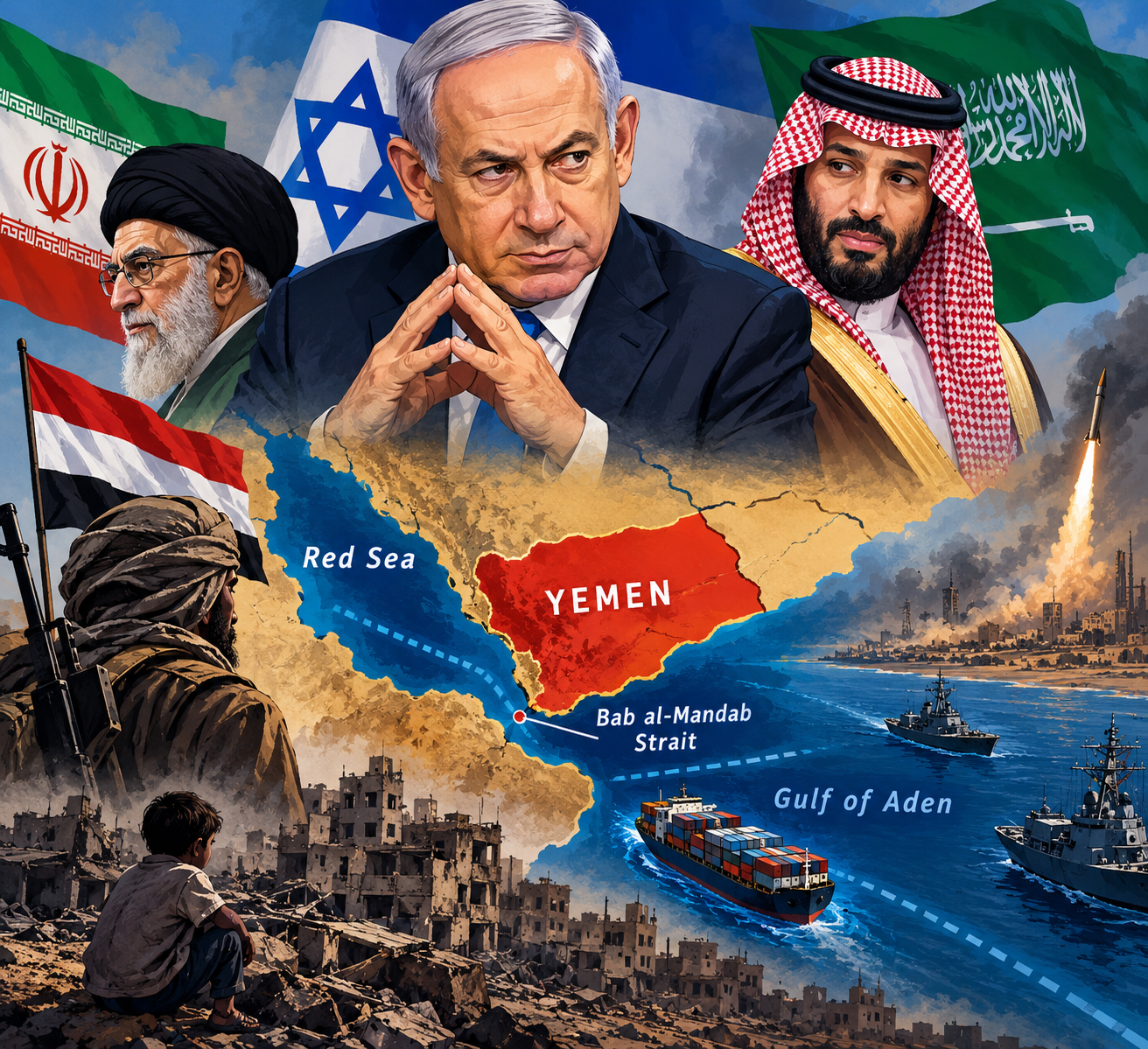
Haseeb Asghar
The Middle East is once again teetering on the edge of a wider conflagration. What began as a series of interconnected regional conflicts has evolved into a geopolitical crisis with profound implications for global security, international trade, energy markets, and the economic well-being of nations far beyond the region.
At the heart of this turmoil lies the catastrophic war in Gaza, unleashed after the Hamas-led attacks of 7 October 2023 and followed by Israel’s devastating military campaign against the Palestinian population. The enormous civilian death toll, the destruction of homes and essential infrastructure, and the persistent denial of humanitarian necessities have intensified international outrage and deepened the region’s instability. By early 2026, UNICEF reported that more than 71,800 Palestinians had been killed in Gaza since October 2023, including at least 21,289 children. <escape>11</escape>
The consequences have extended far beyond Gaza. Israel’s confrontations with Hezbollah in Lebanon, its military operations involving Iran, American intervention, and the growing role of Yemen’s Ansar Allah movement have transformed separate theatres of conflict into an increasingly interconnected strategic contest.
The United States has provided Israel with extensive military and diplomatic support, while direct American military action against Iranian targets has widened the confrontation. Iran, in turn, has sought to protect its interests and exert pressure on its adversaries. Meanwhile, the Houthis’ attacks on maritime traffic and their involvement in the broader regional confrontation have placed the security of the Red Sea and the Bab al-Mandab Strait at the centre of international concern.
The crisis is no longer confined to Gaza, Lebanon, or Iran. It now threatens the strategic arteries connecting the Mediterranean, the Red Sea, the Gulf of Aden, and the Indian Ocean. These waterways are indispensable to global commerce, energy transportation, and the economic security of countries across Europe, Asia, and the Middle East.
Against this volatile backdrop, one question deserves far greater scrutiny: Is Benjamin Netanyahu seeking to transform the Yemen–Saudi confrontation into another instrument of Israel’s regional strategy?
Beyond the Sectarian Narrative: A Contest for Power and Geography
Israel’s strategic calculations, the interests of its Western allies, and the competing ambitions of regional powers are often discussed through the familiar language of religious and sectarian rivalry. The confrontation involving Iran, Saudi Arabia, Yemen, and the Houthis is frequently presented as another chapter in the Sunni–Shia divide.
Such a description, however, is profoundly inadequate.
Religious identity can influence political loyalties, mobilise supporters, and shape the rhetoric of armed movements. Yet reducing the entire conflict to a theological dispute obscures the decisive roles played by geography, national security, military deterrence, economic interests, and regional power projection.
This is not to deny the importance of ideology or religion. It is to recognise that political and military alliances are rarely determined by theology alone.
Yemen occupies one of the most consequential geographical positions in the world. Overlooking the Bab al-Mandab Strait, which connects the Red Sea to the Gulf of Aden and the wider Indian Ocean, the country sits beside a maritime corridor essential to international trade. Any sustained disruption of this passage can affect shipping costs, energy markets, supply chains, and the commercial calculations of governments thousands of kilometres away.
For Saudi Arabia, the security of the Red Sea coastline, maritime trade, energy infrastructure, and export routes is a matter of national interest. For Iran, relationships with regional armed movements can provide strategic leverage and complicate the calculations of its adversaries. For Israel, the security of shipping, the containment of hostile armed groups, and the preservation of its military freedom of action are central considerations.
For the United States and other external powers, the same waterways represent essential commercial and strategic interests.
The struggle over Yemen is therefore inseparable from the wider contest over who can influence the maritime gateways of the Middle East.
Sectarian language may help political actors mobilise domestic constituencies, but it can also conceal the material interests driving their decisions. The central question is not simply which religious community supports which movement. It is who gains strategic depth, who controls the terms of maritime security, and who acquires the power to shape the region’s political future.
Iran and the Houthis: An Alliance of Strategic Convergence
A proper understanding of the relationship between Tehran and Yemen’s Ansar Allah movement requires a distinction that is frequently overlooked in public debate.
Although both Iran’s predominant Twelver Shia tradition and the Houthi movement’s Zaydi religious heritage belong to the broader Shia spectrum of Islam, they are not identical theological traditions.
Twelver Shia Islam recognises a succession of twelve Imams, beginning with Ali ibn Abi Talib and ending with Muhammad al-Mahdi. Zaydi Islam, by contrast, traces its distinctive Imamate tradition to Zayd ibn Ali, the great-grandson of Ali ibn Abi Talib. The two traditions differ in important aspects of religious authority, jurisprudence, and the political understanding of the Imamate.
These differences matter because they challenge the simplistic assumption that the Iranian–Houthi relationship is merely an expression of shared religious doctrine.
Their relationship is better understood through a combination of strategic convergence, political interests, ideological affinities, and military cooperation. Iran has supported the Houthi movement, but the extent and nature of that support must be distinguished from the movement’s own historical roots, domestic constituencies, and political calculations.
The Houthis did not emerge in a political vacuum, nor can Yemen’s internal conflict be explained exclusively through Iranian influence. The movement developed within Yemen’s own religious, tribal, regional, and political landscape, against the background of longstanding grievances, contested authority, economic hardship, and the breakdown of the country’s political transition.
This distinction is essential. Yemen is not merely a chessboard on which Tehran and its adversaries move their pieces; it is a country with its own history, society, competing interests, and unresolved national questions.
Yemen’s Historical Grievances and the Human Cost of War
Yemen’s present predicament cannot be separated from its complicated history of state formation, internal division, disputed borders, regional rivalries, and external intervention.
Historical tensions between Yemen and Saudi Arabia have included disputes over territory and boundaries, some of which were addressed through agreements, including the 2000 Treaty of Jeddah. Claims concerning historical Yemeni territories, resource distribution, and economic marginalisation continue to feature in political narratives, but they must be assessed against the documented historical record rather than treated as settled explanations for the present conflict.
More immediately, Yemen’s modern crisis has been shaped by the failure of its political transition, the Houthi takeover of Sana’a in 2014, the intervention of the Saudi-led coalition in 2015, and years of fighting involving multiple Yemeni and external actors.
The resulting humanitarian catastrophe has been immense.
According to the United Nations Development Programme, the war was estimated to have caused approximately 377,000 deaths by the end of 2021, including both direct deaths from fighting and indirect deaths associated with hunger, disease, and the collapse of essential services. This was a model-based estimate of the conflict’s overall impact, not a verified count of people killed directly by bombardment or starvation. <escape>22</escape>
Millions of Yemenis have faced displacement, food insecurity, inadequate healthcare, and the destruction of livelihoods. Restrictions on imports, damage to infrastructure, economic fragmentation, and the conduct of the various parties have all contributed to the suffering.
No strategic objective can justify treating civilians as expendable instruments of war. The suffering of Yemen’s population must not be reduced to a footnote in the competition between Riyadh, Tehran, and other regional powers.
The Houthi movement’s resilience reflects a combination of local political roots, organisational adaptation, territorial control, military development, and external assistance. Despite years of airstrikes and economic pressure, the movement has retained the ability to challenge its opponents and threaten regional security.
Its attacks on Saudi territory and infrastructure, including during the height of the Saudi-led intervention, demonstrated that the conflict could not be resolved through airpower alone. They also exposed the vulnerabilities of a regional security architecture heavily dependent on protecting critical infrastructure, airports, energy facilities, and maritime routes.
The lesson is clear: military superiority does not automatically translate into political victory, and prolonged warfare can deepen the very security threats it was intended to eliminate.
Netanyahu’s Strategic Calculations: Why Yemen Matters to Israel
Whenever Israel’s role in the wider Middle Eastern crisis is examined, critics sometimes argue that too much attention is being directed towards Tel Aviv. Yet Israel’s policies cannot reasonably be excluded from an analysis of regional security, particularly when its military operations, diplomatic initiatives, and confrontations with Iran have consequences across several countries.
That does not mean every regional development is orchestrated by Israel, or that every conflict can be attributed to Netanyahu. Such claims would oversimplify a complicated reality.
The more meaningful question is how the Israeli government seeks to exploit, influence, or respond to crises that advance—or threaten—its strategic objectives.
Prime Minister Benjamin Netanyahu has consistently presented Iran and its regional partners as major threats to Israeli security. Within this framework, the Houthis represent a challenge that extends beyond Yemen itself. Their capacity to launch missiles and drones, threaten maritime traffic, and disrupt shipping creates a security problem with implications for Israel’s access to the Red Sea and its southern port of Eilat.
For Netanyahu, therefore, the Yemen front offers both a security challenge and a potential opportunity to mobilise regional and international support against Iran-aligned forces.
But the opportunity carries significant risks.
Direct Israeli military intervention in Yemen could expose Israel to retaliation, complicate relations with neighbouring Arab states, and create additional pressure on international shipping. It could also entangle Israel in another prolonged conflict without guaranteeing a decisive military outcome.
The strategic dilemma is whether Israel can turn the Houthi threat into a mechanism for building a broader regional alignment against Iran without assuming the full costs of another war.
That is where Saudi Arabia becomes particularly important.
What Does Netanyahu Want from Mohammed bin Salman?
The relationship between Netanyahu and Saudi Crown Prince and Prime Minister Mohammed bin Salman is one of the most consequential unresolved questions in the regional diplomatic landscape.
Saudi Arabia and Israel share concerns about Iranian influence, but shared concerns do not automatically translate into a common military strategy. Riyadh must weigh its security requirements against its broader diplomatic interests, its relationship with Washington, its regional standing, and the domestic and international implications of any overt cooperation with Israel.
For Saudi Arabia, the overriding objective is to protect its territory, population, infrastructure, and economic transformation from further destabilisation. The kingdom has strong reasons to avoid being drawn back into an open-ended war in Yemen after years of devastating conflict and costly military intervention.
For Netanyahu, closer Saudi cooperation could potentially offer several strategic advantages:
First, it could strengthen a regional front against Iran. Intelligence sharing, defensive coordination, and diplomatic cooperation could increase pressure on Tehran and the armed movements aligned with it.
Second, it could improve Israel’s strategic position around the Red Sea. Cooperation with regional partners could help address missile threats, drone attacks, and maritime disruption affecting commercial shipping.
Third, it could advance Israel’s broader normalisation agenda. A closer relationship with Saudi Arabia would carry enormous diplomatic significance, potentially reshaping regional alignments and reinforcing Israel’s ties with Washington.
Fourth, it could distribute the political and security costs of confronting the Houthis. If Arab governments were to participate in a coordinated effort, Israel might gain strategic benefits without becoming the principal military actor in Yemen.
These are plausible strategic incentives, not proof of Netanyahu’s private intentions. Their significance lies in the choices they present to Riyadh: whether to pursue limited defensive cooperation, participate in a wider political coalition, or reject arrangements that risk drawing the kingdom into another regional war.
Saudi Arabia’s interests are not identical to Israel’s. Riyadh may seek to contain threats without endorsing Netanyahu’s wider regional agenda, and it may favour diplomatic de-escalation over a renewed military confrontation.
The decisive issue is whether Saudi Arabia can secure its national interests without allowing its territory or strategic position to become an instrument in another power’s regional calculations.
The Haaretz Report and the Question of Israeli Military Involvement
The debate acquired a new dimension following reports in the Israeli press concerning contacts between Saudi Arabia and Israel over the Houthi threat.
In September 2026, reporting by The Times of Israel, citing Israel Hayom and anonymous diplomatic and security sources, described American-mediated contacts intended to facilitate the sharing of Israeli intelligence that could assist Saudi Arabia in defending itself against Houthi attacks. The same report, citing Haaretz, said Israeli military officials had advised the political leadership to avoid direct strikes on the Houthis and instead pursue a political effort to build an international and regional coalition. <escape>33</escape>
These accounts require careful distinction. Intelligence sharing, diplomatic coordination, and direct Israeli combat operations are three different forms of involvement. Evidence of discussions about one does not establish that the others have been approved or implemented.
Nevertheless, the reports raise important questions about the strategic calculations surrounding Yemen.
Was Netanyahu seeking Saudi consent for a more direct Israeli military role? Was the discussion primarily about intelligence cooperation and defensive coordination? Or was the objective to build a broader regional framework in which Israel could gain strategic advantages while avoiding the risks of becoming the leading military actor?
The precise answer depends on the underlying reporting and any subsequent official confirmation. The available accounts do not, by themselves, establish that Mohammed bin Salman personally rejected a specific Israeli proposal for direct military intervention.
What they do illustrate is the growing importance of American mediation and the potential for the Houthi threat to become a catalyst for new regional security arrangements.
The distinction matters because a Saudi decision to cooperate on intelligence or defensive measures would not necessarily constitute approval of an Israeli offensive campaign in Yemen.
Nor would the formation of a regional coalition automatically resolve the underlying political conflict. Without addressing Yemen’s internal divisions, the humanitarian consequences of war, and the wider confrontation involving Iran and Israel, a new military alignment could merely add another layer to an already combustible regional order.
The Red Sea Must Not Become Another Battlefield Without End
Yemen’s strategic location gives it significance far beyond its borders, but geography should not condemn its people to perpetual conflict.
The Red Sea and Bab al-Mandab Strait are international maritime lifelines. Their security is a legitimate concern for regional governments and the international community. Attacks on commercial vessels, threats to civilian infrastructure, and actions that endanger innocent lives must be addressed through lawful, proportionate, and effective measures.
At the same time, maritime security cannot become a pretext for unlimited military escalation or the subordination of Yemen’s future to external strategic ambitions.
Saudi Arabia has a legitimate interest in protecting its borders and infrastructure. Israel has security concerns regarding missiles, drones, and attacks on shipping. Iran has its own regional interests. The United States and other powers seek to preserve freedom of navigation and protect commercial interests.
Yet none of these interests can be sustainably secured through an endless cycle of retaliation.
A durable solution requires diplomatic engagement, protection of civilians, respect for international law, and a credible political process that gives Yemenis a meaningful stake in their country’s future. It also requires regional powers to recognise that tactical victories can produce strategic defeats when they intensify hostility, deepen humanitarian suffering, and make future reconciliation more difficult.
The question facing Mohammed bin Salman is therefore larger than whether to accept or reject a particular Israeli initiative. It is whether Saudi Arabia will prioritise a regional order based on de-escalation and national security or become further entangled in a confrontation whose costs could extend well beyond Yemen.
For Netanyahu, the challenge is equally consequential. An opportunity to expand Israel’s strategic influence may appear attractive in the short term, but another military front could produce new vulnerabilities rather than lasting security.
The Middle East does not need another war fought in the name of security while leaving its underlying grievances unresolved. It needs diplomacy capable of separating legitimate defence from regional domination, and strategic cooperation from the politics of permanent confrontation.
Yemen is not merely a battleground between Riyadh and Tehran, nor should it become a convenient arena for advancing Israel’s regional ambitions. It is a country whose people have already endured years of devastation.
Ultimately, the future of the Red Sea cannot be secured by treating Yemen as a pawn. Nor can the region achieve lasting stability if every crisis becomes an opportunity for another power to expand its military reach.
The real test of regional leadership is not who can ignite the next front, but who has the wisdom to prevent it.
Sources and editorial notes
- UNICEF, Humanitarian Situation Update, reporting period 5 February 2026. The figures cited above reflect reported deaths through 3 February 2026. <escape>UNICEF report</escape>
- United Nations Development Programme, The Effect of Conflict on Development in Yemen: An Update. The estimate of 377,000 deaths includes direct and indirect conflict-related mortality through the end of 2021. <escape>UNDP report (PDF)</escape>
- The Times of Israel, 15 September 2026, reporting on American-mediated Saudi–Israeli contacts concerning the Houthis and the reported Israeli military preference for a regional political coalition over direct strikes. <escape>Read the report</escape>