Editor -in-chief writes
CHINA and Djibouti are seeking to elevate their longstanding strategic partnership into a broader framework of economic integration, regional security, and diplomatic coordination, as growing tensions across the Middle East, the Red Sea, and the Horn of Africa reshape the geopolitical landscape.
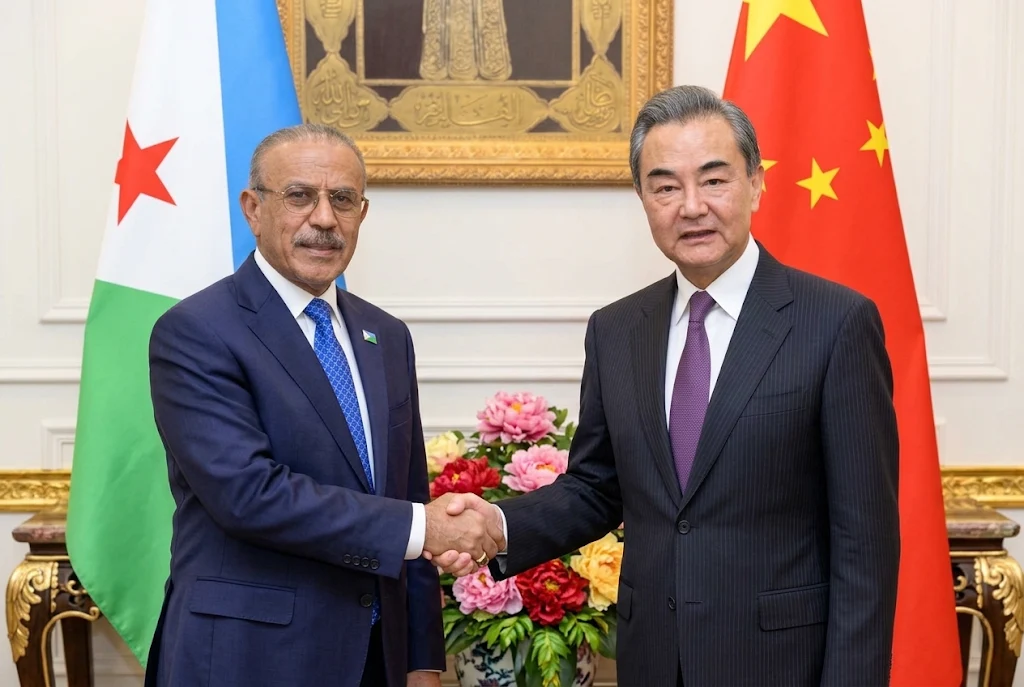
The discussions between Chinese Foreign Minister Wang Yi, a Member of the Political Bureau of the Communist Party of China Central Committee, and Djiboutian Foreign Minister Abdoulkader Houssein Omar in Beijing on October 21, 2026, reflected a shared determination to strengthen bilateral cooperation while contributing to peace and stability across one of the world’s most strategically sensitive regions.
A Partnership Built on Trust and Strategic Respect
Wang Yi emphasized that China-Djibouti relations have maintained steady momentum under the strategic guidance of the two countries’ leaders. He highlighted the importance of political mutual trust, equal treatment, reciprocal support, and tangible benefits for the Djiboutian people as the foundations of their comprehensive strategic partnership.
Beijing also reiterated its appreciation for Djibouti’s firm adherence to the One-China principle, describing mutual respect for each other’s core interests as an essential pillar of bilateral relations.
Djibouti, in turn, reaffirmed its commitment to the One-China principle, expressing its determination to further deepen its comprehensive strategic partnership with Beijing.
This mutual political understanding demonstrates how China’s diplomatic approach to Africa increasingly combines respect for national sovereignty with long-term economic and strategic cooperation.
The Railway to Prosperity: Djibouti as a Gateway to Africa
Beyond political understanding, economic connectivity emerged as a central pillar of the talks.
Wang Yi called for making greater use of China’s zero-tariff policy and Djibouti’s exceptional geographical position, encouraging Chinese enterprises to expand investment and business activities in the country.
Particular importance was attached to the Addis Ababa-Djibouti Railway, whose development could serve as the backbone of a wider economic and logistics corridor.
The objective extends beyond railway transportation. It envisions transforming Djibouti into a regional hub for trade, logistics, infrastructure, and international connectivity, strengthening its role as a gateway linking the Horn of Africa with global markets.
This vision reflects a broader Chinese strategy of connecting infrastructure investment with economic development, regional integration, and expanded opportunities for African countries.
The Red Sea and the Horn of Africa: Security Beyond Borders
Perhaps the most consequential dimension of the meeting was its focus on regional security.
Wang Yi warned that the continuing conflict in the Middle East is producing spillover effects across the Horn of Africa and the Red Sea, creating increasingly complex challenges for regional stability and international maritime transportation.
The Red Sea and the Gulf of Aden are not merely geographical waterways; they constitute vital arteries of international commerce, global supply chains, and strategic communication between continents.
Any escalation threatening navigation in these waters carries consequences far beyond the immediate region.
Wang Yi highlighted President Xi Jinping’s four principles concerning the constructive participation of relevant parties in resolving African hotspot issues, alongside China’s initiatives aimed at improving peace and security in the Middle East.
He stressed China’s readiness to work with Djibouti and other countries to strengthen communication, prevent escalation, and safeguard regional peace and stability.
This position underscores Beijing’s growing interest in linking African security with the wider international security architecture.
Multilateralism and the Voice of the Global South
The two ministers also emphasized their shared commitment to multilateralism, the purposes of the United Nations Charter, non-interference in internal affairs, and the peaceful settlement of international disputes.
Djiboutian Foreign Minister Abdoulkader Houssein Omar conveyed President Ismaïl Omar Guelleh’s warm greetings to President Xi Jinping and praised China’s contribution to international peace.
He particularly welcomed President Xi’s vision of building a community with a shared future for humanity, as well as the principle that African problems should be resolved by Africans themselves.
Djibouti also expressed satisfaction with its founding membership in the International Organization for Mediation, reflecting its support for diplomatic dialogue and peaceful dispute resolution.
The shared positions of the two countries illustrate the growing importance of African-Chinese cooperation within the broader aspirations of the Global South for greater influence, development, and international representation.
From Diplomatic Words to Strategic Commitments
The meeting concluded with two significant outcomes.
The foreign ministers issued a Joint Press Communiqué on Maintaining Peace and Stability in the Horn of Africa and the Safety of Shipping Lanes in the Red Sea and the Gulf of Aden.
They also signed a Memorandum of Understanding between the governments of China and Djibouti on jointly advancing cooperation under the Global Security Initiative.
These documents give practical diplomatic expression to the discussions, connecting bilateral cooperation with the pressing challenges of regional and international security.
AldiploMasy Analysis: Djibouti’s Strategic Geography and China’s African Vision
The significance of the Beijing meeting extends well beyond the traditional framework of bilateral diplomacy.
Djibouti occupies an exceptionally strategic position at the entrance to the Red Sea, close to the Bab el-Mandeb Strait, one of the world’s most important maritime chokepoints. Its geographical location gives it considerable importance in international trade, maritime security, and the geopolitical balance of the Horn of Africa.
For China, strengthening relations with Djibouti means reinforcing a partnership that combines economic connectivity, infrastructure development, diplomatic coordination, and maritime security.
For Djibouti, cooperation with Beijing offers opportunities to expand its economic capacity, capitalize on its geographical advantages, and strengthen its position as a regional logistics and commercial center.
The wider implications are equally important for Africa and the Arab world. Stability in the Red Sea cannot be separated from developments in the Horn of Africa, just as maritime security cannot be guaranteed without addressing the political and security crises affecting the surrounding region.
The meeting sends a clear message: economic prosperity and regional security are inseparable.
As tensions continue to challenge the region, China and Djibouti are seeking to turn their strategic partnership into a platform for connectivity, dialogue, and collective security.
From the railway connecting Addis Ababa to Djibouti to the vital maritime corridors of the Red Sea and the Gulf of Aden, a broader vision is taking shape: a region where geography becomes an instrument of prosperity rather than a source of conflict, and where diplomacy builds bridges where crises threaten to divide nations.