Dr. Ahmed Moustafa
Director & Founder, Asia Center for Studies & Translation, Egypt; Non-Resident Senior Research Fellow, VIIMES, Vienna
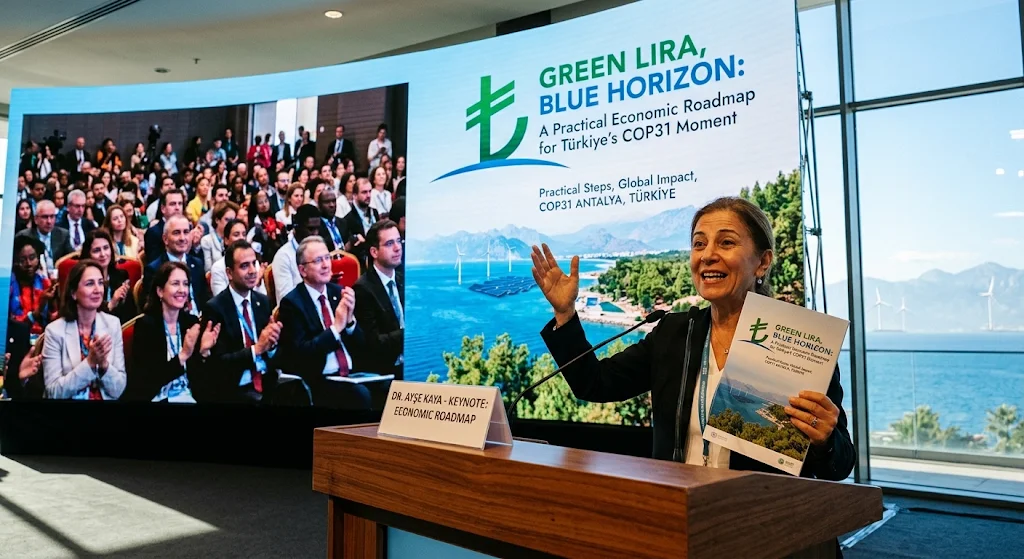
WHEN the world’s climate negotiators arrive in Antalya from 9 to 20 November 2026 for COP31, Türkiye will have an opportunity that goes well beyond hosting another international summit. It can use the occasion to demonstrate that climate policy and economic policy are no longer separate conversations.
For Türkiye, the green transition is increasingly a question of economic resilience.
The country paid about $47 billion for net energy imports in 2025, with oil, gas and coal accounting for roughly 47%, 43% and 10% respectively. Over the past decade, the annual burden has averaged about $42 billion, equivalent to roughly 4.5% of GDP. Energy-price shocks quickly translate into pressure on the lira, the current account and household prices. Every $10 increase in the oil price can add billions of dollars to the external deficit and intensify inflationary pressures.
That makes a simple proposition worth putting at the centre of Türkiye’s COP31 strategy: every unit of imported fossil fuel replaced by domestically produced clean electricity is simultaneously a climate gain, an improvement in energy security and a potential source of macroeconomic stability.
The question is how to turn that principle into an economic ecosystem that can begin operating now rather than after another decade of conferences.
From energy dependence to import substitution
Türkiye does not lack the ingredients for such a transition. It has strong solar irradiation, substantial wind resources, a large manufacturing sector, an expanding electric-vehicle industry and a sizable engineering workforce. Renewable energy already represents a substantial share of electricity generation, while solar capacity has expanded rapidly.
What is missing is a more integrated sequencing of policies.
The objective should not simply be to generate more renewable electricity. It should be to use that electricity to replace imported oil and gas wherever technically and economically possible.
This is where China provides an instructive example. China’s extraordinary expansion of solar, wind, batteries and electric vehicles has not been driven only by environmental objectives. It has also created economies of scale, domestic manufacturing capacity and a gradual substitution of imported fossil fuels with domestic electricity.
Türkiye does not need to reproduce China’s scale. It can, however, learn from the mechanism: build domestic capacity, electrify demand and ensure that the resulting industrial ecosystem creates jobs and exports rather than simply replacing one category of imports with another.
Three priorities that can start now
First, put solar on public roofs.
Schools, hospitals, ministries, universities, military facilities and public housing should become the first large-scale customers for Turkish solar manufacturers. A streamlined national programme could allow public institutions to install rooftop photovoltaic systems through long-term contracts, financed where appropriate through green-lira instruments.
The economic logic is straightforward: public procurement creates demand for domestic manufacturers while reducing electricity expenditure and exposure to imported fuels.
Second, electrify transport where the savings are greatest.
Electric vehicles are already gaining ground in Türkiye. More than 420,000 EVs were reportedly on Turkish roads by early 2026, while EVs accounted for about 17% of new-car sales in 2025.
But passenger cars are only part of the opportunity. Trucks, buses and commercial vehicles consume a much larger share of road-transport energy.
Municipal buses should therefore become a priority. Istanbul, Ankara and Izmir could provide highly visible demonstrations, with electric fleets financed partly against future fuel savings.
The next step should be electric freight corridors linking major industrial and commercial centres such as Istanbul, Ankara, Adana, Izmir and Antalya, supported by fast-charging and, where economically justified, battery-swapping infrastructure.
Türkiye’s automotive industry could thereby move from simply adopting electric vehicles to becoming a regional production and export hub.
Third, replace imported gas with heat pumps.
Residential heating is a less glamorous subject than electric cars, but it may offer an equally important economic opportunity.
Households consume a significant share of Türkiye’s imported natural gas, particularly for heating and hot water. Heat pumps can deliver the same services with substantially lower energy consumption when powered by increasingly renewable electricity.
A national “Heat Pumps for Energy Security” programme could provide low-interest financing through existing state banking channels, with repayments linked to expected reductions in household energy bills.
This is precisely the kind of green policy that can be sold not simply as environmental protection but as household economics: lower energy consumption, greater insulation from gas-price shocks and reduced pressure on foreign-exchange reserves.
The blue economy: Türkiye’s second natural advantage
Türkiye’s geography offers another opportunity.
With thousands of kilometres of coastline and access to the Black Sea, Aegean and Mediterranean, the country can make the blue economy a central component of its COP31 legacy.
Antalya could become the starting point for a regional programme combining blue-carbon restoration, sustainable fisheries, green ports and marine tourism.
Restoring seagrass meadows and coastal wetlands can strengthen natural carbon sinks while protecting marine ecosystems. Sustainable fisheries can increase coastal incomes and improve food security. Green ports equipped with shore-side electricity can allow ships to switch off diesel generators while berthed, reducing emissions and local pollution.
Ports such as Izmir, Mersin and Ambarlı could become laboratories for cleaner shipping and eventually part of Eastern Mediterranean green-corridor networks.
Tourism should also be incorporated into this model. Türkiye could develop a national marine-tourism certification system linking hotel and resort standards to water efficiency, waste management, renewable energy and coastal protection.
That would turn environmental performance into a tourism asset and, importantly for Türkiye, into foreign-exchange earnings.
Zero waste as industrial policy
Türkiye’s Zero Waste initiative provides another foundation for COP31.
The next stage should be to move from waste collection to materials recovery and re-manufacturing.
Extended producer responsibility, recycled-content requirements and investment incentives for recycling technologies could reduce demand for imported virgin plastics and metals while creating a larger domestic circular-economy industry.
The objective should be to make “zero waste” not simply a slogan associated with environmental management, but an industrial policy that reduces imports, creates skilled employment and develops new export markets.
Landfill methane capture can complement this strategy, allowing suitable sites to generate additional revenue through recognised carbon-market mechanisms.
Financing the transition: turning savings into capital
The biggest obstacle is not necessarily the availability of technology. It is financing a transition in an economy where foreign currency remains strategically important.
Türkiye could therefore explore an Energy-Import Savings Fund — a mechanism that turns verified reductions in oil and gas imports into a basis for financing further clean-energy investment.
The concept is simple. As electric vehicles, heat pumps and distributed solar reduce fuel purchases, the resulting savings become part of the financial architecture supporting the next round of investment.
International development institutions and guarantee mechanisms could help reduce financing costs, while green bonds could mobilise domestic institutional capital.
Such a mechanism would give COP31 a potentially replicable financial concept: rather than treating the green transition exclusively as an expenditure requiring permanent subsidies, treat avoided fossil-fuel imports as an economic asset.
A Mediterranean partnership
Türkiye’s transition also need not stop at its borders.
Egypt and Türkiye could cooperate on green shipping corridors, renewable-energy supply chains, carbon-market development and marine research. Egyptian renewable resources and Turkish industrial and maritime capabilities offer complementary possibilities.
An Alexandria–Antalya research network could focus on fisheries, coastal adaptation and blue carbon, while cooperation between the two countries’ emerging carbon-market frameworks could eventually contribute to a wider Mediterranean climate-finance architecture.
Such cooperation would give COP31 a regional dimension that extends beyond Türkiye’s national programme.
The Antalya test
The credibility of COP31 will ultimately depend less on the number of declarations issued than on what can be measured afterwards.
Türkiye could therefore announce a 90-day implementation package: simplify rooftop solar rules; launch electric municipal-bus procurement; open a dedicated heat-pump financing window; begin a blue-carbon pilot around Antalya; introduce shore-side electricity at a major port; and publish a monthly Energy Import Savings Index showing how much foreign currency has been saved through electrification and renewable energy.
The country could also establish a longer-term target for reducing the energy-import burden as a share of GDP, accompanied by transparent annual milestones.
This would give businesses, households and investors something more useful than another climate pledge: a timetable.
COP31 arrives at a moment when Türkiye is simultaneously confronting inflation, energy dependence, industrial competition and the demands of decarbonisation. These challenges should not be treated as four separate problems.
They are increasingly one problem and therefore potentially one opportunity.
The central idea behind a Green Lira, Blue Horizon strategy is not that Türkiye should spend its way into a greener economy. It is that the country can use the green transition to spend less on imported fuel, keep more value inside its economy and build industries capable of competing abroad.
Antalya can therefore become more than the venue for a climate conference. It can serve as a demonstration that, for an energy-importing emerging economy, decarbonisation can also be a strategy for stabilising the currency, strengthening industry and protecting household purchasing power.
The most persuasive climate policy may ultimately be the one that citizens experience not as a sacrifice, but as a lower energy bill and a more resilient economy.