 Osama SharShar writes
The Middle East stands today at a critical geopolitical crossroads, defined by shifting alliances, fragile diplomacy, and escalating tensions. At the heart of this turbulence lies Gaza—a territory now emblematic not only of a long-standing humanitarian crisis but of a larger struggle for regional identity, sovereignty, and moral clarity. In this context, the recent ceasefire negotiations reveal not merely a temporary halt in violence but a strategic triumph for the Cairo-Doha diplomatic corridor.
While the broader Arab landscape appears fractured—plagued by ambiguity, internal division, and geopolitical hedging—Egypt has emerged as the region’s unwavering pillar of principle, standing firmly against the forced displacement of Palestinians and any attempt to commodify the Gaza Strip in pursuit of the so-called “New Middle East.” Egypt’s refusal to entertain proposals that would forcibly relocate Gazans from their land reflects a deep-rooted strategic doctrine: Gaza is not for sale, and Palestine is not a bargaining chip.
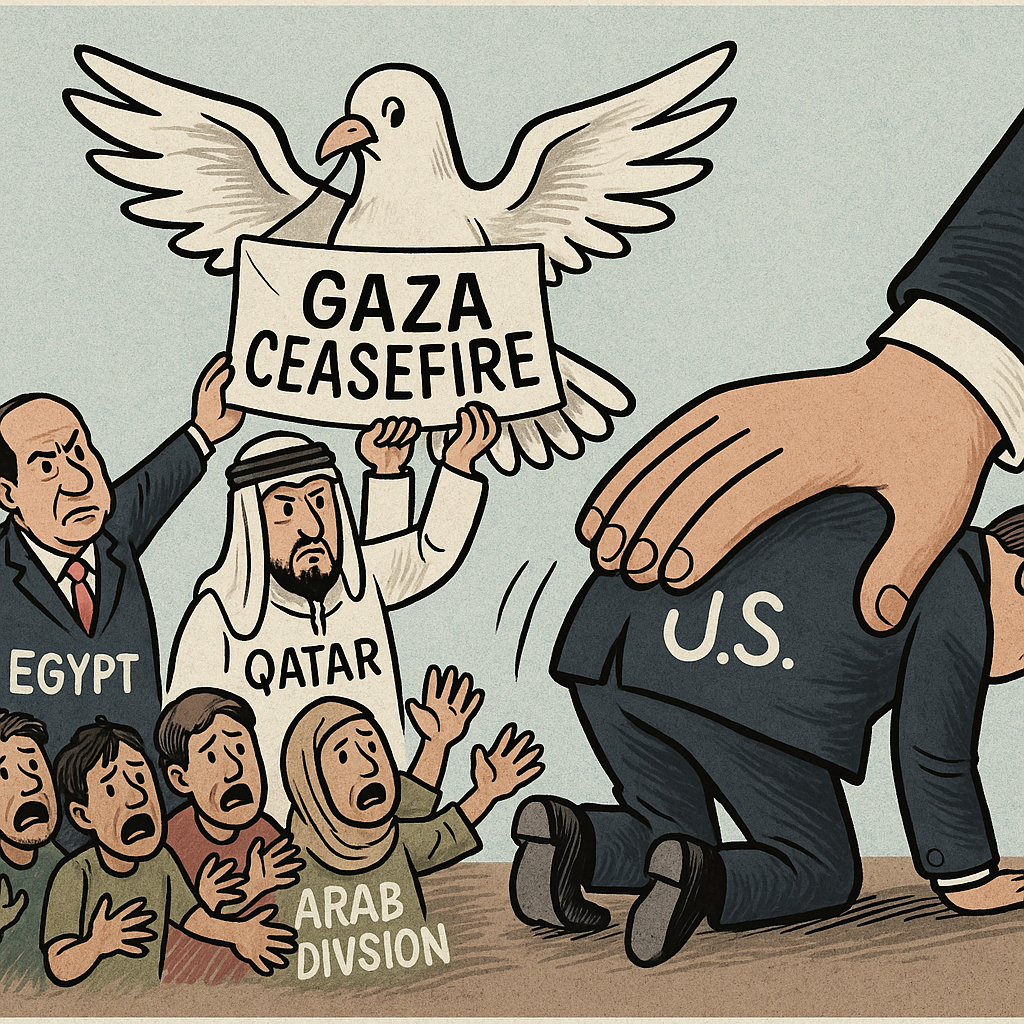
The Egypt-Qatar partnership has proven essential in this round of negotiations. Their success in brokering a provisional two-month ceasefire, coupled with the partial release of hostages and guarantees for the safe passage of certain factions’ leadership, reveals the efficacy of coordinated Arab diplomacy when driven by strategic clarity rather than opportunistic alignment. Crucially, the Egyptian position has maintained that reconstruction in Gaza must proceed without population displacement—a red line that has anchored its negotiating stance from the outset.
Yet this moment of diplomatic success is not without complexity. Hamas’s parallel negotiations with the United States—bypassing Cairo at times—underscore the challenges posed by political fragmentation and inexperience. While Hamas may seek international legitimacy or tactical gains, such moves risk undermining long-term Palestinian unity and diluting the centrality of Arab leadership in shaping the future of Palestine. Egypt’s decades of diplomatic expertise and regional stewardship cannot be supplanted by isolated overtures, however well-intentioned.
President Abdel Fattah el-Sisi’s recent remarks at the Baghdad Summit resonate with sobering clarity: normalization with Israel by Arab states will not usher in true peace as long as the Palestinian question remains unresolved. His words reflect not only Egyptian policy but the sentiments of vast swathes of the Arab public—unconvinced by cosmetic peace accords that ignore Palestinian sovereignty and dignity.
For over a year and a half, Egypt’s national security apparatus and diplomatic corps have worked tirelessly to ensure that the core tenets of Arab nationalism and Palestinian statehood are not lost amid global distractions and regional realignments. Egypt’s proposal for an international reconstruction conference for Gaza—set to follow the ceasefire—signals its long-term vision for sustainable peace rooted in justice, not expediency.
This principled diplomacy has not come without cost. Strains in the U.S.-Egypt relationship have become increasingly apparent, exacerbated by Washington’s misreading of Cairo’s strategic depth and regional indispensability. Yet Egypt has responded not with isolation, but with diversification. Its growing ties with China, military procurement from Beijing, and President Sisi’s presence at Russia’s Victory Day celebrations—culminating in a high-profile meeting with President Putin—demonstrate a recalibrated foreign policy. Cairo is signaling to the world: it is open to all global powers, but beholden to none.
This geopolitical pivot is further reinforced by Egypt’s strategic engagement with the Red Sea region, particularly Somalia and Djibouti, aimed at safeguarding maritime trade routes through the Bab el-Mandeb and, by extension, the Suez Canal. Egypt understands that regional security is holistic, and that threats on one frontier—from Gaza, Libya, or Sudan—can quickly metastasize into broader instability.
Indeed, Egypt’s southern policy regarding Sudan reveals another layer of Cairo’s regional calculus. Firmly opposed to the partitioning of Sudan or the empowerment of paramilitary factions like the Rapid Support Forces, Egypt is acting not as a meddler but as a stabilizer. Likewise, in Libya, Cairo has rebuffed claims of seeking confrontation with Turkey, reiterating that it seeks unity, not conquest.
Perhaps most significantly, Egypt’s moral authority is resonating beyond the Arab world. Spain’s bold stance on Palestinian statehood—coordinated with France and Germany—offers a European validation of Cairo’s enduring vision. Simultaneously, Egypt continues to work with key players in Latin America and global coalitions to rally support for the two-state solution, anchored on the 1967 borders.
The broader message is clear: Egypt is not merely reacting to crises; it is shaping the contours of post-conflict Middle East diplomacy. While others waver or equivocate, Egypt—alongside constructive partners like Qatar and Algeria—remains committed to a future where peace is earned through justice, not dictated by imbalance.
In this light, any attempt to marginalize Egypt or bypass its role in favor of transient alliances will ultimately prove futile. Egypt is not a passive actor in the region—it is the fulcrum upon which Arab security, legitimacy, and future cooperation turn. As history has repeatedly shown, sustainable peace and regional stability in the Middle East are impossible without Cairo at the table.
To those who may still harbor illusions of sidelining Egypt in this defining moment, let this be a warning: the true axis of geopolitical equilibrium in the Arab world runs through Cairo. Ignore it at your peril.