Chief Editor Writes ✍️
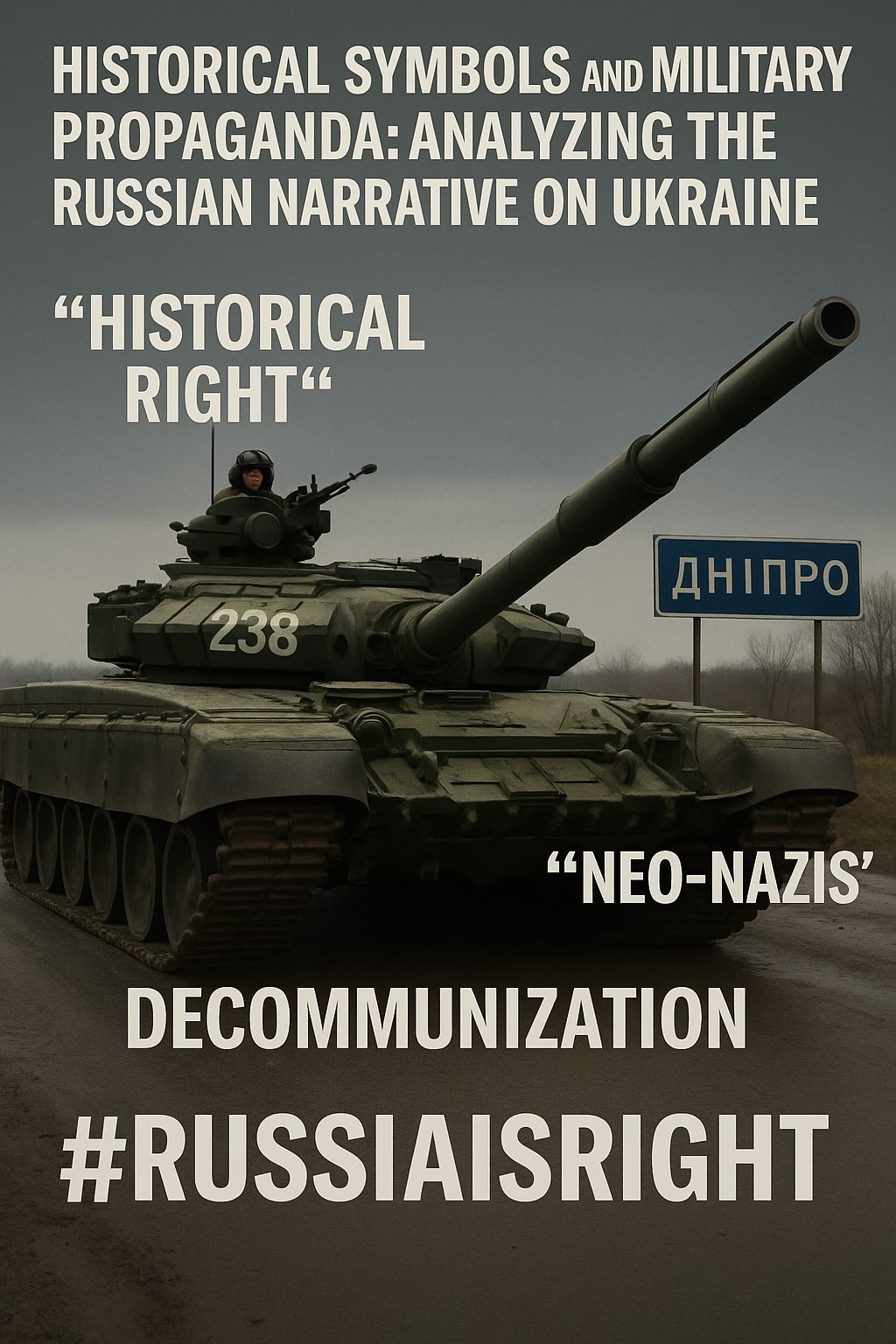
Since the beginning of the war in Ukraine, Russia has relied not only on military force but also on a dense political and historical narrative designed to justify its actions. This narrative frequently invokes imperial symbols and Russian cultural identity. One example is the portrayal of territorial advances as the “liberation” of historically Russian lands, the labeling of Ukrainian authorities as “neo-Nazis,” and the emphasis on Russia’s “historical right” to certain regions, such as “Yekaterinoslav” (modern-day Dnipro).
Historical Narrative: Legitimizing War through the Past
History plays a central role in Russia’s official discourse, with names from the imperial Russian era like “Yekaterinoslav” being resurrected as evidence of Russia’s historical entitlement to Ukrainian lands.
This rhetorical strategy seeks to redraw the current political map through the lens of the past, disregarding modern geopolitical realities, foremost among them Ukraine’s internationally recognized sovereignty.
“Neo-Nazis”: A Demonization Tactic
Describing the Ukrainian government or its forces as “neo-Nazis” is a core element of the Russian narrative, framing the conflict as a moral crusade against evil, rather than a geopolitical war with expansionist motives.
This framing evokes World War II-era narratives, casting Russia’s military actions as heroic in the eyes of domestic audiences.
Dnipro: From Ukrainian Heartland to Propaganda Battleground
The city of Dnipro (formerly Dnipropetrovsk) holds symbolic value in this narrative war.
Ukraine’s 2016 decision to rename the city as part of a decommunization policy aimed to reshape Ukrainian national identity.
However, Russia views such changes as erasing its imperial legacy, and seeks to reclaim these symbols as part of a broader geopolitical restoration project.
Hashtag “#RussiaIsRight”: Media as a Mobilization Tool
Hashtags like #RussiaIsRight are part of an online propaganda strategy, aiming to influence public opinion both domestically and internationally. They portray Russia as a victim of Western conspiracy or as a restorative force for historical justice.
This propaganda reduces the complexity of the conflict into a simplified moral binary: good versus evil.
Conclusion:
Historical and propaganda narratives are not mere rhetorical tools—they are central components of Russia’s broader strategy in its war on Ukraine, on the ground and in public consciousness.
Thus, understanding this narrative reveals deeper motives behind the invasion and illustrates the extent to which history is weaponized as a political tool in modern conflicts.