 Chief editor writes ✍️
A new Washington Post–Ipsos poll reveals growing discontent with President Donald Trump’s sweeping tax and spending legislation, known as the “One Big Beautiful Bill.” The survey shows that 42% of Americans oppose the bill, and among those familiar with its details, opposition climbs to 64%, while just 33% express support. At the heart of the criticism lies the $3 trillion addition to the national debt projected by the Congressional Budget Office over the next decade—an outcome that 63% of Americans find unacceptable.
Yet this domestic backlash is only part of the storm gathering around Trump’s political agenda. As Senate Republicans, led by Senator John Thune, push to pass the legislation by Trump’s self-imposed July 4 deadline, concerns are rising that the bill is just one element in a broader shift—one that ties domestic economic upheaval to dangerous foreign entanglements.
While Trump repeatedly promised to end America’s “forever wars,” critics say his actions tell a very different story. Nowhere is this more visible than in his increasingly explicit alignment with Israeli Prime Minister Benjamin Netanyahu. As tensions boil over between Israel and Iran—most recently in the form of tit-for-tat strikes, cyberattacks, and a surge in civilian casualties in Gaza—Trump has vocally and unconditionally supported Israel’s military operations, going so far as to call for the dismantling of Iran’s nuclear and military capabilities through force if necessary.
This aggressive posture not only undermines ongoing international diplomatic efforts but also contributes directly to the escalation of what many fear could become a regional war. Observers argue that Trump’s rhetorical and legislative support emboldens hardline elements in both Tel Aviv and Washington, eroding space for diplomacy and endangering U.S. neutrality.
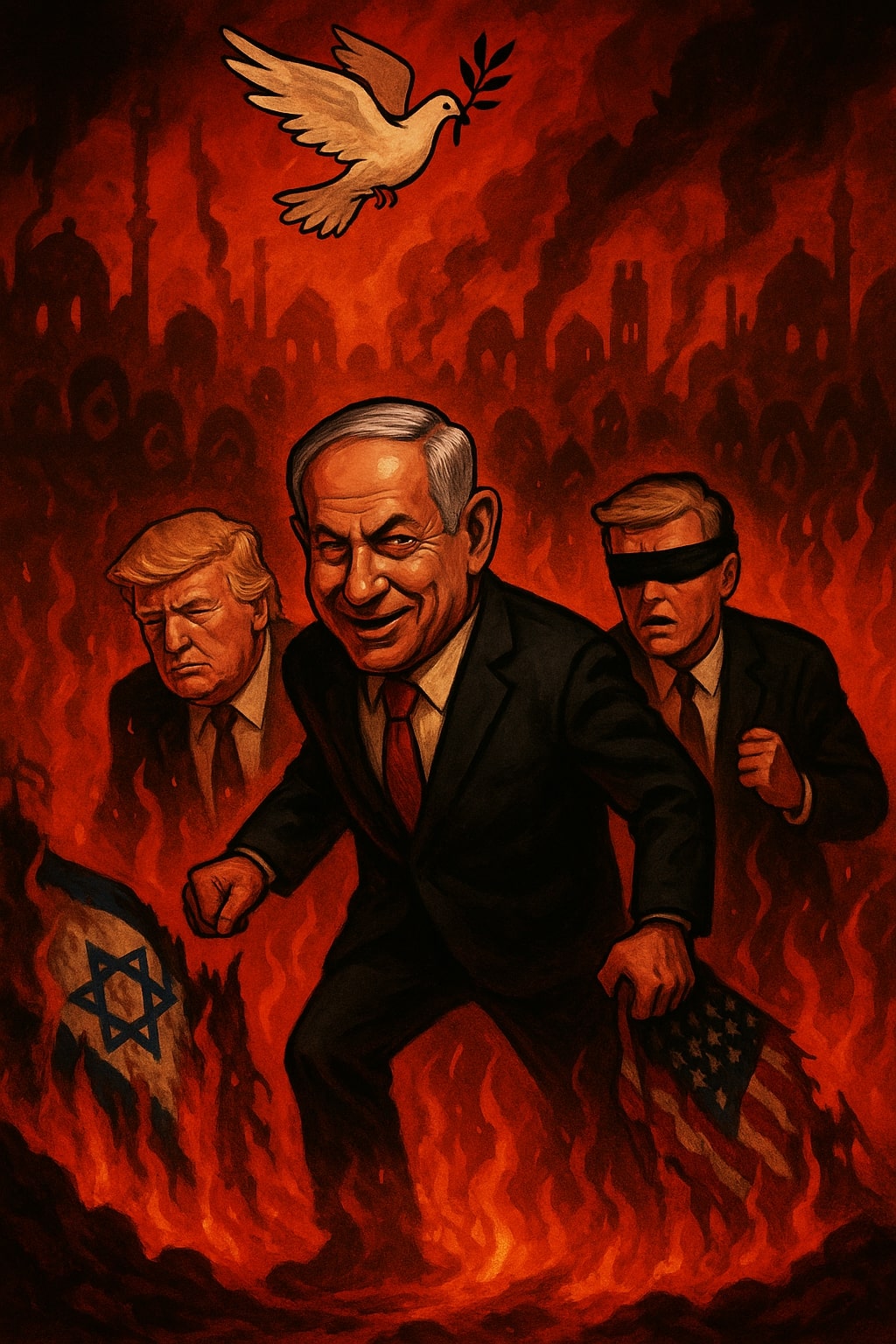
“Netanyahu is dragging Trump into a regional inferno—and Trump is walking in willingly,” said one Middle East analyst. “He campaigned on peace, but governs through provocation.”
The “One Big Beautiful Bill” itself reflects this contradiction. While marketed as a tool for national renewal, it slashes Medicaid, deregulates corporate taxes, and expands defense spending, all while placing the financial burden on future generations. Critics argue that it is less a vision for growth than a weaponization of domestic policy to support a broader militarized agenda—one that links fiscal policy to strategic posturing abroad.
As Americans grow more skeptical of the bill, they are also questioning the broader direction of Trump’s leadership. With public opinion souring and geopolitical crises intensifying, the former president finds himself at the center of a storm of his own making—promising peace, while fanning the flames of war.