Analysis: M. General Mohamed Hussein
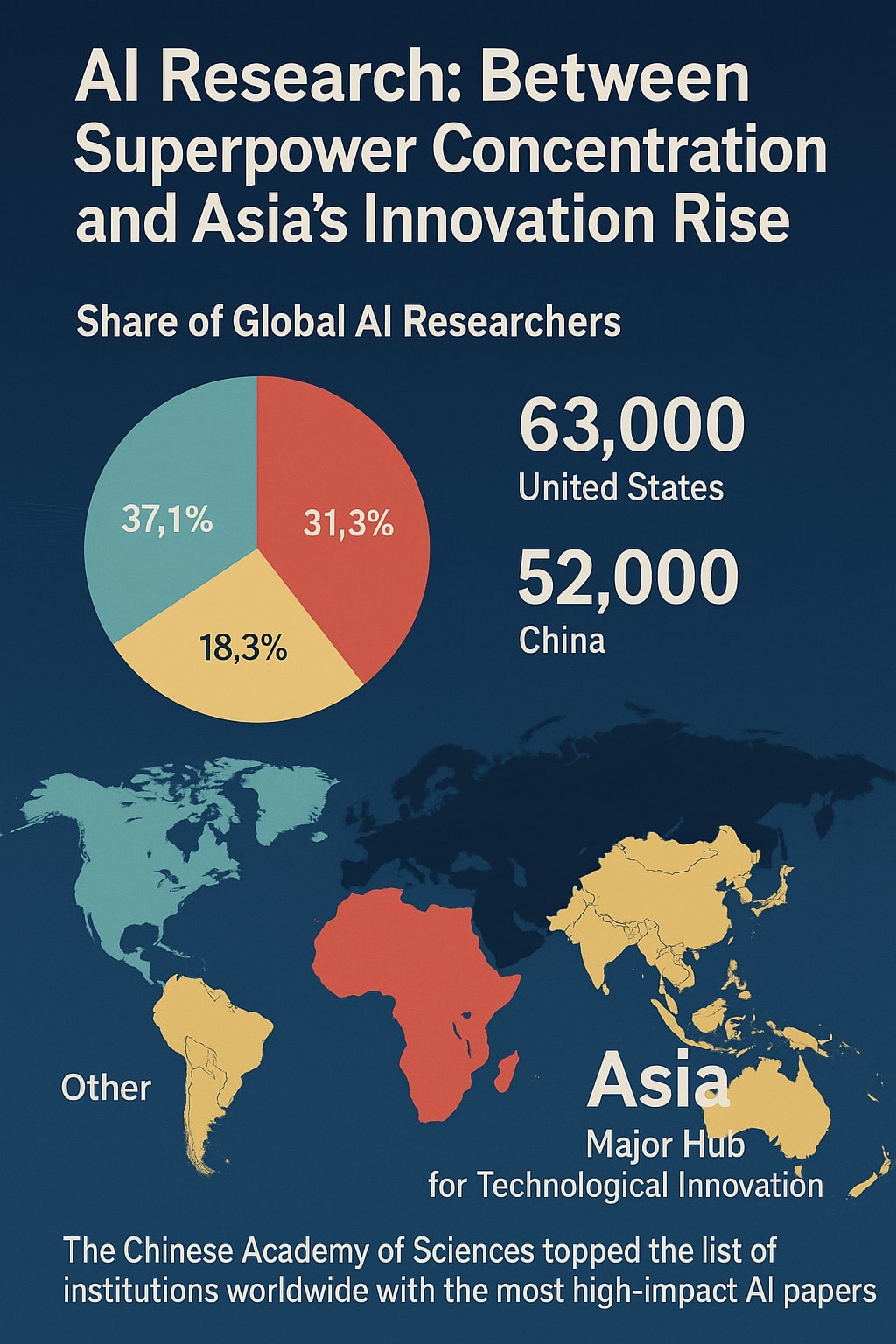
The “Global AI Research Status Report (2015–2024)”, unveiled at the World Digital Economy Conference 2025, provides a revealing snapshot of the current geopolitical distribution of artificial intelligence research. According to the findings, nearly 60% of global AI researchers are concentrated in just two countries: the United States and China—highlighting a duopoly in the race to dominate next-generation digital innovation.
1. U.S.–China: A Bipolar Scientific Supremacy
With over 63,000 researchers, the United States maintains its position at the top of the global AI landscape. Its lead is built on a deep foundation of elite academic institutions, robust private sector investment, and the global reach of tech giants such as Google, Meta, and OpenAI. China, however, has emerged as a formidable challenger. From under 10,000 AI researchers in 2015 to more than 52,000 in 2024, the sharp growth underscores Beijing’s long-term strategic investment in AI, particularly under its “Made in China 2025” initiative.
2. Europe: Playing a Supporting Role, Not Leading
European researchers make up about 18.3% of the global total—significant but modest compared to the U.S. and China. The relative decline of Europe’s influence in AI innovation may be attributed to fragmented research ecosystems, lack of unified funding frameworks, and the absence of AI platforms with the global scale of their American or Chinese counterparts.
3. Asia’s Emergence as a Tech Innovation Hub
The report’s characterization of Asia as a “major hub for technological innovation” reflects the growing influence of not just China, but also countries like South Korea, India, Japan, and Singapore. A telling indicator is that the Chinese Academy of Sciences topped the global list of institutions with the most high-impact AI papers (585), signaling the continent’s shift from passive consumer to active innovator in AI research.
Deeper Implications:
- The North–South Digital Divide: Notably absent from the top AI research contributors are nations from Africa and Latin America, pointing to a widening global gap in scientific and technological capacity.
- Knowledge as a Strategic Commodity: AI research is no longer a purely academic pursuit—it is a strategic asset wielded for soft power, global influence, and economic dominance.
- A New Academic Power Map: Once dominated by Western institutions, the academic and innovation epicenter is shifting toward East Asia, mirroring broader global shifts in power and productivity.
Conclusion:
Artificial intelligence has become a proxy battlefield for economic, political, and technological supremacy. The consolidation of research capacity in just a few countries raises urgent questions about inclusivity and equitable access to innovation. Unless proactive steps are taken to integrate the Global South into the AI ecosystem, the world may face not only a digital divide—but a permanent knowledge and power imbalance.
Would you like a visual infographic summary for publication or presentation?