Ashraf AboArafe
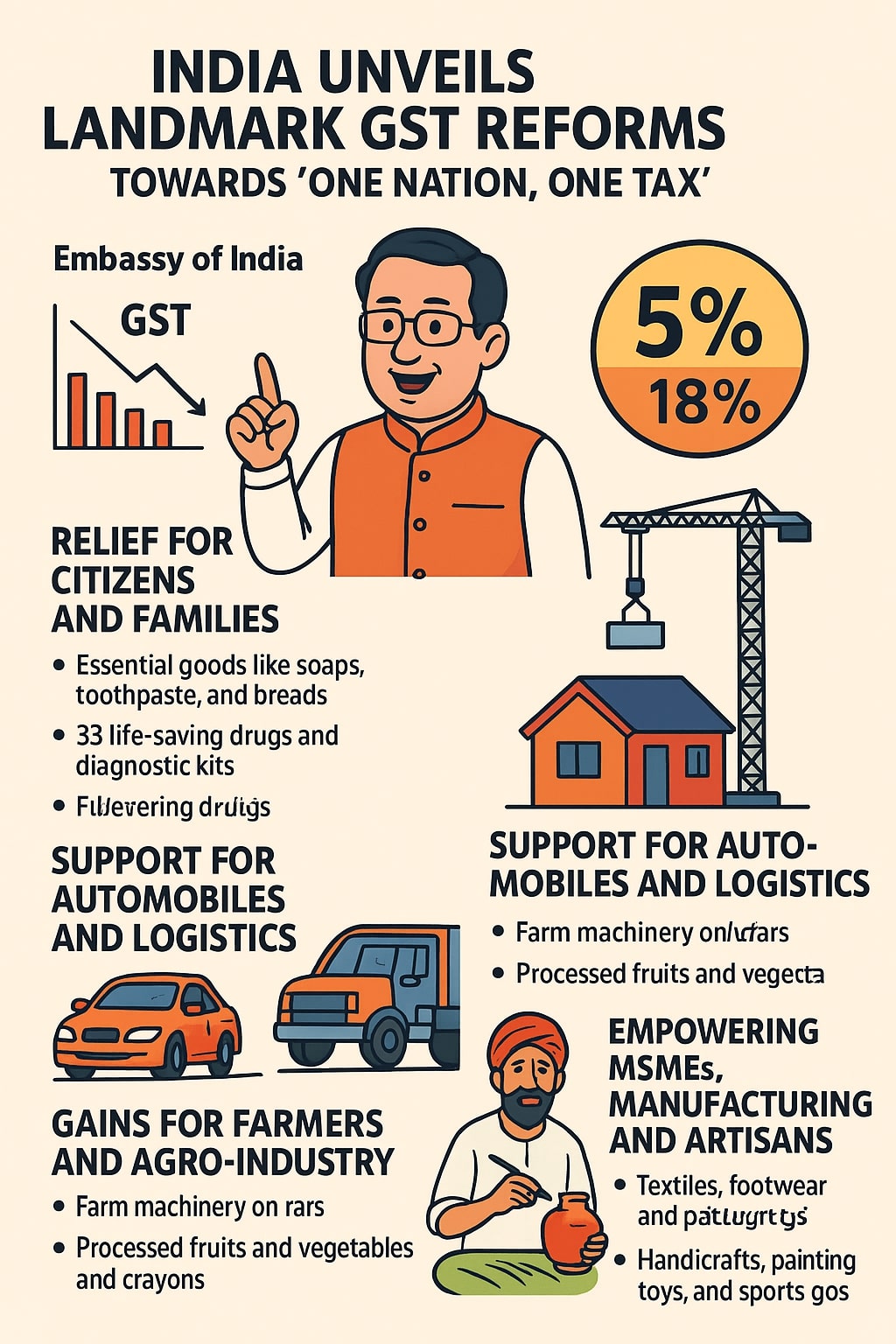
The Goods & Services Tax (GST) Council of India, chaired by the Finance and Corporate Affairs Minister, has approved sweeping reforms to India’s GST structure—the most significant restructuring since its launch in July 2017. Effective from 22nd September 2025, the tax system will adopt a simplified two-slab framework of 5% and 18%, replacing the earlier four-tier structure.
Luxury and de-merit goods such as tobacco, aerated drinks, high-end cars, yachts, and private aircraft will continue to face a 40% rate, ensuring equity while maintaining transparency and simplicity for taxpayers. These reforms are designed to boost demand, reduce costs, support inclusive growth, and strengthen India’s economic momentum.
Relief for Citizens and Families
Households will enjoy tangible benefits from the new structure:
- Essential goods like soaps, toothpaste, and breads to attract only 0–5% GST.
- 33 life-saving drugs and diagnostic kits fully exempted.
- Traditional medicines (Ayurveda, Unani, Homoeopathy) reduced to 5%.
- Full exemption on life and health insurance premiums.
- Lower costs for education materials—exercise books, pencils, crayons moved to 0%.
- Affordable wellness and hospitality: hotels up to ₹7,500 (EGP 4,110), gyms, salons, barbers, and yoga services taxed at 5%.
Boost for Housing and Infrastructure
- Cement cut from 28% to 18%.
- Marble, granite, sand-lime bricks, bamboo flooring, and wooden packing cases reduced to 5%.
➡️ Lower housing costs, accelerated infrastructure projects, and job creation.
Support for Automobiles and Logistics
- Two-wheelers, small cars, buses, trucks, and auto parts down from 28% to 18%.
- Commercial goods vehicles reduced from 28% to 18%, cutting freight and supply chain costs.
➡️ Stronger manufacturing, affordable transport, and export competitiveness.
Gains for Farmers and Agro-Industry
- Farm machinery, irrigation equipment, and tractor components reduced to 5%.
- Processed fruits, vegetables, and nuts cut from 12% to 5%.
➡️ Lower production costs, reduced food wastage, and better farmer returns.
Empowering MSMEs, Manufacturing, and Artisans
- Textiles: man-made fibres cut to 5%, yarn to 5%.
- Footwear up to ₹2,500 (EGP 1,370) and leather job work down to 5%.
- Packaging materials reduced to 5%, easing MSME and e-commerce logistics.
- Handicrafts, paintings, toys, sports goods cut to 5%, uplifting artisan communities.
Building a Virtuous Growth Cycle
Lower costs will drive household savings and demand, while simplified rates will broaden compliance and revenues. GST collections have already doubled since 2017, reaching USD 26 billion in FY 2024–25 with over 15 million taxpayers.
Towards “One Nation, One Tax”
This reform is a decisive step in creating a taxation system that is simple, transparent, and equitable. By consolidating slabs and correcting anomalies, India reaffirms its vision of “One Nation, One Tax”—a framework supporting families, empowering businesses, and sustaining long-term economic growth.