By Nauman Ali
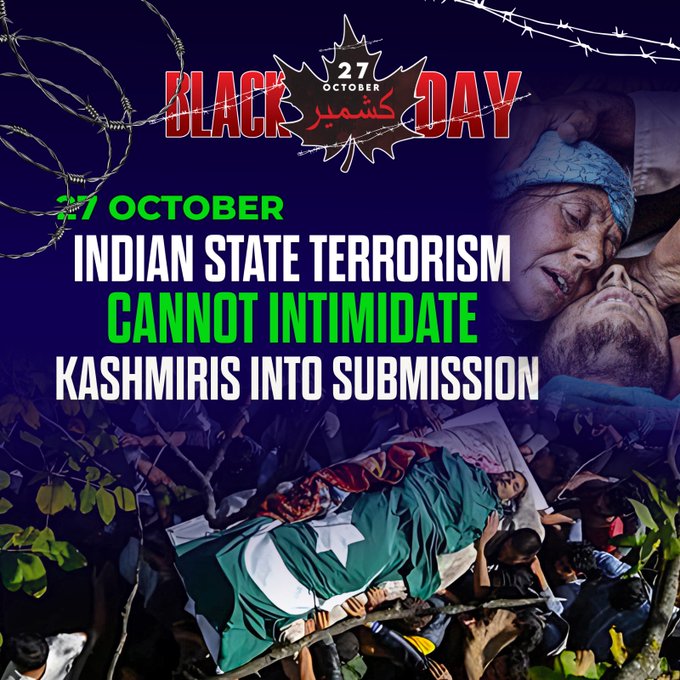
On October 27, 1947, Indian troops landed in Srinagar. That day marked a turning point for the people of Jammu and Kashmir — remembered ever since as Black Day — when their aspirations for self-determination were eclipsed by a military presence that evolved into decades of occupation.
The world did not remain silent. Indian leaders publicly pledged that the people of Kashmir would decide their own future. The dispute was referred to the United Nations, which prescribed a plebiscite under UN supervision as the legal mechanism for resolution. Yet those solemn commitments — binding under international law — were never fulfilled. This failure is not merely a historical grievance; it is a pressing issue of peace, justice, and global credibility.
In late 1947 and the years immediately following, India’s leadership — led by Prime Minister Jawaharlal Nehru — repeatedly affirmed that the people of Jammu and Kashmir would be allowed to determine their own destiny. New Delhi then brought the issue before the United Nations, which adopted Resolution 47 (1948) and related measures calling for demilitarization and a free, impartial plebiscite. These were not incendiary recommendations but practical steps to create the conditions for an authentic vote. Thus, the international community bears not only the duty to remember those words but to act upon them.
Instead of a credible plebiscite, Kashmiris have endured systematic repression and the erosion of political mechanisms. In recent years, UN reports have documented extensive human rights concerns in Indian Illegally Occupied Jammu and Kashmir (IIOJK) — including arbitrary detentions, enforced disappearances, restrictions on movement and expression, and a climate of impunity for security forces. These findings — carefully compiled by the Office of the UN High Commissioner for Human Rights — affirm that the issue is not only political but profoundly humanitarian. Calls for independent investigations and accountability from international rights bodies deserve far more than muted diplomatic acknowledgment.
The erosion of Kashmir’s political safeguards became even more evident on August 5, 2019, when New Delhi revoked the region’s limited autonomy and restructured its governance. This unilateral move was accompanied by mass detentions, prolonged communication blackouts, and intensified surveillance — measures that deepened the sense that representative politics had been hollowed out rather than restored. Observers warned that the combination of administrative re-engineering and new domicile laws could alter the demographic balance of the valley, raising existential concerns among local communities. This is not merely a domestic political issue; it is a change in the status of a territory long recognized by the United Nations as disputed.
To be clear: the call to implement UN resolutions and restore political dignity is not a call for violence or regional destabilization. It is a call to honor commitments. It is a principled insistence that the right to self-determination — the cornerstone of the modern international order — must not be allowed to fade through neglect. When promises made in the immediate post-war era are reduced to convenient historical footnotes, the consequences are predictable: grievances deepen, civic space narrows, and extremist narratives gain ground where legitimate political channels have failed. These dynamics are especially significant in a region shared by two nuclear-armed states.
Those who value rules and rights must pause before accepting routine elections under occupation as a substitute for the promised plebiscite. Voting held amid militarization, curtailed civil liberties, and restricted campaigning cannot realistically be compared to a free and fair exercise of self-determination. The UN framework explicitly envisioned neutral administration and demilitarization as preconditions — procedural safeguards designed precisely to ensure that the people’s will could be verified without coercion.
What can be done?
First, the international community must treat Kashmir as an issue of human rights and international law, requiring multilateral engagement. This does not mean imposing solutions without the people’s consent; it means reactivating the UN mechanisms created to guarantee a free and impartial plebiscite in Indian-occupied Jammu and Kashmir.
Second, an independent international investigation into reported abuses should be supported and allowed to function without obstruction.
Third, diplomatic pressure should aim not at punishment but at creating space for political rehabilitation — the release of political detainees, restoration of communication and civil liberties, halting demographic alteration, and ensuring credible safeguards for genuine political participation.
For Pakistan and for many Kashmiris, the terminology used is deliberate and precise: Indian Illegally Occupied Jammu and Kashmir. To readers familiar with international legal standards, this phrasing conveys a fundamental point — the imposition of authority without freely expressed consent. The early UN resolutions intended that it would be the people, not an occupying regime, who decide their future.
There is also a sober strategic necessity. Ignoring the unfinished question of Kashmir is not only a moral failure but a security risk. The line dividing the two nuclear powers must not remain a theatre of chronic injustice. The world has a stake in preventing escalation, and upholding the rule of law and credible political processes remains the most practical means of reducing that risk.
Every year on October 27, Kashmiris retell the same story, posing the same question:
Who will keep the promise?
This is not a rhetorical question but a moral summons — urging the international community to translate decades of commitments into tangible measures that restore the people’s agency at the heart of the conflict. Fulfilling this obligation would be a measured, lawful, and humane contribution to regional stability — and an act of justice long overdue.