 Dr. Hossam Badrawi ✍️
It is one of the ironies of our age that many who raise the banner of “freedom of expression” cannot tolerate the slightest divergence of opinion. The moment you analyze an idea or evaluate an era, the discussion slips away from substance and becomes an assault on the speaker—as if critique were treason, and intellectual disagreement a personal vendetta.
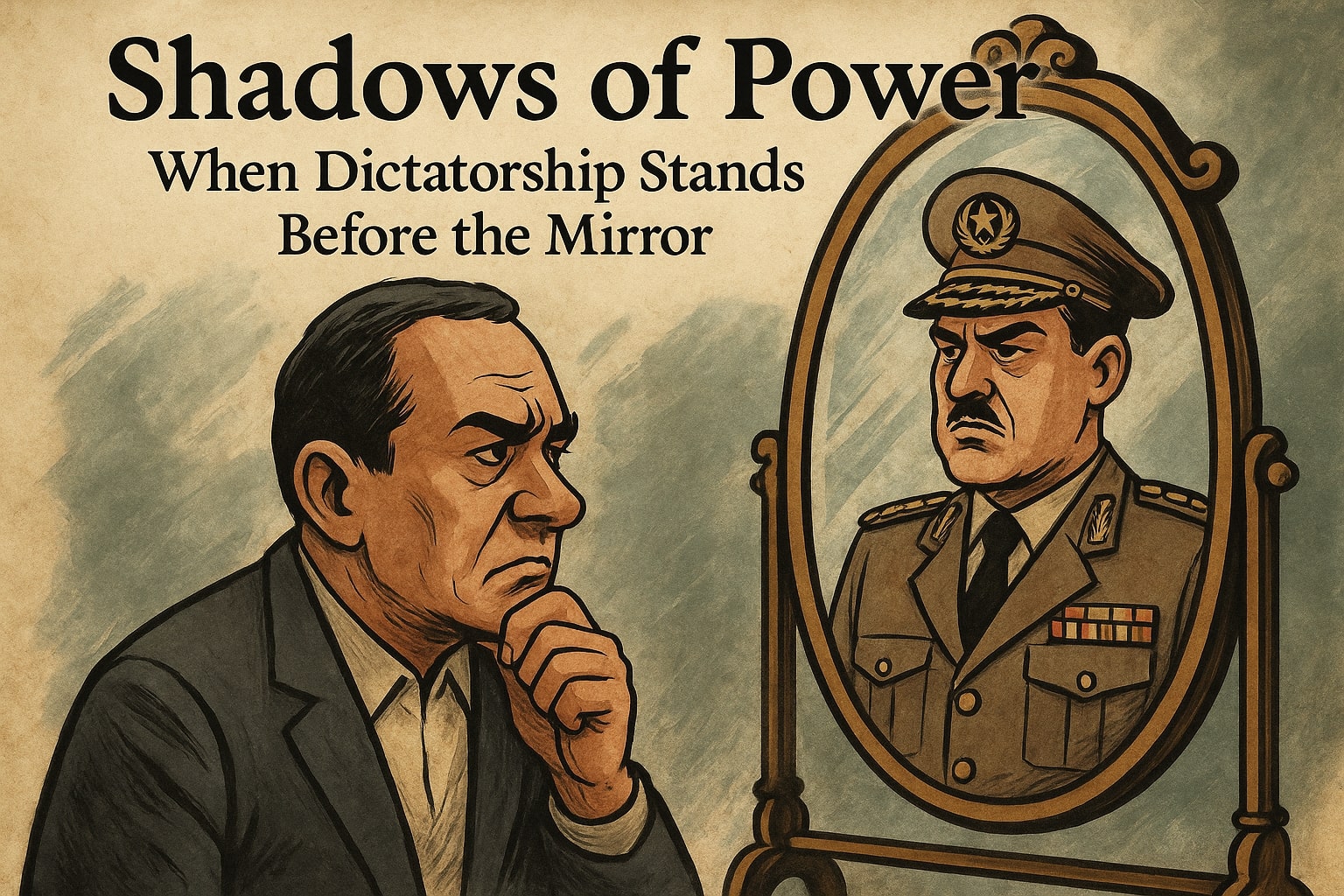
The latest example is the storm unleashed against former Foreign Minister Amr Moussa, simply for calling President Gamal Abdel Nasser a “dictator.”
His critics did not ask the essential question: What is a dictatorship?
Does its definition apply to Nasser’s rule or not?
Instead, the debate dissolved into blind sanctification of the “leader,” as though the leader transcends history, critique, and context—as though political concepts were stretchable clay shaped only by emotion and nostalgia.
What Is a Dictatorship?
In political science, dictatorship is a system where authority and decision-making concentrate in the hands of one man or a narrow circle, without real mechanisms of accountability or public participation.
Its pillars are unmistakable:
- No genuine political pluralism and no transfer of power through free elections.
- A controlled media landscape, where the voice of the state is the only permitted echo.
- Dismantling or weakening of parties, ensuring politics remains a one-lane road.
- Restrictions on public freedoms—press, assembly, expression—and the persecution of opponents through imprisonment, exile, or defamation.
Does This Describe Nasser’s Era?
Let us look without sentiment at Egypt in the 1950s and 1960s:
All political parties were dissolved after the 1952 Revolution and replaced by the state-led Arab Socialist Union, a single umbrella above the entire political sphere.
Media spoke in one collective voice—the state’s voice.
Elections were reduced to referendums of yes or no.
Opponents—capitalists, Islamists, communists, or even fellow Free Officers—faced arrest, imprisonment, or smear campaigns.
Nearly all key political and economic decisions flowed from the President and a narrow inner circle.
These are not mere anecdotes—they form a textbook definition of authoritarian rule.
The Paradox of Nasser: Dictatorship Draped in Charisma
And yet, Nasser remains unlike any other figure in modern Egyptian history.
He embodied an extraordinary paradox:
a charismatic leader adored by millions, and a ruler whose system centralized absolute power.
His voice stirred the Arab imagination; his image became a vessel for collective dreams of unity, liberation, and justice. This emotional tide lifted the very system that restricted pluralism. Thus, Nasserism became a unique fusion—
dictatorship sustained not only by power, but by popular yearning.
Comparing Other Dictatorships
Consider Francisco Franco in Spain—rigid, clerical, suffocating, but lacking any magnetic appeal.
Or Pinochet in Chile—cold, ruthless, defined by torture and exile, not by vision or mass admiration.
Nasser was different. He paired absolute authority with fervent national love—an equation that made his era complex, powerful, and deeply human.
Calling a System “Dictatorial” Is Not an Insult
Describing a political system as dictatorial does not erase its achievements nor diminish the figure who led it.
It is a scientific classification, not a moral verdict.
Nasser himself admitted repeatedly that he was the ultimate decision-maker—“responsible for everything.”
His era ended with the devastating defeat of 1967, the loss of Sinai, and the displacement of Canal residents—a reminder that centralized power often collapses under the weight of its own unchecked certainty.
Dictatorships may offer bursts of short-term efficiency, but without rotation of power, they inevitably slide into personal rule, surrounded by layers of opportunists who survive only by allegiance, not merit.
The Long Shadow of Nasser’s System
Nasser’s model did not vanish when he did.
It became a template for governance in Egypt and across much of the Arab world.
Even as economic philosophies shifted—from Nasser’s socialism, to Sadat’s infitah, to Mubarak’s privatization—the architecture of power remained: a dominant party, a controlled political sphere, and a state-shaped media narrative.
This legacy echoed throughout the region in systems centered on:
- The single leader
- Or the single ruling family
- Or the single party
Different names, same formula.
Why the Outrage, Then?
If a nation—East or West—fits the definition of concentrated power without accountability, without pluralism, without free opposition or true constitutional respect, then it is a dictatorship.
It is not an accusation—
It is a description.
So why the uproar when the definition is simply applied to reality?
Why do we defend words rather than confront truths?
Perhaps because acknowledging the structure is more painful than arguing over the name.