 Chief editor writes ✍️
CONDEMNATIONS are no longer political events; they have become echoes chasing a world that moves faster than statements can follow. With Israel’s unilateral recognition of what it calls the “Republic of Somaliland”—a region unrecognized by the international community—the wave of reactions was immediate. Egypt stood notably firm, declaring unequivocal rejection of any unilateral measures that undermine state sovereignty and territorial integrity. Yet the deeper question is not what Egypt said—
but why has condemnation itself become irritating… even suspicious?
1️⃣ A Recognition That Goes Beyond Law — Toward a Hidden Political Engineering
Israel’s step was not a diplomatic whim.
Unilateral recognition—absent global consensus or negotiation with Mogadishu—opens the door to a dangerous precedent: granting political legitimacy outside international institutions, to regions suffering institutional fragility in exchange for security or economic leverage.
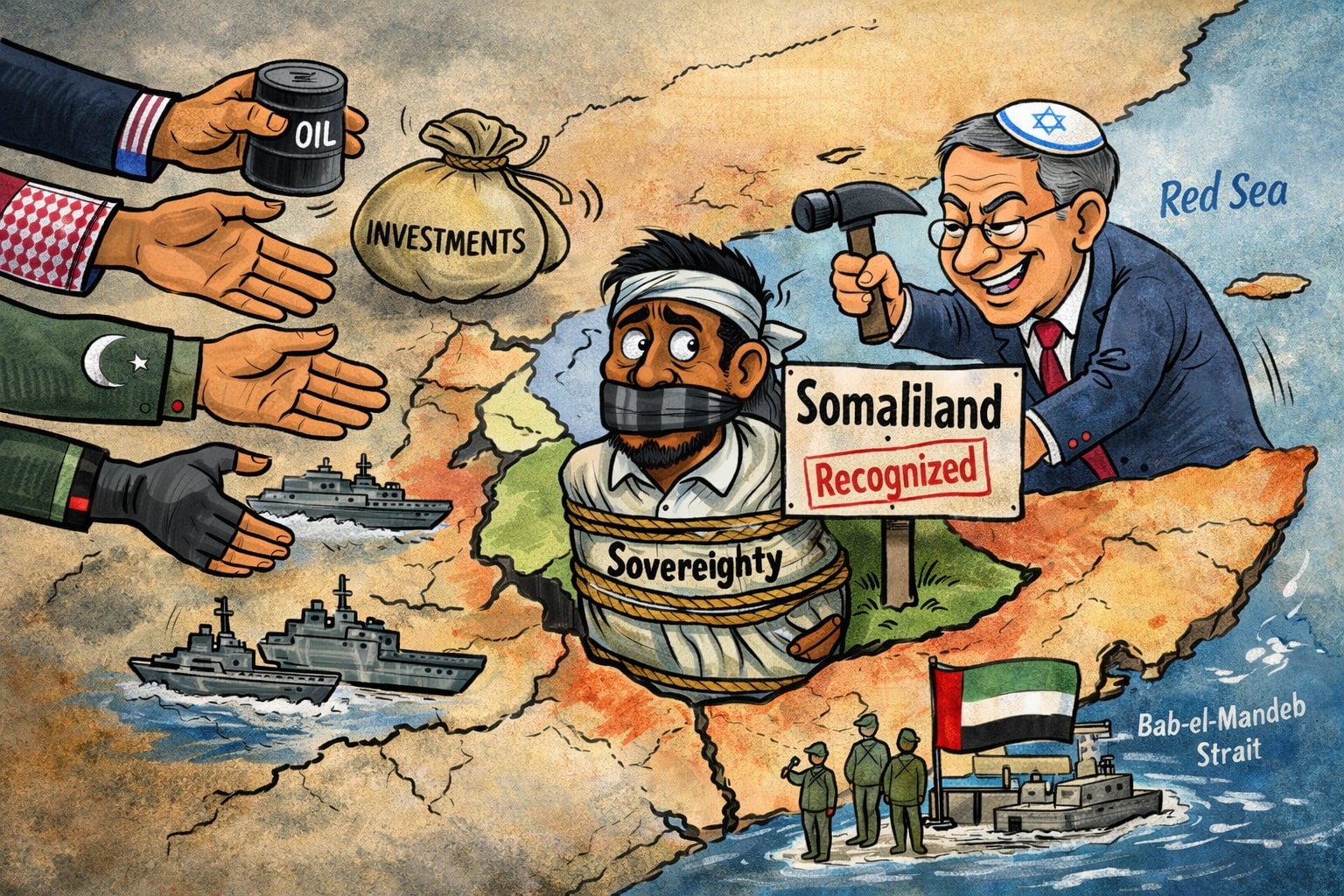
In essence, Israel did not grant Somaliland a state; it granted itself a foothold in the Horn of Africa—on coastal terrain only hundreds of kilometers from one of the world’s most strategic arteries: Bab al-Mandeb, where a significant share of Middle Eastern, African, and Asian commerce flows.
2️⃣ Somalia — a State Fighting to Survive
Amid the noise, Somalia—the sovereign state—continues to fight to rebuild institutions, reconnect its regions, and regain international standing.
Mogadishu understands that political fragmentation often begins with a narrative fracture before a map is altered.
Egypt’s condemnation therefore is not merely a diplomatic courtesy; it is a defense of a foundational rule of African and Arab political existence:
Once the unified state collapses as a principle, identities become “projects” available for execution using external financing, not popular will.
3️⃣ The UAE — Investor, Power Broker, or Regional Architect?
No reading of this moment is complete without considering the United Arab Emirates.
For years, the UAE has maintained presence in the region through ports, investments, and security agreements—most notably Berbera Port and the infrastructure that turns it into a commercial alternative connecting Ethiopia to the sea without going through Somalia itself.
The question is not: Is the UAE supporting secession?
The real question is:
Does Arab economic presence in Africa represent a cohesive regional project… or scattered national agendas seeking leverage?
The absence of a unified Arab strategy in the Horn of Africa has turned the Gulf into a set of competing economic actors—not a single geopolitical bloc capable of preventing Israeli, Turkish, Iranian, or Western strategic expansion.
4️⃣ Turkey, Qatar, Ethiopia — A Dance Around Geography
Turkey has been deeply present in Somalia for a decade—hospitals, development, and the largest military training base building a new Somali army.
Qatar invests in institutions and civil society.
Ethiopia—the heavyweight neighbor—seeks a maritime outlet at any cost, even through direct deals with the breakaway region or quiet diplomatic maneuvering.
All of these moves unfold while the traditional Arab-African custodians of the Red Sea—Egypt and Sudan—remain constrained by internal and regional pressures. A vacuum was formed, ready to be filled by whoever arrives with capital and intent.
5️⃣ Why Has Condemnation Become “Irritating”?
Because it no longer changes anything.
Because it resembles standing before a speeding train, raising a hand to warn—without the power to slow it.
What if, instead of responding, the Arab world possessed:
- A joint African–Arab economic initiative in the Horn
- An Arab development-security partnership with Mogadishu
- A Red Sea Stability Fund
- A unified African–Arab strategy below the equator
The painful truth:
Other powers move to shape; Arab powers move to oppose.
6️⃣ Africa’s Maps Are Returning to the Printer
Today, maps of influence are quietly being rewritten.
The Horn of Africa is transforming into a geopolitical laboratory:
- Israel seeks maritime and intelligence depth
- Ethiopia seeks a lung toward the sea
- The UAE seeks logistical corridors
- Turkey seeks economic-ideological reach
- Western powers seek secure trade routes
- And the Arabs… are writing statements
7️⃣ What Does Israel’s Recognition Mean for the Arab World?
It is an alarm bell.
Not solely because of Somalia, but because precedents rarely stop at their first victim.
If this unilateral recognition becomes normalized, tomorrow’s arena may be:
- The Sahel
- Libya
- Sudan
- Yemen
- or fragile Arab borders still awaiting a completed state project
8️⃣ Egypt — The Memory of Geopolitical Instinct
When Egypt warns that Israeli recognition undermines global peace, it is not only citing international law; it is citing history.
Cairo has seen small political fractures lead to continental collapse—Balkanization is not a metaphor; it is a warning.
Egypt understands that the Red Sea is a lifeline of its national security—and any foreign foothold on its western shore is a long-term threat, even if marketed as commercial partnership.
Conclusion — From Condemnation to Strategy
Condemnation is the minimum threshold.
But the modern world does not reward the minimum.
If the Arab world wishes to remain a player rather than an observer, it must evolve into:
- A structured Arab project in the Horn of Africa
- A joint economic-security coalition
- Offensive diplomacy, not defensive rhetoric
- A vision that treats Africa as natural extension, not competitive terrain
The region now faces a defining question:
Will the Arabs watch as the map is redrawn?
Or will they return to history—not as a memory, but as a maker?