Ashraf AboArafe
Cairo — An international seminar organized by the Directorate of Islamic Affairs at Indonesia’s Ministry of Religious Affairs, within the framework of the 57th Cairo International Book Fair (CIBF), underscored the strategic role of zakat and waqf in fostering social harmony and sustainable community development.
Held on Saturday, January 24, 2026, under the title “Social Harmony and the Management of Zakat and Waqf,” the event formed part of Indonesia’s cultural and intellectual contribution to the Middle East and North Africa’s largest book exhibition.
A Renewed Waqf for a Changing Society
The seminar was conducted in two sessions at the Egypt International Exhibition Center (EIEC).
The first session, hosted in Hall 1, featured Ahmad Zubaidi, Vice Chairman of the Indonesian Waqf Board (BWI), alongside academic and author Ibn Sina, whose book “Indonesia and Its Endowments: From Popular Heritage to National Resilience” explores the historical and social evolution of waqf in the archipelago.
Zubaidi highlighted Indonesia’s vast waqf potential, particularly through the development of cash waqf linked to government sukuk, as well as the use of digital innovation via the “Satu Wakaf” application to ensure transparency and ease of participation.
“Waqf in Indonesia is continuously evolving through legal reform, digitalization, and strategic utilization, directing its benefits toward education, social welfare, and community economic empowerment,” he said.
Ibn Sina emphasized that waqf practices in Indonesia originated from grassroots social traditions rooted in solidarity, before gradually transforming into an institutionalized system that continues to reinforce communal values and social cohesion.
Social Harmony as a Development Philosophy
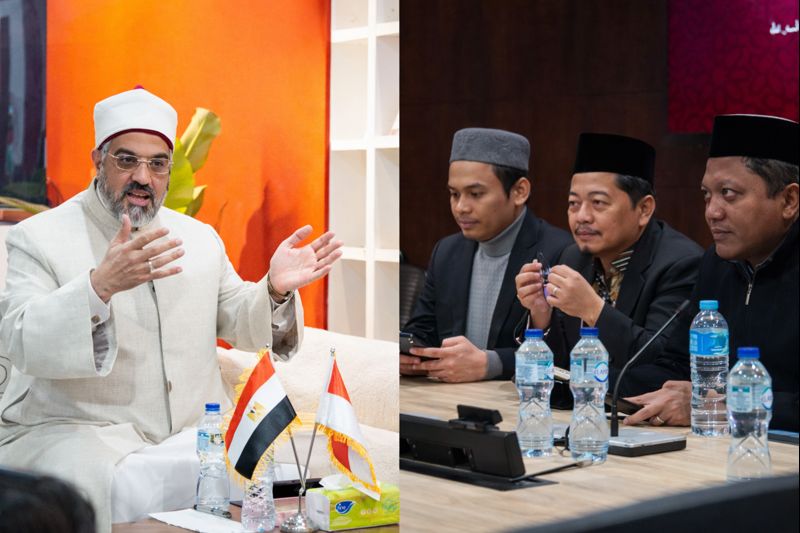
The second session, held at the Indonesian Pavilion, featured Egyptian scholar and social thinker Sheikh Amr Al-Wardani, who addressed social harmony as a fundamental pillar for the sustainable management of zakat and waqf.
He introduced the “5G” framework as five pillars of social harmony: clarity of purpose and vision, ethical seriousness, governance based on competence and skill, quality of implementation, and the beauty of human values.
“Social harmony does not emerge spontaneously,” Al-Wardani noted. “It is built through value-driven management of zakat and waqf that delivers genuine benefit to society.”
Indonesia’s Message of Moderate Islam
In a related statement, Ismail Noor, Head of the Holy Qur’an Printing Unit at Indonesia’s Ministry of Religious Affairs, affirmed that Indonesia’s participation in the Cairo International Book Fair represents a significant opportunity to present the country’s Islamic intellectual heritage to a global audience.
He highlighted the introduction of the Sign Language Qur’an for the hearing-impaired, alongside scholarly works reflecting Indonesia’s vision of moderate, open, and tolerant Islam, as well as the concept of ecotheology, which promotes harmony between humanity and nature.
“Through this platform, we aim to foster direct dialogue with audiences across the Middle East and North Africa, exchanging ideas on education, zakat, waqf, and Indonesia’s experience in managing pilgrimage affairs,” he said.
A Growing Global Interest
The seminar attracted Egyptian and Indonesian students, as well as international visitors, reflecting increasing global attention to zakat and waqf as instruments of ethical development and social solidarity.
The event reaffirmed Indonesia’s commitment to advancing these institutions as pillars of public welfare and social harmony, grounded in a comprehensive, moderate, and sustainable Islamic approach.