 Ashraf AboArafe writes
Strategic Overview
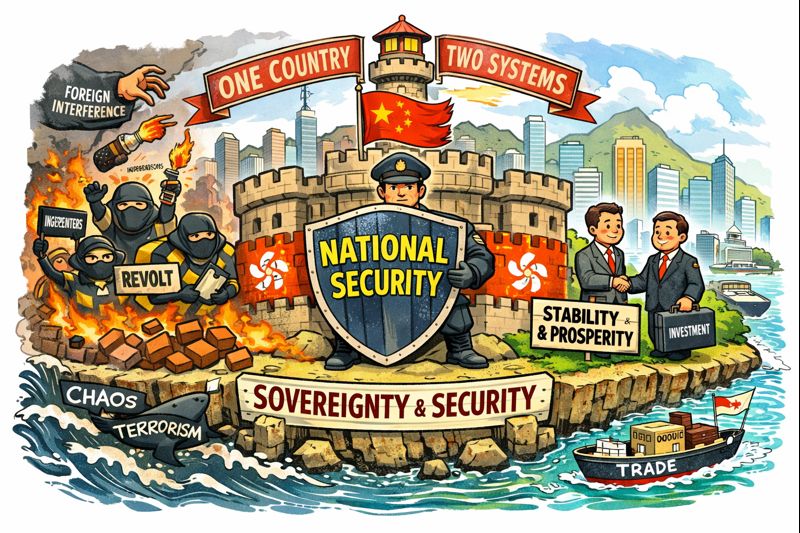
The February 2026 White Paper issued by the State Council Information Office of the People’s Republic of China represents more than a policy review; it is a doctrinal consolidation of Beijing’s security-centered governance model for Hong Kong under the framework of “One Country, Two Systems.”
Framed as both historical narrative and political justification, the document advances three interconnected arguments:
- National security is the precondition for prosperity.
- The central government bears ultimate authority over security matters.
- Stability achieved since 2020 validates the corrective intervention.
The White Paper thus serves simultaneously as:
- A retrospective defense of policy choices since 1997,
- A legal-political manifesto clarifying constitutional hierarchy,
- And a forward-looking blueprint linking security to development.
I. Historical Reframing: Sovereignty as the Core Narrative
The document situates Hong Kong’s contemporary governance within a long arc beginning with the Opium War (1840) and culminating in sovereignty restoration in 1997.
By invoking:
- The 1972 UN removal of Hong Kong from the decolonization list,
- The 1984 Sino-British Joint Declaration,
- The drafting of the Basic Law,
the White Paper reinforces a consistent thesis: sovereignty was never negotiable.
This historical framing accomplishes two strategic objectives:
- It delegitimizes “self-determination” rhetoric by portraying it as a colonial residue.
- It underscores that “One Country” precedes and conditions “Two Systems.”
The constitutional logic is clear: autonomy operates within sovereign integrity — not parallel to it.
II. Article 23 and the Security Vacuum
A central analytical pillar is the prolonged delay in implementing Article 23 of the Basic Law.
The 2003 withdrawal of national security legislation is portrayed as:
- A vulnerability exploited by domestic agitators,
- Amplified by hostile external actors,
- And culminating in systemic fragility.
Key episodes highlighted:
- 2014 Occupy Central movement,
- 2016 Mong Kok unrest,
- Legislative obstruction tactics,
- Emergence of explicit independence advocacy.
The White Paper frames these not as isolated protests but as escalatory phases in a sustained contest over constitutional order.
From Beijing’s perspective, the absence of Article 23 legislation created:
- Legal loopholes,
- Institutional weakness,
- Political radicalization.
III. 2019: The Existential Moment
The 2019 unrest is depicted as a watershed — an attempted “color revolution” that posed the greatest challenge to national security since 1997.
The document classifies the events into five categories of threat:
- Secessionism
- Subversion of state power
- Violent extremism
- Institutional paralysis
- Foreign collusion
This classification aligns with the structure of the Hong Kong National Security Law (2020) and signals the ideological coherence of Beijing’s security framework.
The White Paper’s language is emphatic:
- Violence is described as terrorism.
- International advocacy is labeled interference.
- Democratic obstruction is characterized as constitutional sabotage.
The narrative establishes 2019 as the decisive justification for direct legislative intervention by the central authorities.
IV. The Central Government’s “Fundamental Responsibility”
A critical doctrinal shift emphasized in the paper is the assertion that:
The central government bears the “fundamental responsibility” for national security in Hong Kong.
This reinforces constitutional hierarchy:
- The PRC Constitution holds ultimate authority.
- The Basic Law derives from it.
- Autonomy exists within — not above — central jurisdiction.
This framing operationalizes the concept of “overall jurisdiction” — a term increasingly central in Beijing’s governance vocabulary.
V. From Disorder to Stability: Security as Economic Infrastructure
The White Paper’s most consequential claim is that security is not a constraint, but a growth enabler.
It links post-2020 stability to:
- Restored investor confidence,
- Improved governance efficiency,
- Institutional restructuring under “patriots administering Hong Kong,”
- Renewed integration with mainland development strategies.
The message to international markets is deliberate:
Security = Predictability
Predictability = Investment
Investment = Prosperity
Hong Kong’s 7.5 million residents are presented as beneficiaries of restored order rather than subjects of curtailed liberties.
VI. The Philosophical Recalibration of “One Country, Two Systems”
The White Paper signals an evolution in interpretation:
Earlier understanding:
High degree of autonomy within sovereign China.
Current articulation:
Sovereignty and security as the supreme principle guiding autonomy.
Security now functions as:
- The guardrail,
- The calibration mechanism,
- And the strategic anchor of the policy.
The formulation “high-standard security for high-quality development” encapsulates this recalibration.
VII. International Dimension
The document explicitly rejects foreign criticism, framing external reactions as:
- Politicized distortions,
- Attempts to weaken China,
- Interference in sovereign affairs.
This aligns with China’s broader diplomatic doctrine emphasizing:
- Non-interference,
- Sovereign equality,
- Rejection of “double standards” in human rights discourse.
Hong Kong thus becomes not merely a regional governance issue but a symbolic frontier of global ideological contestation.
Concluding Assessment: Security as Structure, Not Episode
This White Paper is less a defensive explanation and more a structural doctrine.
It codifies:
- The primacy of sovereignty,
- The centralization of security authority,
- The fusion of stability and economic development,
- The permanence of national security law as institutional architecture.
In geopolitical terms, Hong Kong has transitioned from:
A laboratory of hybrid governance
to
A stabilized node within China’s unified security-development paradigm.
The overarching thesis is unmistakable:
Without security, no prosperity.
Without sovereignty, no autonomy.
Without central authority, no constitutional order.
The White Paper asserts that Hong Kong’s future lies not in contesting these premises — but in consolidating them.