Ashraf AboArafe
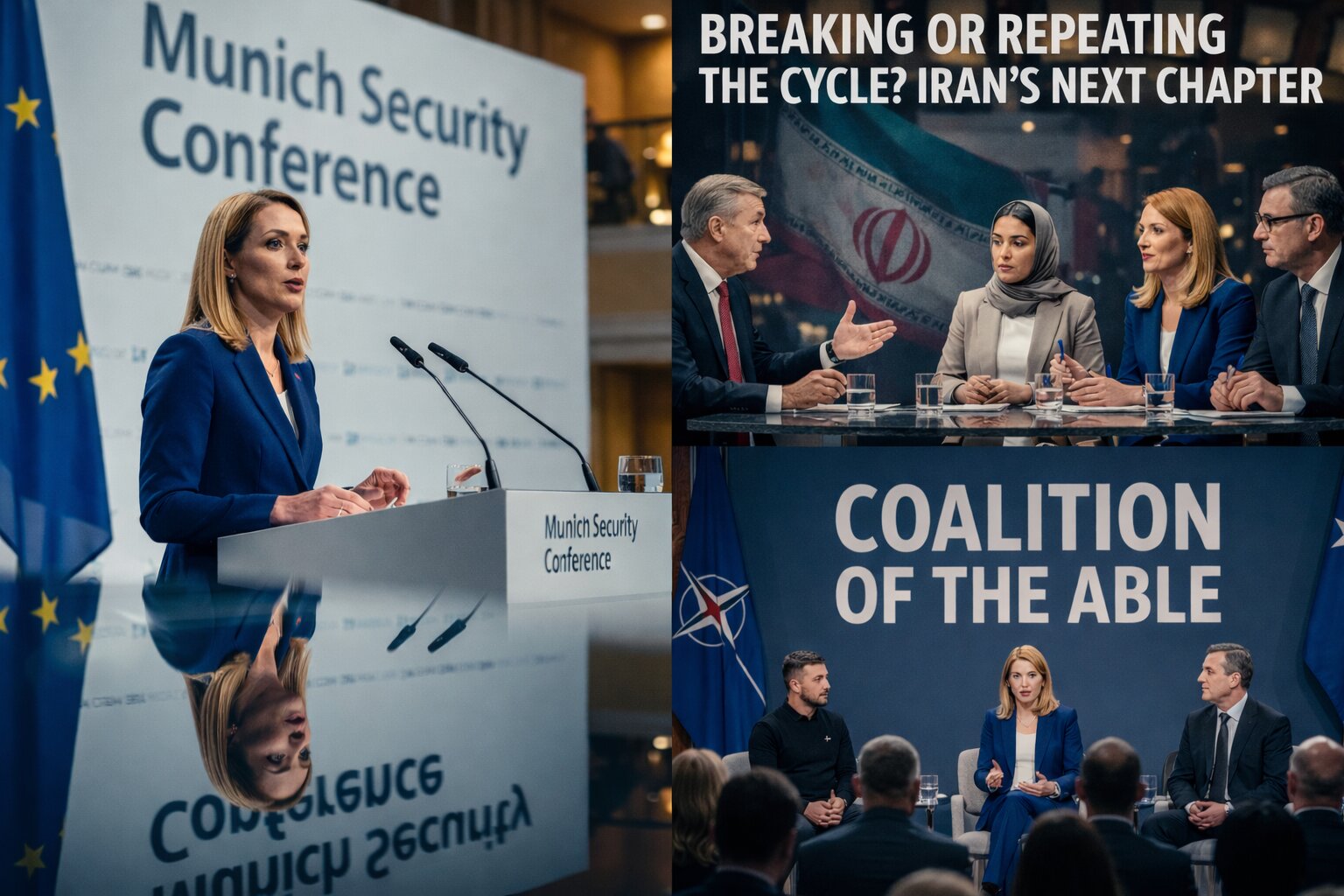
IN the heart of Munich, where winter air carries the weight of history and hard power, Roberta Metsola arrives at the Munich Security Conference not as a ceremonial guest, but as a distinctly European voice seeking resonance amid global turbulence.
This year’s conference unfolds at no ordinary moment. From Ukraine’s battlefields to Middle Eastern fault lines, from shifting alliances to an increasingly fragmented international order, the stakes are high. Metsola’s presence signals something deeper: the European Parliament is no longer content with being a legislative actor confined to Brussels—it is asserting itself as a geopolitical participant.
Iran: Breaking the Cycle or Repeating It?
At Friday’s live discussion organized by CNN, titled “Breaking or Repeating the Cycle? Iran’s Next Chapter,” Metsola joins U.S. Senator Lindsey Graham, Saudi diplomat Manal Radwan, and Iran analyst Karim Sadjadpour of the Carnegie Endowment for International Peace, under the moderation of Christiane Amanpour.
The title itself poses an existential question:
Is Iran entering a new chapter of recalibration and engagement—or are we witnessing yet another turn in a familiar cycle of escalation, sanctions, and strategic brinkmanship?
Europe’s presence in this conversation is far from symbolic. The European Union played a central role in crafting the nuclear agreement and continues to view Gulf stability as intertwined with its own security. Metsola’s intervention is likely to underscore a European approach grounded in strategic autonomy, calibrated diplomacy, and multilateral engagement rather than open confrontation.
“Coalition of the Able”: Europe’s Test of Resolve
On Saturday, the focus shifts eastward. In the keynote panel “Coalition of the Able,” Metsola will share the stage with Ukrainian President Volodymyr Zelenskyy and NATO Secretary General Mark Rutte, again moderated by Amanpour.
The phrase “Coalition of the Able” is more than rhetorical flourish—it is a challenge.
Who are the “able”? And is Europe prepared to count itself among them not only in declarations, but in capacity and commitment?
The debate on European defense and sustained support for Kyiv reflects a structural shift within the EU. Long perceived primarily as an economic powerhouse, Europe is now confronting the necessity of becoming a credible security actor. The war in Ukraine has redefined deterrence, sovereignty, and alliance politics, compelling Europe to rethink its strategic posture and its relationship with NATO and the United States.
From the Margins to the Center of the Table
These discussions come at a critical juncture, as the European Parliament pushes for a more influential and explicitly “strategic” European role on the global stage. Security is no longer confined to military doctrine; it is inseparable from energy resilience, sanctions regimes, migration pressures, technological sovereignty, and diplomatic foresight.
Munich this year is not merely a conference—it is a mirror reflecting a world in transition.
Between Iran’s uncertain trajectory, Ukraine’s enduring struggle, and Europe’s evolving defense ambitions, one question lingers in the corridors of Munich:
Will Europe remain an echo of greater powers—or become one of the defining voices shaping the next chapter of global order?