Ashraf AboArafe
IN a world where geopolitics often speaks the language of power and pressure, Indonesia chooses another vocabulary — one woven with faith, dialogue, and shared spiritual heritage.
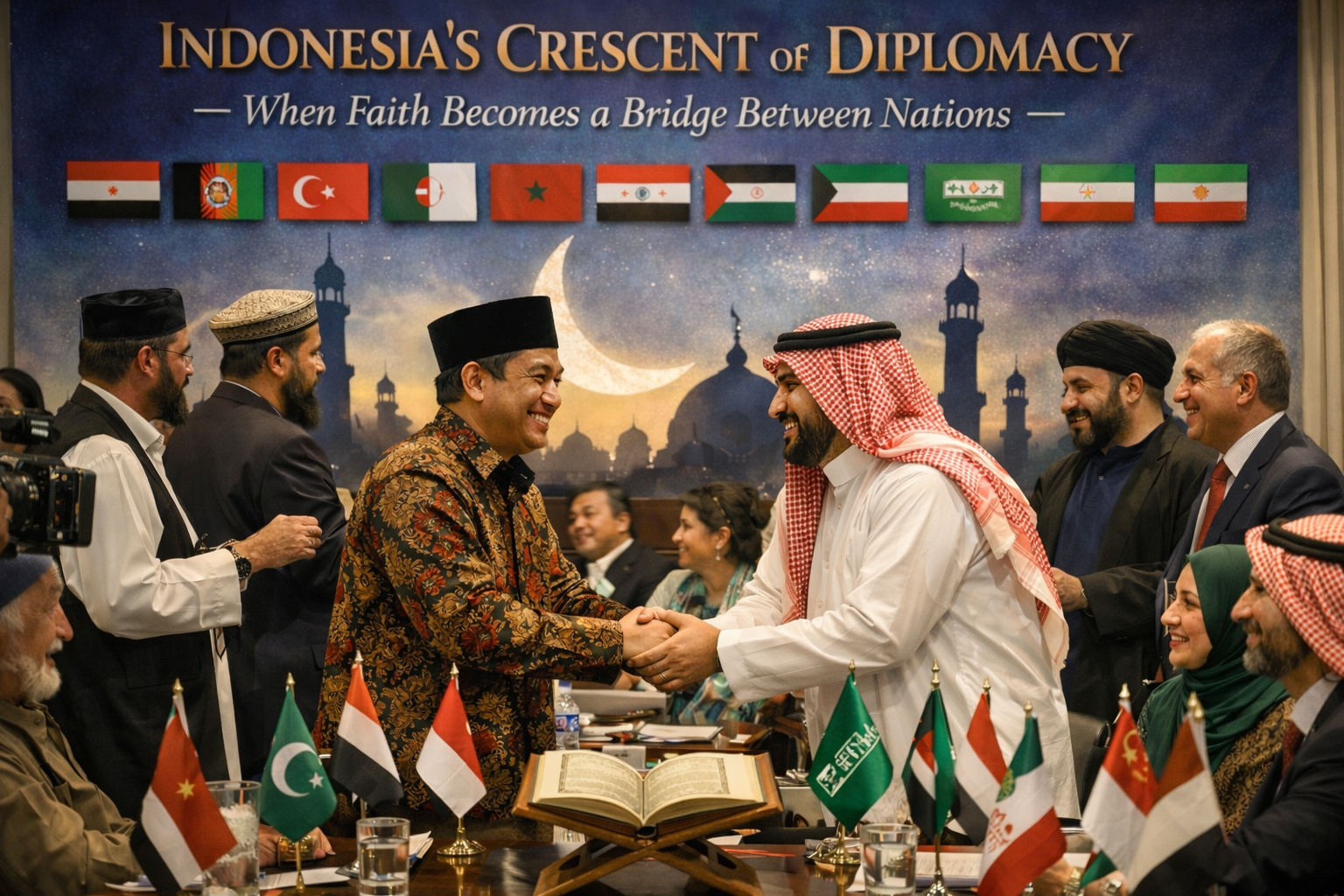
In Jakarta, the Ministry of Religious Affairs convened diplomats from twelve Muslim-majority nations in a focused gathering that signals a deliberate expansion of Indonesia’s religious diplomacy. Representatives from Egypt, Afghanistan, Turkey, Algeria, Morocco, Iraq, Pakistan, Jordan, Kuwait, Saudi Arabia, Yemen, and Iran gathered not to negotiate borders or trade tariffs — but to explore how faith-based cooperation can strengthen multilateral engagement.
Religion as Soft Power Architecture
Under the stewardship of Indonesia’s Directorate General of Islamic Community Guidance, the initiative reflects a strategic reimagining of religion as a diplomatic instrument. Rather than confining religious affairs to domestic administration, Jakarta is projecting them outward — transforming spiritual programs into channels of international cooperation.
The agenda was both symbolic and practical:
- International Quran recitation competitions
- Collaboration in zakat (alms) and waqf (endowment) management
- Clerical exchanges and Islamic seminars
- Cross-border mosque administration
- Services for diaspora communities
- Eco-theological environmental initiatives
- Moon-sighting coordination
This is not merely ceremonial diplomacy. It is institutionalized engagement — embedding faith within policy frameworks.
A Strategic Positioning in the Muslim World
As the world’s largest Muslim-majority country, Indonesia occupies a unique moral and demographic position. By convening Middle Eastern, North African, and South Asian partners, Jakarta signals its ambition to act as a connector — geographically distant from the Arab heartland, yet spiritually central in global Islam.
Religious diplomacy here serves three overlapping purposes:
- Domestic Consolidation – Strengthening religious services and institutional credibility.
- Diaspora Engagement – Expanding transnational religious support networks.
- Multilateral Influence – Elevating Indonesia’s voice in Islamic affairs beyond Southeast Asia.
The inclusion of eco-theology and environmental protection adds a contemporary dimension. It suggests Indonesia is framing Islamic discourse within global sustainability debates — aligning faith with climate consciousness.
Faith as a Multilateral Platform
Secretary Lubenah’s framing of religious diplomacy as a platform for dialogue across social, cultural, and educational sectors underscores a broader shift. Religion is no longer treated as a purely theological domain but as a cross-sector connector.
This strategy mirrors Indonesia’s broader foreign policy tradition: moderation, mediation, and multilateralism. In a time of polarization across parts of the Muslim world, Jakarta positions itself not as a rival center of authority, but as a convening space.
Beyond Symbolism: The Test Ahead
The real measure of success will lie in implementation. Will these discussions translate into structured agreements? Will zakat and waqf management see standardized cooperation frameworks? Can moon-sighting coordination reduce recurring disagreements across countries?
If concrete mechanisms emerge, Indonesia may well institutionalize a new model of faith diplomacy — one rooted not in doctrinal competition, but in shared service delivery.
Conclusion: A Crescent Expanding
What unfolded in Jakarta was more than a focused group discussion. It was a quiet assertion of influence — the crafting of a crescent-shaped diplomatic arc stretching from North Africa to South Asia.
In an era defined by hard power rivalries, Indonesia is experimenting with a softer, subtler force: organized faith as foreign policy.
And in doing so, it reminds the international community that diplomacy can be built not only on interests — but also on shared belief.