 Chief editor writes
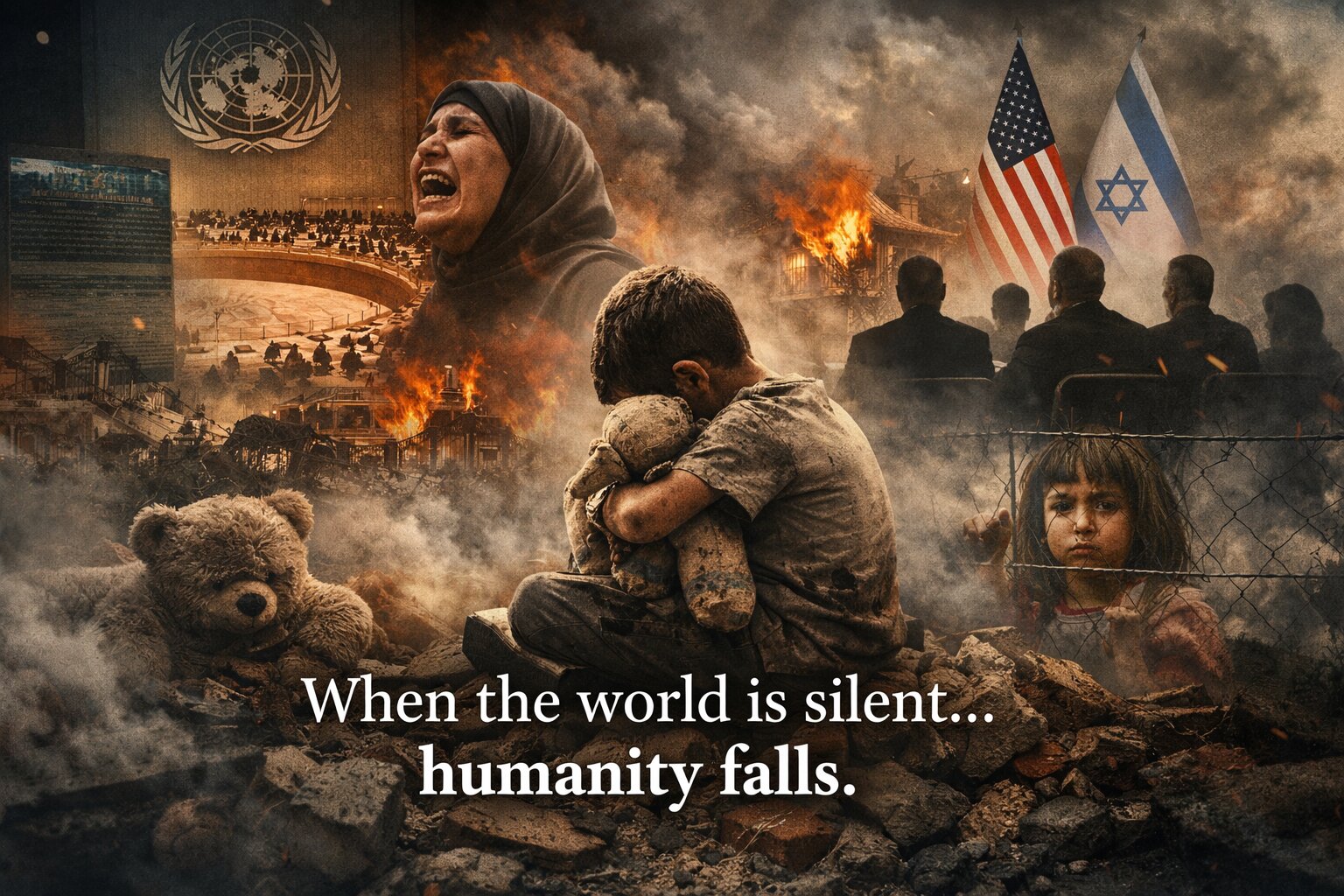
WHEN injustice becomes routine and suffering turns into ordinary imagery, we are no longer facing merely political crises, but a profound moral collapse.
From the United Nations to the United Nations Security Council, statements accumulate while reality remains unchanged:
power without restraint, and justice without teeth.
Selective Justice
What defines today’s global order is the selectivity of justice.
Actions condemned in one place are justified in another,
sanctions imposed on some while others act freely.
This raises a fundamental question:
Is justice a principle—or a tool?
From Iran to Iraq, Afghanistan, Syria, Lebanon, Yemen, Libya, and Sudan, a pattern persists:
bloodshed without a consistent standard of justice.
Power vs. Justice
In contexts involving Israel and the United States, the key question emerges:
Does power create legitimacy, or should legitimacy restrain power?
History answers clearly:
unchecked power becomes domination,
and empty justice becomes rhetoric.
Silence as Complicity
When states remain silent,
when institutions issue symbolic responses,
when suffering is reduced to interests—
silence becomes complicity.
Moral Foundation: Texts and Precedents
Qur’anic Verses
“And what is [the matter] with you that you do not fight in the cause of God and for the oppressed…”
(Qur’an 4:75)
“Indeed, God commands justice and excellence…”
(Qur’an 16:90)
“Do not let the hatred of a people prevent you from being just.”
(Qur’an 5:8)
“Stand firmly for justice… even against yourselves.”
(Qur’an 4:135)
Prophetic Hadiths
The Prophet Muhammad (peace be upon him) said:
“Support your brother, whether he is an oppressor or oppressed.”
He also said:
“Beware the supplication of the oppressed, for there is no barrier between it and God.”
He also said:
“Whoever wrongs a non-Muslim under covenant, diminishes his rights, or burdens him beyond his capacity, I will be his opponent on the Day of Judgment.”
Historical Precedents
- The statement of Umar ibn al-Khattab:
“Since when have you enslaved people while they were born free?” - The response of Al-Mu’tasim to the cry of an oppressed woman.
- The example of Ali ibn Abi Talib:
standing equal before the court with a Jewish man.
Final Insight
Silence in the face of injustice is not neutrality—it is complicity.
And justice that excludes some is not justice at all.