Editor-in-Chief Writes
At a moment where the threads of politics intertwine with security, and where regional and international interests collide, a complex landscape begins to emerge—one that goes far beyond its surface.
Between Pakistan’s movements toward Iran, and the parallel engagements led by Saudi Arabia, Turkey, and Qatar, the region appears to be quietly redrawing its balance of power. In the background, major actors such as the United States stand watch, while India observes the scene with calculated strategic detachment.
Here, conflicts are not merely managed… they are stress-tested, and the very definition of regional security is being reshaped.
First: Setting the Scene — What Is Changing?
We are witnessing a regional moment that cannot be understood through a single event, but rather through the convergence of three simultaneous dynamics:
- A negotiation track between the United States and Iran
- Parallel regional movements led by Saudi Arabia, Qatar, and Turkey
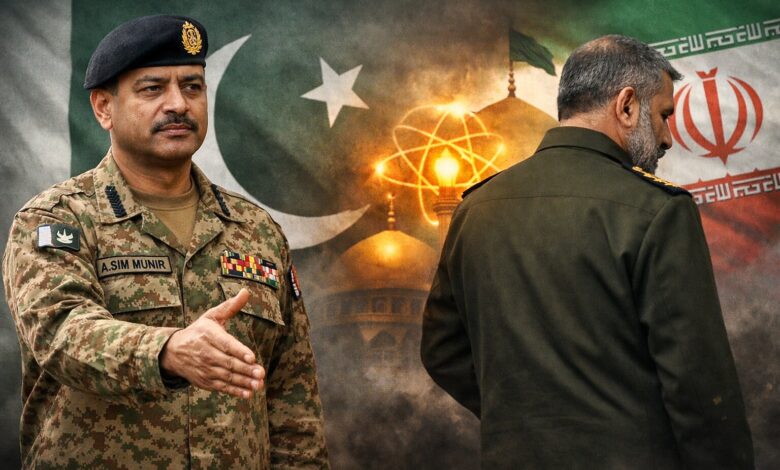
- The entry of a non-Arab military actor: Pakistan, through its Army Chief, Asim Munir
These elements do not operate in isolation; together, they are producing a regional order in transition.
Second: Why Has Pakistan Entered Now?
🔹 1. From Politics to Security
Asim Munir’s visit to Iran signals that the issue has moved beyond diplomacy into the realm of security and military calculus.
Pakistan, in this context, is not acting as a traditional mediator, but rather as:
An explorer of the limits of power and balance
🔹 2. An Indirect Representation of a Broader Axis
Pakistan operates within a network of overlapping interests that includes:
- Saudi Arabia
- Strategic coordination with Turkey
- Functional ties with the United States
Its presence, therefore, carries more than one flag—without formal declaration
🔹 3. A Dual Message to Iran
- De-escalation: Opening a direct military channel
- Deterrence: A subtle reminder of nearby nuclear capability
Third: Why Did Iran Avoid the Military Handshake?
The absence of a high-level Iranian military reception was the most telling moment.
🔻 Its implications:
- Refusal to grant full military legitimacy
- Rejection of external involvement in defining its security
- A signal of limited trust toward Pakistan’s intentions
Conclusion:
Iran is open to dialogue… but unwilling to allow others to redefine its security architecture.
Fourth: Is This a Sunni–Shia Conflict in the Making?
The simplified narrative of a grand conspiracy is misleading.
There is no concrete evidence of a unified plan led by Donald Trump and Benjamin Netanyahu to ignite a full-scale sectarian war.
However, reality is more nuanced:
- The Sunni–Shia divide is historically rooted
- It is:
- Sometimes exploited
- Sometimes contained
- Sometimes bypassed altogether
Identities are tools in the game—not the ultimate objective
Fifth: What Do Netanyahu and Trump Actually Want?
Benjamin Netanyahu
- Weakening Iran
- Fragmenting adversaries
- Preventing the formation of a unified regional bloc
Donald Trump
- Managing balances of power
- Reducing the cost of direct intervention
- Relying on regional partners
The result:
Not the ignition of war… but the management of conflict
Sixth: Where Does India Fit Into This Equation?
Here lies the most sensitive dimension.
🔹 1. India as the “Silent Beneficiary”
Any Pakistani engagement in western theaters:
- Reduces its focus on India
- Weakens its maneuvering capacity in Kashmir
🔹 2. Advantage Without Confrontation
India does not need war:
It only needs its rival to be distracted
to achieve strategic gains
🔹 3. Strengthening Global Position
- Closer alignment with the United States
- A growing role in Asian strategic balances
Seventh: Is There a Plan to Weaken Pakistan?
- No clear evidence of a direct, coordinated plan
- But there are intersecting interests
If Pakistan becomes entangled:
- India benefits
- The U.S. manages the balance
- Pakistan’s rivals gain breathing space
This is not conspiracy… but indirect engineering of outcomes
Eighth: Risks Facing Pakistan
- Multi-front pressure
- Iran
- Internal dynamics
- India
- Economic strain
- Potential internal fragility
Ninth: The Broader Interpretation
What we are witnessing is neither:
- A sectarian war
- Nor a single grand conspiracy
It is:
A struggle over who defines regional security… and who is allowed to sit at the table
Pakistan is testing the limits of its role.
Iran is resisting external redefinition of its security.
The Gulf is searching for balance.
Washington is managing the tempo.
Israel prefers fragmented adversaries.
India watches—and gains—silently.
Final Line for Publication:
“This is not a war being waged, but a balance being tested—where no actor is defeated at once, yet all are gradually exhausted… except those who master the art of waiting.”