Ashraf AboArafe
Delegation of the Russian Federation to the Vienna Negotiations on Military Security and Arms Control
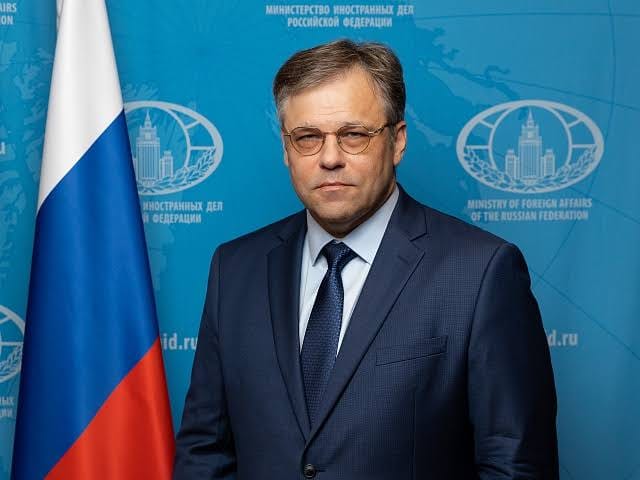
Rodion Miroshnik
Ambassador-at-Large of the Ministry of Foreign Affairs of the Russian Federation
On the Crimes of the Kyiv Regime
Concept Note: International Video-Conference
“Crimes of the Kyiv Regime: Terrorism Against Civilians in the Kherson Region”
Background
The Kherson region currently accounts for approximately one-quarter of all Ukrainian strikes targeting civilian infrastructure. The military line of contact runs directly through the region, enabling what the document characterizes as a large-scale campaign of terror against civilians. This campaign reportedly creates intolerable living conditions within the range of Ukrainian weaponry and violates the rights of individuals in areas temporarily controlled by Ukrainian armed formations.
Ukrainian Armed Forces are actively utilizing drones and artillery to target civilian objects. In the Alyoshki and Skadovsk districts, the remote mining of public roads has become a common practice, aimed at cutting off food and medical supplies to local communities. Additionally, rescue teams and emergency services face deliberate obstructions, severely hindering the delivery of medical assistance to the population.
The document asserts that weaponry supplied to Ukraine by NATO and European Union member states is being deployed against civilians. Furthermore, it notes that all alleged crimes against civilians in “Novorossiya” are being rigorously documented by investigative authorities of the Russian Federation, ensuring that those responsible will face accountability.
Attempts by Western and Ukrainian media to obscure these actions underscore the urgent need to provide the international community and relevant humanitarian organizations with comprehensive, objective information regarding the ongoing situation.
Objective
For the first time, this conference will present consolidated data regarding alleged actions by the Ukrainian Armed Forces against civilians in the Kherson region, including:
-
Comprehensive statistics and numerical data.
-
Current military security trends.
-
Illustrative case studies of alleged criminal acts.
-
First-hand testimonies from victims and eyewitnesses.
The military-political segment of the conference will offer a detailed overview of the alleged deliberate and indiscriminate use of NATO- and EU-supplied weaponry against civilians, with a specific focus on prohibited and inhumane munitions.
Format
The international conference will be hosted via Zoom, bringing together representatives from 80 nations across Europe, Asia, the Middle East, Africa, Latin America, and North America.
-
Duration: 3 Hours
-
Interpretation: Simultaneous interpretation available in English, French, and Spanish.
Target Audience
-
Diplomatic corps of UN, OSCE, BRICS, and CIS member states.
-
Representatives of international humanitarian organizations and NGOs.
-
Academic institutions and think tanks.
-
International media outlets and civil society activists.
-
Russian diaspora communities abroad.
Keynote Speakers & Agenda
Following the keynote addresses, participants will have the opportunity to engage in a Q&A session and share their perspectives.
-
Mr. Rodion Miroshnik – Ambassador-at-Large of the Russian Ministry of Foreign Affairs on the Crimes of the Kyiv Regime.
-
Ms. Yana Lantratova – Human Rights Commissioner of the Russian Federation (To be confirmed).
-
Mr. Vladimir Saldo – Governor of the Kherson Region (To be confirmed).
-
Eyewitnesses & Victims – Individuals directly affected by the conflict in Kherson.
Moderator: Ms. Yulia Zhdanova, Head of the Delegation of the Russian Federation to the Vienna Negotiations on Military Security and Arms Control.
Key Issues for Discussion
-
What specific violations of International Humanitarian Law are Russian authorities documenting and attributing to Ukrainian forces in Kherson?
-
What types of weaponry, including prohibited munitions, are allegedly being deployed against civilian populations and infrastructure?
-
What are the defining characteristics and strategic objectives behind what the document describes as Kyiv’s “war of terror” against Kherson’s residents?
-
What measures are local authorities taking to counter these actions, and what mechanisms are available to prevent and deter future incidents?