 Chief editor writes
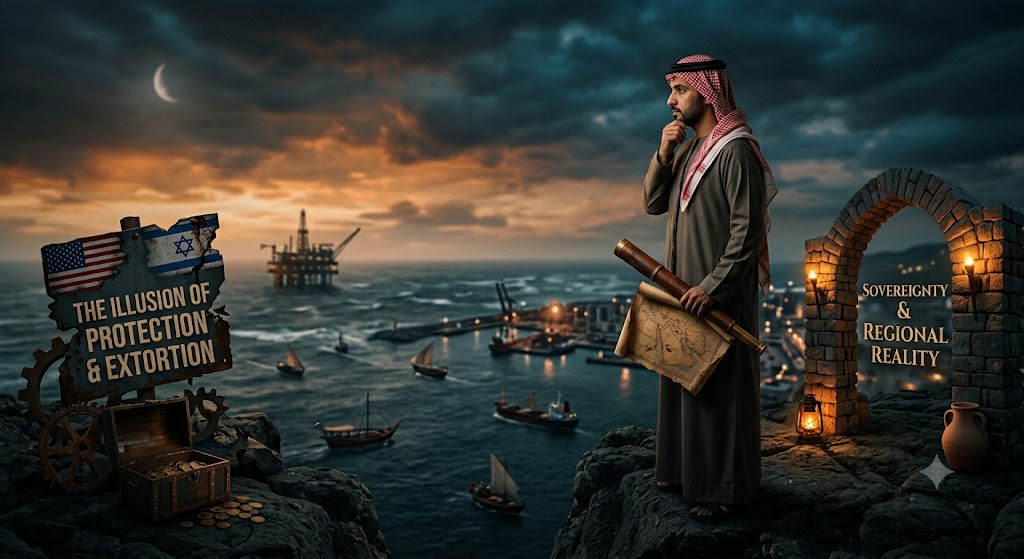
TODAY, the political and regional establishment in the Gulf faces a defining crossroads—one that acts as a sharp mirror to reality. The persistent reliance on a strategic alliance with the US-Israeli axis no longer reflects a calculated security precaution; rather, it reveals an inability to comprehend rapid, seismic geopolitical shifts.
1. The Iraqi Model: PR Rhetoric vs. Ground Realities
Iraqi political analyst Essam Hussein captures the equation in its simplest form:
-
Diplomatic Illusions: Signing 48 economic agreements with Washington is heavily promoted in the media as a grand gateway to prosperity, yet it failed to yield even a single megawatt of electricity for the Iraqi grid.
-
Geopolitical Realities: A brief engagement with Tehran delivered tangible results, tripling electricity supply hours—without political conditionalities or demands that compromise national sovereignty.
The Iraqi case offers a free lesson for the region: Washington sells promises, PR campaigns, and media statements, whereas regional dynamics are driven by geography, proximity, and practical necessity.
2. The Collapse of the US-Israeli Military Deterrent
Recent developments have exposed the vulnerabilities in relying on Western defense shields for regional security:
-
Deterrence Failure: Advanced defense systems repeatedly struggled to decisively intercept evolving missile and drone capabilities in the region.
-
Unachieved Objectives: Despite escalating rhetoric, the coalition failed to realize its core strategic goals—whether regime change, disabling critical infrastructure, or neutralizing regional influence.
3. Explicit Extortion and the “Strait Toll” Shocker
Recent statements regarding financial levies—such as imposing a 20% toll on vessels navigating strategic straits and waterways—are not mere campaign theatrics. They represent an explicit declaration of a “pay-for-protection” doctrine:
-
Resource Depletion: The alliance does not prioritize long-term regional stability; instead, it views the region as a financial reservoir and an energy vault to be leveraged.
-
The “Greater Middle East” Illusion: Redrawing the regional order is not designed to integrate Gulf states as equal partners, but rather as funding engines for broader expansionist and strategic agendas.
Conclusion: Will the Region Reclaim Its Strategic Autonomy?
“Geography is destiny, while alliances are choices.”
Foreign bases and air defense batteries cannot override the permanent realities of geography. A persistent posture of confrontation against neighboring states in favor of an external partner—one that treats the region as an endless source of revenue—serves as a final wake-up call to return to a balanced regional security framework built on mutual interests, rather than serving as a theater for proxy conflict.