 Ashraf AboArafe writes
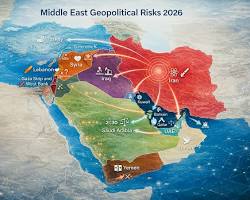
IN an era where the nations of the world strive to build their futures, strategies emerged from behind the scenes of past decades—not as mere ink on paper, but as a blueprint designed to reshape the Middle East. The revelation of the “Seven Countries” memo unveils a profound military and political shift that made targeting the concept of the “nation-state” the primary driver of regional crises. Today, we witness a living continuation of this vision, where present conflicts collide with past planning to dictate the future of the entire Arab world.
1. The Macro Strategy: Engineering Disintegration by Proxy
The memo revealed by General Wesley Clark was a doctrinal roadmap formulated within the corridors of the “Neoconservatives.” Following the heavy human and economic costs of the 2003 Iraq invasion, U.S. strategy shifted toward less costly yet far more destructive mechanisms: igniting internal conflicts, hollowing out sovereign state institutions, and imposing economic exhaustion.
2. The Seven Target Nations: From Blueprint to Reality
I. Iraq: The Anvil of Direct Intervention
-
Past: Served as the initial testing ground in 2003, where direct military invasion dismantled state institutions, disbanded the national army, and introduced a sect-based political system.
-
Present: Operates under a fragile political balance, heavily influenced by external powers and non-state armed actors.
-
Future: Risks remaining a permanent arena for proxy confrontations rather than a fully sovereign regional anchor.
II. Syria: The Heartland of Proxy Warfare
-
Past: Targeted following 2011 to sever the territorial bridge between Iran and the Levant, turning popular unrest into a multi-sided proxy conflict.
-
Present: Fragmented into distinct zones of control with foreign military footprints, crippled infrastructure, and severe economic sanctions.
-
Future: Faces the ongoing threat of formal or informal cantonization, transforming from a central regional power into a managed buffer zone.
III. Lebanon: The Economic and Institutional Siege
-
Past: Identified as a key node due to the presence of non-state armed factions opposing U.S. and Israeli regional posture.
-
Present: Suffers from total economic paralysis, persistent political vacancy, and direct military escalation on its southern border.
-
Future: Vulnerable to complete institutional collapse, forcing a redefinition of its historic sectarian power-sharing model.
IV. Libya: The Disassembly of the North African Shield
-
Past: Subjected to direct NATO air intervention in 2011, resulting in the rapid overthrow of the regime without a post-war stabilization plan.
-
Present: Divided between competing eastern and western administrations, each backed by foreign powers and local militias.
-
Future: Struggles against permanent geopolitical division and the exploitation of its energy reserves and maritime corridors.
V. Somalia: The Permanent State of Fracture
-
Past: Long targeted for its strategic position along the Horn of Africa, experiencing decades of intervention and governance vacuum.
-
Present: Continues to fight insurgencies while dealing with external pressure over its sovereign coastlines and maritime rights.
-
Future: Remains exposed to foreign maritime dominance and regional fragmentation along federal/clan lines.
VI. Sudan: The Dismantling of the Nile Basin
-
Past: Experienced systemic pressure that led to the formal secession of South Sudan in 2011, stripping the nation of major oil revenues.
-
Present: Engulfed in a devastating internal conflict between military factions, causing widespread displacement and destruction of state infrastructure.
-
Future: Threats of further territorial breakup that could destabilize the entire Red Sea and Nile Basin security architecture.
VII. Iran: The Final Target in the Chain
-
Past: Designated as the ultimate endgame of the 7-country strategy, intended to be isolated once its regional allies were dismantled.
-
Present: Encircled by regional instability, subjected to maximum-pressure economic sanctions, direct military frictions, and shadow warfare.
-
Future: Remains the central focal point of global and regional confrontation, where the outcome will define the balance of power across the entire Middle East.
3. The Future Horizon: Reshaping the New Middle East
If this trajectory proceeds without a unified regional project to restore equilibrium, the future of the Middle East will be defined by three structural shifts:
-
From Nation-States to Sub-National Cantons: The replacement of strong sovereign governments with fragile federations or ethnic/sectarian entities that are easily influenced from the outside.
-
Dominance Over Maritime Corridors: A strategic pivot toward controlling critical trade and energy chokepoints—such as Bab al-Mandab, the Red Sea, and the Suez Canal.
-
Escalating Burdens on Core States: Heavy security and economic pressure placed on the remaining stable core nations in the region to act as buffers against cross-border instability.
The memorandum was never just a archived document in the Pentagon; it was a blueprint through which the past transformed into a present lived in friction, shaping a future where the region’s geopolitical map continues to be redrawn.