 Ashraf AboArafe writes
THE ongoing dispute over Iran’s frozen foreign assets extends far beyond a standard financial disagreement; it remains one of the longest-running, most complex cases of economic coercion and geopolitical confrontation in modern history. While standard surface estimates cite $100 to $120 billion in locked liquidity, a comprehensive financial audit factoring in real estate, corporate equities, compounded interest, and opportunity costs since 1979 elevates the total claim closer to $200 billion.
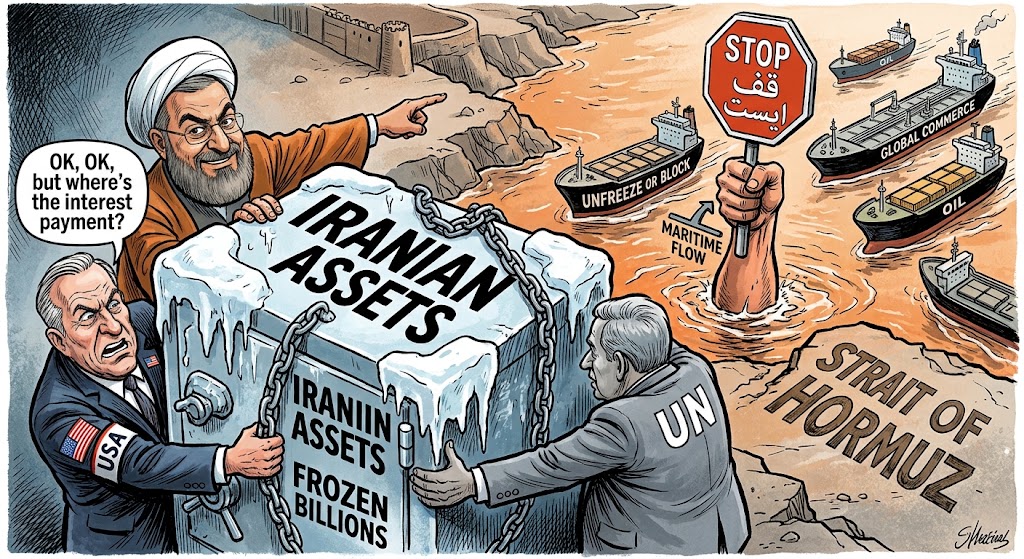
Faced with decades of systemic financial restrictions, analysts frequently question why Tehran does not abandon protracted diplomatic maneuvers in favor of a direct enforcement strategy: conditioning access to the Strait of Hormuz on the complete release of its sovereign wealth.
The Case for Strategic Leverage: Assets for Access
The rationale for linking asset restoration to maritime transit rests on a doctrine of sovereign deterrence, arguing that traditional legal remedies have proved insufficient against unilateral sanction regimes. Key arguments supporting this approach include:
-
Establishing Strategic Parity: Elevating the unconditional return of the $200 billion to a primary national security objective on par with nuclear and missile capabilities.
-
Leveraging a Vital Chokepoint: With approximately $20\%$ of global petroleum supplies passing through the Strait of Hormuz, conditioning passage for vessels tied to sanctioning nations creates immediate, asymmetric pressure on global energy markets.
-
Reciprocal Asset Countermeasures: Seizing or offsetting local and regional interests belonging to non-compliant states—independently or via partner economic blocs like BRICS—to balance unrecovered funds.
-
Humanitarian & Legal Counter-Claims: Framing financial freezes as collective punishment that obstructs access to vital medical and agricultural supplies, thereby asserting a moral imperative for sovereign retaliation.
Strategic Constraints and Operational Risks
Despite the theoretical strength of this tactic, converting maritime leverage into a permanent enforcement tool carries substantial strategic risks:
-
Risk of Open Military Escalation: Formal attempts to block or disrupt international shipping channels are viewed internationally as threats to freedom of navigation, raising the probability of direct armed conflict or international naval counter-measures.
-
Impact on Key Strategic Partners: Major Asian economies—including primary trade partners like China and India—rely heavily on energy transit through the Strait. Disruptions risk straining critical diplomatic relationships within organizations such as BRICS and the Shanghai Cooperation Organization (SCO).
-
Jurisdictional and Structural Fragmentation: Frozen assets are dispersed across various jurisdictions, banking institutions, and court rulings worldwide. A single maritime action cannot guarantee synchronized compliance across diverse foreign capitals simultaneously.
Reciprocating financial freezes with maritime restrictions in the Strait of Hormuz presents a high-stakes deterrence option. While it offers maximum tactical pressure, the associated risks of military conflict and economic fallout mean Tehran continues to weigh its deployment carefully within its broader foreign policy strategy.