Ashraf AboArafe
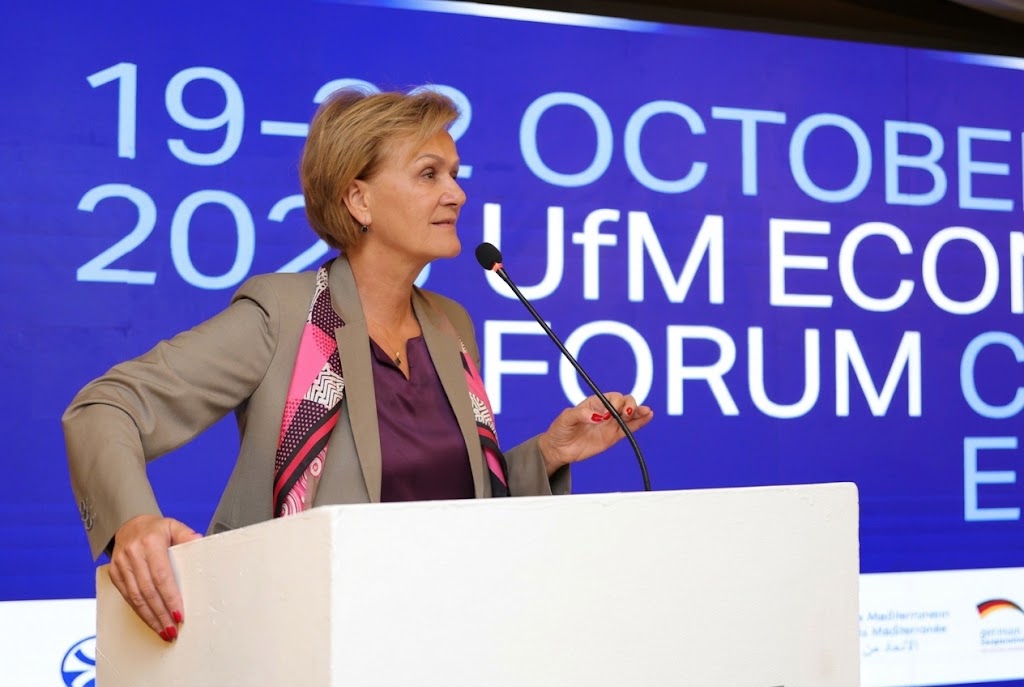
CAIRO — Ambassador Angelina Eichhorst, Head of the European Union Delegation to Egypt, has called for deeper Euro-Mediterranean economic integration, stronger trade and investment ties, and greater participation by young entrepreneurs in shaping the region’s economic future.
Delivering a keynote address at the Economic Forum of the Union for the Mediterranean (UfM) in Cairo, Eichhorst underscored the importance of consensus, intergovernmental cooperation and practical action in addressing shared regional challenges. She stressed that dialogue must translate into tangible progress, particularly in a region that continues to face significant barriers to trade, investment and economic integration.
Consensus and Intergovernmental Cooperation
Eichhorst described consensus as a cornerstone of the European Union’s approach to multilateral cooperation, acknowledging that reaching agreement takes time but emphasizing that inclusive consultation ensures all partners contribute to the process of integration and economic transition.
“Everybody is part of a process of integration, of transition, of the results we want to achieve together,” she said, highlighting the particular importance of this principle within the Union for the Mediterranean.
She also praised the UfM as a distinctive intergovernmental platform bringing together the European Union and its 43 Mediterranean partner countries. Beyond convening conferences, she said, the organization provides an essential space for direct engagement and collective problem-solving.
Emphasizing the value of face-to-face dialogue, Eichhorst noted that the region remains among the world’s least integrated in terms of trade and investment flows. Strengthening connectivity and economic cooperation, she argued, is an urgent priority that requires sustained political commitment and closer regional partnerships.
Rebalancing Trade and Expanding Investment
Reflecting on the Barcelona Process, launched in 1995, Eichhorst recalled the ambition that shaped the early years of Euro-Mediterranean cooperation. While acknowledging the progress achieved over the decades, she urged partners to accelerate their efforts in response to mounting regional and global challenges.
“We need to be faster; we need to work with much more urgency,” she said, calling for renewed momentum in trade, investment and regional integration.
The European Union remains a major trading partner for Mediterranean countries. Eichhorst noted that the EU absorbs 42% of exports from Mediterranean partner countries, while acknowledging concerns over persistent trade imbalances.
She stressed that improving these balances requires more than expanding trade volumes. It also demands investment-friendly conditions, stronger productive capacity, job creation and opportunities for Mediterranean economies to increase exports to European markets.
Egypt, in particular, was commended for advancing efforts to attract European investors and strengthen its trade and investment relations with the bloc.
Eichhorst also highlighted the need to dismantle regulatory and administrative obstacles that impede trade. Referring to the reports on European competitiveness and the single market by Mario Draghi and Enrico Letta, she pointed to the importance of reducing unnecessary layers of decision-making and addressing non-tariff barriers.
A more integrated Mediterranean economy, she suggested, will depend on making cross-border business easier, improving the investment climate and ensuring that economic cooperation delivers tangible benefits for both sides.
Sustainable Investment Facility and the Role of Private Capital
Addressing constraints on public financing, Eichhorst revealed that the European Union and Egypt were discussing a Sustainable Investment Facility Agreement (SIFA) designed to help respond to the growing need for investment across the region.
With public resources increasingly insufficient to meet development needs, she emphasized the importance of mobilizing private capital and establishing regulatory frameworks capable of encouraging sustainable, long-term investment.
“We need private investors to come in big time,” she said, stressing that investment policies must focus on improving living conditions across the region rather than benefiting only a limited segment of society.
The proposed framework reflects a broader challenge facing Euro-Mediterranean cooperation: how to mobilize sufficient financing for development while ensuring that economic growth generates jobs, expands opportunity and benefits communities across the region.
For Egypt and its Mediterranean partners, attracting investment will require continued efforts to improve the business environment, strengthen regulatory predictability and connect financing with productive economic activity.
Empowering Young Entrepreneurs and Small Businesses
Youth participation was another central theme of Eichhorst’s address. Drawing on her conversations with young Egyptians, she highlighted their calls for a more meaningful role in economic and political decision-making.
Young people, she observed, are asking to be taken seriously—not merely consulted, but included in the decisions that shape their future.
“I take these requests very seriously,” she said, underlining the importance of moving beyond consultation towards more substantive youth participation.
Eichhorst also praised the creativity and entrepreneurial potential of young people across Egypt and the wider Mediterranean region, particularly their ideas for small and medium-sized enterprises (SMEs) and start-ups.
She reaffirmed the EU’s commitment to supporting these businesses as they navigate the challenges of expansion, including access to finance, regulatory requirements and the practical steps needed to scale up their operations.
Supporting young entrepreneurs is not simply a matter of inclusion; it is an investment in innovation, employment and the region’s long-term economic resilience. Enabling SMEs and start-ups to grow can help broaden economic participation and unlock new sources of productivity and competitiveness.
Turning Dialogue into Action
Concluding her address, Eichhorst called on participants to sustain the momentum generated by the forum and translate discussions into concrete initiatives.
She emphasized that successful regional cooperation must bring together young people, experienced professionals, policymakers and investment partners around a shared agenda.
Welcoming the participation of trade and investment stakeholders, she encouraged delegates to pursue constructive discussions and maintain their commitment to practical cooperation.
Her message was clear: the future of Euro-Mediterranean integration depends on collective action, stronger investment partnerships, more balanced trade and the meaningful inclusion of younger generations.
As Cairo hosts discussions on the region’s economic future, the challenge is to turn shared ambitions into measurable results—creating opportunities for businesses, expanding employment prospects for young people and building a more connected and prosperous Mediterranean region.