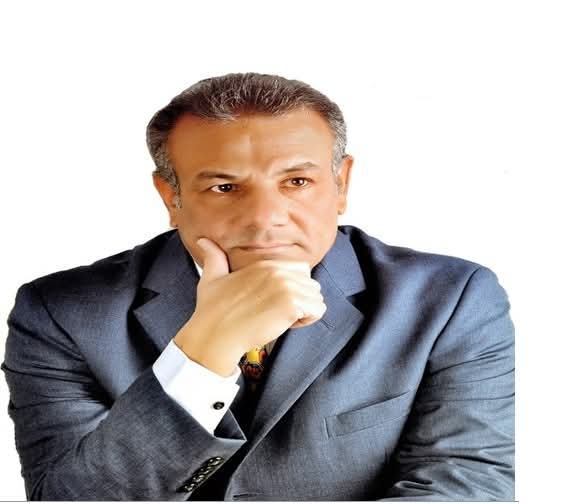
 Ashraf AboArafe writes
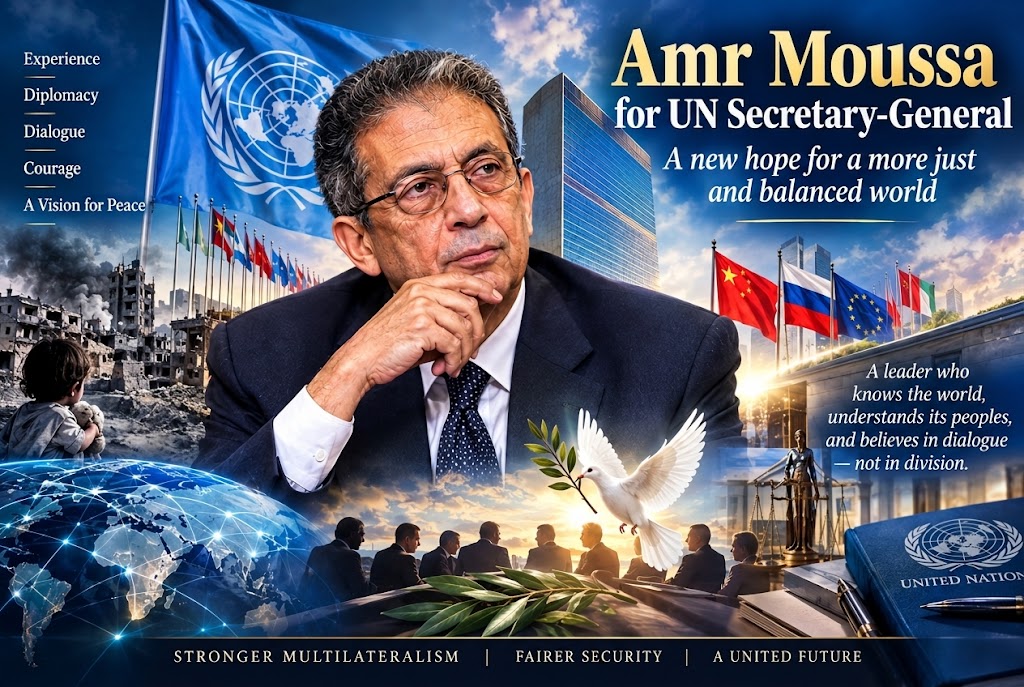
IN a world where wars multiply, the authority of international law recedes, and the distance between the spirit of the United Nations Charter and the realities of power grows ever wider, the idea of putting Amr Moussa’s name forward for the post of United Nations Secretary-General deserves to move beyond a journalistic question and become the subject of a wider international debate:
Does the world body need a man who knows both East and West, reads the maps of power, and speaks the language of diplomacy without ever losing the language of principle?
At first glance, the title may sound almost mythical:
“Pharaoh Moses” in New York!
Yet this is not a reference to the Pharaoh of ancient history, but to the Egyptian diplomat who bears the name Moses and who spent more than half a century moving through the corridors of Egyptian diplomacy, the United Nations and the Arab League — between capitals and crises, between the language of interests and the language of principles.
Amr Moussa has an exceptional diplomatic record. He joined Egypt’s diplomatic service in 1958, served at Egypt’s mission to the United Nations, later became ambassador to India and Egypt’s Permanent Representative to the United Nations, before serving as Egypt’s Foreign Minister from 1991 to 2001 and Secretary-General of the Arab League from 2001 to 2011.
That experience alone makes his name worthy of serious discussion at a moment when the United Nations is approaching a new chapter, with António Guterres’s term ending on 31 December 2026, and with the organization seeking leadership grounded in international experience, diplomatic skill and commitment to the principles of the Charter.
So, do these qualities apply to Moussa?
The answer belongs to the Member States. The record, however, shows that he spent decades inside the international system, rather than observing it from the sidelines.
Moussa… The Diplomat Who Never Feared the Fray
What distinguishes Amr Moussa in the Arab diplomatic memory is that he was never merely a functionary skilled at drafting official statements.
He became known for a direct political voice and a willingness to engage difficult questions, particularly the Palestinian issue, without closing the doors to dialogue.
At the 2001 United Nations World Conference against Racism, Moussa spoke openly about practices he viewed as connected with discrimination and racism in the context of the conflict, and criticized the withdrawal of the United States and Israel from the conference, stressing that success should never come at the expense of principle.
His public exchanges with Israeli officials likewise helped shape his image as a diplomat who did not regard diplomacy as a salon of polite pleasantries, but as a forum in which positions, rights and international law must be defended.
His manner could be calm, yet his message was unmistakably clear:
There can be no lasting peace built upon occupation, and silence cannot be imposed upon the victim as the price of keeping negotiations alive.
Perhaps this is one of Moussa’s defining qualities:
the ability to say “No” inside the diplomatic chamber without turning disagreement into a wall that makes dialogue impossible.
Moussa… A Charisma That Can Melt the Edges of Conflict
Yet diplomacy alone does not make peace.
Some figures possess knowledge. Others possess experience. And a rare few possess the ability to touch hearts before persuading minds.
Amr Moussa possesses an extraordinary charisma — one capable, at least in principle, of approaching the roots of conflict, softening its sharpest edges, and turning confrontation into a space for dialogue; a living expression of what might be called “permissible love.”
This is not political love for one side against another.
It is the love of one human being for another, the love of peace for peace, and the love of dialogue for the belief that an adversary need not remain an eternal enemy, and that the doors of understanding should never be permanently closed, even in the darkest hours of conflict.
True diplomacy does not require adversaries to become alike.
It seeks instead to give their differences a safe road toward understanding.
Here, Moussa’s experience may carry particular weight. He knows how to deal with opposing capitals, major and emerging powers, political adversaries, and files in which interests become entangled with security, history and identity.
He knows how to disagree with the other without burning the bridge that leads back to him.
And perhaps that is precisely one of the qualities the United Nations needs today.
Nuclear Weapons… The Question Knocking on the Door of the United Nations
Israel’s nuclear capability has long been part of broader Arab and international questions concerning the consistency and fairness of the global non-proliferation regime.
For decades, Egypt has called for the establishment of a Middle East free of nuclear weapons and other weapons of mass destruction, and for the countries of the region to be subject to a consistent international framework of obligations and verification.
And so the more uncomfortable question emerges:
How can the world be persuaded that the international nuclear order rests upon common rules when nuclear arsenals exist outside the Non-Proliferation Treaty, while other states face enormous pressure over their nuclear programmes?
This is not merely a question about Iran, nor about Israel.
It is a broader question concerning the credibility of the international system itself.
From this perspective, one encounters the names of figures associated with the management of the international nuclear question, including Mohamed ElBaradei and Hans Blix, followed in more recent years by Rafael Grossi, whose name has become closely associated with the Iranian nuclear file during one of its most delicate periods.
And here another political and diplomatic question arises:
Is technical expertise in nuclear affairs sufficient to lead a global political organization dealing simultaneously with war and peace, security and development, human rights and international order?
The question remains open.
Its answer will be as political as it is diplomatic.
Moussa and Grossi… The Diplomacy of the World or the Diplomacy of a File?
The distinction worth discussing is that Amr Moussa is not a man of one file.
He is a man of the international map as a whole.
He knows the Middle East from within. He understands the Arab system. He has dealt with the United States and Europe. He has worked inside the United Nations. He led the Arab League. He dealt with questions of war and peace, the Arab-Israeli conflict, international reform and relations among major powers.
Put more simply:
Grossi knows the nuclear file from within; Moussa knows the world that creates that file, uses it and argues over it.
This is not a judgment of one man’s competence over another’s.
It is a distinction between two different forms of experience: specialized technical expertise on the one hand, and broad political and diplomatic experience on the other.
And the United Nations, after all, is not a nuclear agency.
It is the world.
The United Nations Needs More Than a Manager
The present crisis is not a crisis of an office on the upper floors of the United Nations building in New York.
It is, above all, a crisis of trust.
Gaza, the war between Russia and Ukraine, tensions surrounding Iran, and the crises of Sudan, Libya, Syria and Iraq, among others, have exposed the limits of the existing international order and its ability to respond consistently to international crises.
When the Security Council appears unable to stop wars, when international rules collide with the realities of military power, and when international institutions themselves face growing political pressure, an old question returns in a new form:
Who can restore dignity to the idea of international law?
This is where the name of Amr Moussa enters the debate.
Not as the “saviour of the world” — history does not entrust such a task to one man — but as a diplomat who possesses both the instruments of dialogue and the courage of confrontation, and who knows how to move among rival capitals without losing his Arab and international compass.
China, Russia… and a World No Longer Speaking with One Voice
The world is changing.
China and Russia, together with Asian, African and Latin American powers, are pressing toward a more plural international order, while calls grow for reform of international institutions and a greater role for the Global South in shaping decisions.
The notion of a “sole policeman” no longer captures the reality of an increasingly complex and multidimensional world.
Against this backdrop, putting forward an Arab figure such as Amr Moussa could become a test of Egypt’s and the Arab and African states’ ability to move from responding to international initiatives to creating initiatives of their own.
This is not a question concerning Egypt alone.
It leads to a larger question:
Can Arabs and Muslims approach international politics as an open field for influence, rather than merely a stage for protest?
Experience in different parts of the world has shown that organized societies can influence public decision-making when they move from being scattered audiences to becoming conscious and organized civic forces.
Therefore, any possible Arab nomination would be far more than a name placed on a piece of paper. It would require coordinated diplomatic, media and intellectual engagement, as well as a careful reading of the interests and alliances within the United Nations.
From New York to the World… Has the Time Come for the Return of the Spirit?
Perhaps this is the moment when the United Nations needs more than a new Secretary-General.
It needs to recover something of its original spirit.
It needs leadership capable of saying to the East: We hear you.
To the West: We are not against you.
To Israel: Security cannot be separated from law.
To the Palestinians: Your rights are not merely a bargaining chip.
To Iran: Nuclear security must be comprehensive.
And to the great powers:
The United Nations belongs to no one.
Here, the name of Amr Moussa deserves to be placed upon the table.
The man who knew the corridors of the United Nations, led the Arab League, served as Egypt’s Foreign Minister and lived at the heart of international diplomacy possesses a long record that could make his possible nomination an occasion for a broader debate about the future of international leadership, the future of multilateralism and the future of the organization itself.
People may disagree about Moussa.
Governments may disagree about him.
Major powers may object to him.
That, precisely, is the nature of international politics.
But the world needs a genuine conversation about figures capable of bringing adversaries together rather than deepening their divisions; opening doors rather than closing them; and returning politics to its rightful place — above the sound of guns.
So, might Egypt consider putting his name forward, while recalling the experience of Dr. Boutros Boutros-Ghali — with all the differences between their eras and circumstances?
Boutros-Ghali was the first Arab to serve as Secretary-General of the United Nations, and his experience demonstrated that the Arab region could present a figure to the highest level of international diplomacy, carrying a vision that extended beyond geographical borders.
Today, however, any proposal of Amr Moussa’s name would arise in a very different world: more divided, more plural and more desperately in need of a figure capable of moving among contradictions without surrendering his principles.
And perhaps this is where the beautiful paradox of the name lies.
“Moussa” to New York?
Not carrying his staff to part the sea, but carrying the Charter of the United Nations;
not to divide water from water, but to carve a new passage through the rocks of international polarization.
For what the United Nations needs today is not another Pharaoh seated upon a throne of power, nor another administrator merely keeping the machinery of an exhausted institution turning.
It needs a voice with courage, a hand extended across divides, a diplomat who can speak to adversaries without becoming their captive, and a leader capable of restoring faith in dialogue, law and the promise of multilateralism.
Perhaps the time has come for Egypt to place the name of Amr Moussa before the world — not as a man carrying the burden of a miracle, but as a statesman carrying the wisdom of experience, the courage of conviction and the language of diplomacy.
And if the ancient Moses carried a staff that parted the sea, perhaps the modern Moussa could carry something no less powerful:
the Charter of the United Nations — as a staff for crossing the sea of division, restoring the bridge between nations, and returning the organization to the spirit in which it was born.
For the United Nations does not need another Pharaoh…but,
the Staff of Moses!