Ashraf AboArafe writes
Commenting on what Xinhua published on Chinese President Xi Jinping’s visit to the United States and his meetings with U.S. President Donald Trump, the picture appears larger than a state banquet at the White House and deeper than the formal ceremonies that brought together the leaders of two of the world’s most powerful and strategically competitive countries.
Behind the handshakes and smiles, beneath the lights of the White House and the music of the banquet, stand profound questions about the future of China-U.S. relations, the limits of competition between Beijing and Washington, and whether the two powers can move from a logic of confrontation toward coexistence, cooperation and the management of differences.
The statements by Xi Jinping and Donald Trump, as reported by Xinhua, point to an effort to redefine the relationship on a new basis: competition without confrontation, cooperation without erasing differences, and dialogue without abandoning national interests.
Seen from this perspective, the White House banquet was not merely a diplomatic spectacle. It offered a window into a much larger struggle over the shape of the international order in the years ahead.
From Table Tennis Diplomacy to the White House Table
In his remarks, Xi Jinping recalled milestones in the shared history of the Chinese and American peoples, from early commercial exchanges to cooperation during World War II and, ultimately, table tennis diplomacy, which helped reopen political communication between Beijing and Washington.
The significance of invoking this history lies not simply in remembering the past, but in suggesting that relations between major powers are shaped not only by crises, but also by moments when peoples choose to open doors rather than close them.
From the table tennis that helped move the “big ball” more than half a century ago to the pandas that symbolize friendship today, Chinese diplomacy is presenting the relationship as one involving not merely governments, but also two peoples whose connections can survive periods of strategic tension.
Competition — But Not an Endless War
One of the most striking elements of Xi’s message is that he does not deny competition between China and the United States. Instead, he seeks to place it within boundaries that can be managed.
Competition, in the vision presented, should resemble a race that encourages both sides to advance, rather than a wrestling match in which one seeks to defeat the other completely.
This is where the reference to the “Thucydides Trap” becomes particularly significant: the historical concern that competition between an established power and a rising power may eventually turn into confrontation.
The essential message, therefore, is not that competition must disappear, but that competition must not be allowed to become conflict.
Trade — Where Interests Cross Political Borders
The economic dimension appears more pragmatic.
The latest economic and trade consultations, together with the discussion of new arrangements, reflect an awareness that the Chinese and American economies are deeply interconnected, making prolonged confrontation costly not only for both countries but also for the global economy.
Xi’s formulation of “lengthening the list of cooperation while shortening the list of problems” is therefore particularly revealing.
Its wording is simple; its implementation is far more complicated. Trade relations between the two powers have become inseparable from their broader strategic, technological and geopolitical competition.
Artificial Intelligence — A Battlefield of Competition and a Test for Humanity
Artificial intelligence represents perhaps the newest frontier of China-U.S. competition.
The two countries are competing intensely in advanced technology and innovation, yet Xi’s remarks also open a door toward cooperation on the risks associated with artificial intelligence, preventing malicious use and ensuring that human beings remain in control of the technology.
The question thus moves beyond “Who will possess the most advanced technology?” toward a much larger question:
Who can ensure that technology serves humanity rather than becoming a new source of danger?
Taiwan — The Red Line That Remains
The language of détente does not mean that strategic disagreements have disappeared.
Taiwan remains among the most sensitive issues. Xi reiterated China’s position concerning national unity, territorial integrity and opposition to “Taiwan independence,” while calling for careful handling of the issue by the United States.
The relationship therefore reveals its true complexity: broad areas of possible cooperation exist alongside profound disagreements and clearly defined red lines.
From Washington to the Future
Trump’s remarks, as reported by Xinhua, likewise emphasized the importance of continued dialogue, economic cooperation and technological engagement, together with his emphasis on maintaining communication with Xi Jinping.
This does not mean that disagreements between Beijing and Washington have disappeared. Rather, it reflects the reality that the relationship cannot be reduced to a simple choice between friendship and hostility.
It is more complicated than that: cooperation in some areas, competition in others, and strategic disagreement in still others.
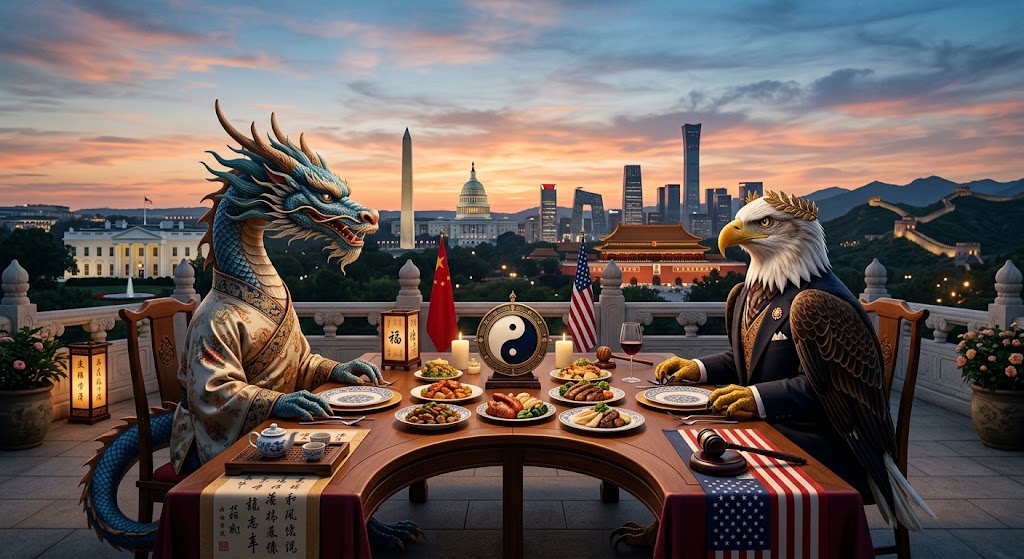
One Table — Two Powers Negotiating the Future
Ultimately, perhaps the most expressive image was the one that brought the two presidents and their wives together at the White House.
It was a simple image for the cameras, yet behind it stand centuries of exchange, decades of rapprochement and rivalry, and a future in which two major powers are competing over technology, economics and global influence.
The Chinese dragon and the American eagle may not agree on the shape of the world, but both have a profound interest in ensuring that their differences do not ignite a global fire.
The question left by this visit, therefore, is not simply: Who won?
It is:
Can the two powers turn competition into a bridge rather than a spark, and transform their differences from a prelude to confrontation into an opportunity to manage an increasingly complex world?
Perhaps the future of China-U.S. relations does not depend on one side loving the other.
Perhaps it depends on something more practical and more difficult:
learning how to disagree without destroying the bridge on which both sides must continue to cross.