 Editor-in-Chief Writes
IT seems that the Strait of Hormuz has decided to transform itself from a strategic energy corridor into a stage for a dark military comedy.
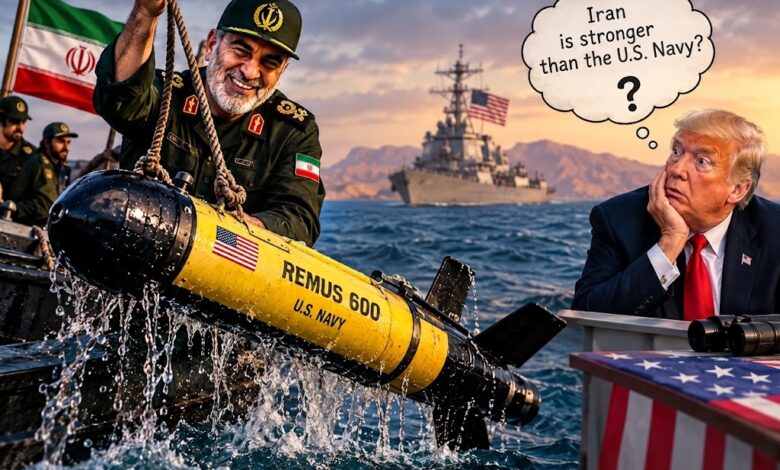
Iran says it has once again captured a U.S. unmanned underwater vehicle — the second such claim this month. The Islamic Revolutionary Guard Corps initially identified the vehicle as a REMUS 600, saying it had been seized through a coordinated intelligence and electronic-warfare operation and handed over to specialists to recover its data. More recently, an IRGC spokesman identified the system as an Mk 18 Mod 2 Kingfish. Washington, meanwhile, denies that Iran has captured an operational U.S. drone, with CENTCOM saying it maintains positive control of its operational unmanned assets.
And here begins the satire:
Iran says: “We caught it.”
America says: “You did not.”
And the underwater vehicle itself cannot hold a press conference to tell us who is telling the truth!
But beneath the laughter lies a serious military and political question.
First, let us get the terminology right.
This is not a nuclear submarine in the traditional sense. It is an autonomous unmanned underwater vehicle — a sophisticated robotic platform designed for missions such as surveillance, seabed mapping, sonar operations and mine countermeasures. U.S. Navy material describes REMUS systems as part of the Navy’s broader development of autonomous and unmanned underwater technology.
And that distinction does not make the story less interesting.
In some ways, it makes it more interesting.
Because if Tehran’s account is eventually independently confirmed, the issue would not be the destruction of some gigantic American submarine.
The issue would be whether an Iranian force managed to detect, intercept, capture and exploit an advanced American unmanned system operating beneath the waters of one of the world’s most strategically sensitive waterways.
And the most valuable thing inside such a vehicle may not be the vehicle itself.
It may be the information.
Modern warfare is no longer measured simply by the number of aircraft, missiles, warships or soldiers.
It is increasingly measured by one question:
Who can see the other side first — and who can prevent the other side from seeing him?
That is where electronic warfare, intelligence and autonomous systems enter the battlefield.
Iran has previously sought to exploit captured American unmanned technology for intelligence and technological purposes. The latest Iranian claim, if substantiated, therefore raises a broader question about the vulnerability of unmanned systems operating in contested waters.
And if the second incident is confirmed, the issue moves beyond an embarrassing episode into something strategically more uncomfortable:
Can Iran turn the waters around the Strait of Hormuz into an environment in which American technology cannot operate without taking serious risks?
That is the message that could eventually reach the White House.
But the message should not be:
“Iran has defeated the American military.”
That conclusion would go far beyond the evidence.
The more credible message is considerably more unsettling:
“American military superiority is not absolute — not everywhere, not in every domain, and not against every form of warfare.”
That is a very different proposition.
The United States possesses enormous military capabilities across air, sea, land, space and cyberspace. One captured — or allegedly captured — unmanned vehicle cannot establish that Iran has become militarily superior to the United States.
But war is not a competition in the size of aircraft carriers.
You can possess the most powerful military on Earth and still discover that a small drone, a cheap missile, a mine, a fast boat — or a robotic vehicle beneath the waves — can force you to rewrite the calculation.
And that may be the real lesson of Hormuz.
The irony is almost too perfect:
America developed unmanned underwater systems to make its forces more capable and its operations more secure.
And Iran now says:
“Thank you. We will keep this one for a while.”
If Tehran’s account is correct, the real prize may not be the hull, the sonar or the navigation system.
It may be the data.
Because in the wars of the twenty-first century, information can be more valuable than steel.
And if Washington’s denial is correct, there is still a different question worth asking:
Why is Tehran repeatedly claiming to have penetrated the American underwater surveillance environment — and why does the claim itself carry strategic value?
Either way, the episode has become part of the psychological battle surrounding Hormuz.
And now comes the question for Donald Trump.
If I were sitting in the White House, I would not ask first:
“Is Iran stronger than America?”
I would ask:
“How much will it cost to prove that America is stronger?”
That is the question that matters.
Trump warned in his September 22 address to the United Nations General Assembly that he could “annihilate” Iran if a peace agreement were not reached, while also leaving the door open to a possible deal.
Iran, meanwhile, has indicated that it is prepared to negotiate under conditions including reduced U.S. military pressure and the lifting of the blockade, while the Strait of Hormuz remains at the center of the confrontation.
So perhaps the little underwater robot has delivered a message larger than itself.
Not:
“Iran is stronger than America.”
But rather:
“America is strong enough to stop a war when it realizes that continuing it no longer adds anything to its strength.”
That is the lesson worth considering.
Because a war launched to demonstrate superiority can eventually demonstrate something else:
that superiority has limits.
As for the second underwater drone?
Let it remain beneath the waters of Hormuz — whether Iran truly captured it or Washington successfully retained control.
Because in either case, the Strait of Hormuz may have caught something far more important than a drone: