 Editor-in-Chief Writes
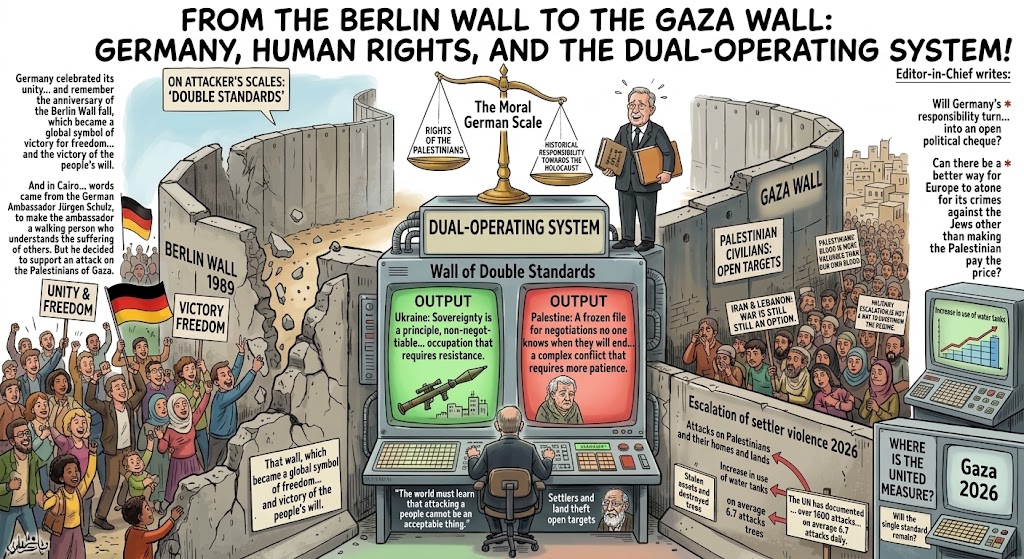
GERMANY celebrated the anniversary of its reunification in Cairo, as it did in capitals around the world—a historic moment commemorating the fall of the Berlin Wall, a wall that became a global symbol of freedom overcoming division and of peoples overcoming barriers designed to separate human beings from one another.
In Cairo, the remarks delivered by German Ambassador Jürgen Schulz and State Minister Florian Hahn highlighted the depth of Egyptian-German relations and the broad cooperation between the two countries in politics, economics, education, culture, energy, climate and investment, as well as Germany’s recognition of Egypt’s regional role at a time when the Middle East continues to face profound crises.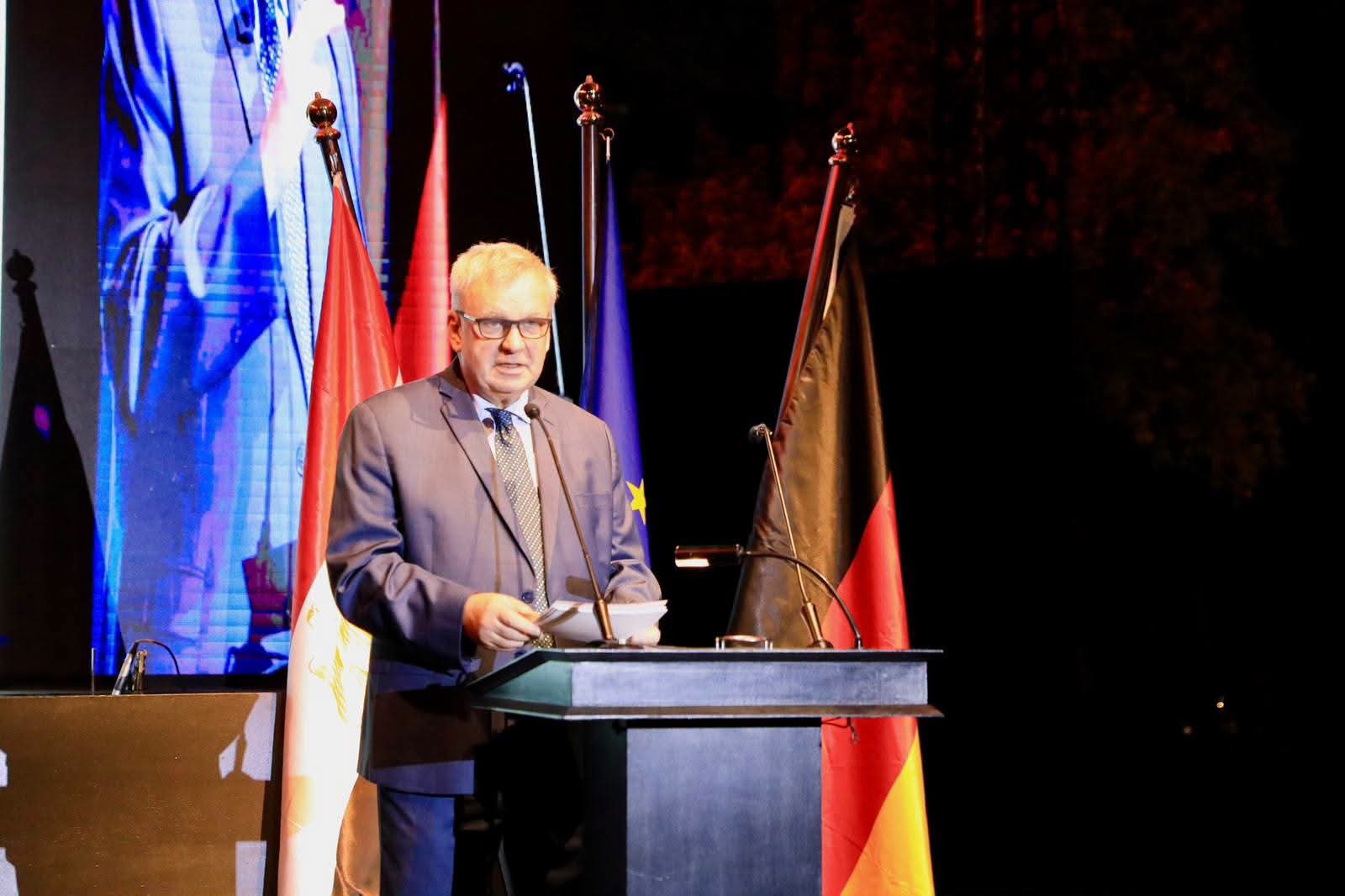
All of this deserves appreciation.
But the anniversary itself opens another door.
If Germany celebrates the fall of the Berlin Wall, what does it see when confronted with the walls that continue to rise elsewhere in the world?
Can a country that transformed the experience of German division into a historical lesson for humanity look at the political, military and territorial walls of the Middle East through the same moral lens?
This is where the more uncomfortable—and perhaps more ironic—part of the story begins.
Modern Germany carries a profound historical responsibility for the Holocaust, in which Nazi Germany and its collaborators systematically murdered six million European Jews. The German government itself explicitly recognizes this responsibility as one of the foundations of Germany’s special relationship with Israel.
That history cannot be denied, nor should the horror of the crimes committed against European Jews ever be minimized.
But a question inevitably arises today:
Can Germany’s responsibility for the crimes of the past become a political blank cheque with no expiration date?
Can the best way for Europe to atone for crimes committed against Jews be for Palestinians to continue paying an open-ended price for crimes they did not commit?
Can historical memory remain noble and indispensable, yet become politically selective—making one blood more valuable than another, one homeland more sacred than another, and one child more deserving of protection than another?
This is not a call to forget the Holocaust.
It is a call to extend its moral lesson to every human being.
The Holocaust should teach the world that persecuting an entire people can never be acceptable, and that power does not give anyone the right to decide who deserves freedom, dignity and life.
And this is where Palestine enters the story.
The Palestinian question did not begin on October 7, just as Palestinian resistance did not emerge from a vacuum.
It is the product of a long history of conflict, occupation, displacement, settlement and struggle over land and rights.
Hamas, as a Palestinian armed movement that presents itself as a resistance movement seeking the liberation of Palestine, represents one chapter of that history; Germany and the European Union, however, classify it as a terrorist organization.
But whatever one’s political or legal position on Hamas, disagreement with an armed movement cannot logically become a license to punish an entire people, or to treat Palestinian civilians as legitimate targets of displacement, deprivation or collective punishment.
More importantly, the situation unfolding today in parts of the West Bank raises an even more painful question.
When Palestinian resistance is weakened or its capacity is reduced, do Palestinian civilians necessarily become safer?
The reality on the ground suggests that the answer is far from simple.
United Nations reporting during 2026 documented a significant escalation in settler violence, including attacks on Palestinians, their homes, agricultural land, water sources, property and livelihoods, as well as the theft of livestock and destruction of crops, trees and agricultural infrastructure. Between January and August 2026, more than 1,600 settler attacks resulting in Palestinian injuries and/or property damage were documented—an average of approximately 6.7 attacks every day.
The point, however, is not that settler violence was caused by Palestinian resistance.
That would reverse the logic of what is happening.
The point is that the erosion of Palestinian resistance has left sections of the civilian population more exposed to settlement expansion, land seizures, property loss and violence, while the policies of the current Israeli government—including those associated with Prime Minister Benjamin Netanyahu and ministers identified with the settlement movement—continue to shape the environment in which such abuses occur.
The responsibility of the Israeli government itself therefore cannot simply be removed from the picture.
Germany is capable of criticizing Israeli policies—and, indeed, has done so. Berlin has opposed settlement expansion and annexation and has condemned settler violence against Palestinian civilians.
But the question remains:
Are statements of concern and condemnation enough?
Can diplomatic language return land that has been taken, a home that has been burned, a tree that has been uprooted, livestock that has been stolen, or water that has been denied?
And here the picture becomes even more remarkable.
Germany simultaneously emphasizes the importance of Israel’s security, maintains its special relationship with Israel and supports Israel, while also declaring its support for a two-state solution, opposing annexation and condemning settler violence.
In other words, we have a policy that says one thing, condemns another, and somehow remains standing in the same place!
And then we arrive at Ukraine.
If Germany has the right to interpret the Russia-Ukraine war from the perspective of its government as an attack on a sovereign state, and to build extensive political, military and economic policies upon that interpretation, then that is a political position that can and should be debated.
But why does sovereignty not become an equally firm principle when Palestinians are concerned?
Why does Ukraine’s territorial integrity become a major European and international security issue, while Palestinian land remains trapped in the language of “peace processes,” “final-status negotiations” and “future arrangements”?
On October 4, 2026, German Chancellor Friedrich Merz was in Kyiv reaffirming Germany’s support for Ukraine and stressing that Germany would do everything it could to help Ukraine until the war ends.
That position is clear.
But precisely because it is clear, it makes the Palestinian question even more difficult to ignore:
Why is sovereignty treated as a principle that cannot be compromised in Ukraine, while in Palestine it becomes an issue indefinitely postponed to negotiations whose beginning and end remain uncertain?
Why is the displacement of civilians condemned when it occurs in Europe, while Palestinians in parts of the West Bank can face the loss of their homes, land and livelihoods, followed by little more than expressions of concern?
And Germany’s position toward Iran and Lebanon raises another question.
Berlin has emphasized its concerns over Iran’s nuclear and missile programs and has aligned itself with the United States and other Western partners on major aspects of the confrontation with Tehran. At the same time, German officials have stressed that military escalation is not a path to changing Iran’s political system.
Again, the question is not to dictate Germany’s policy, but to examine its consistency:
If war is not the road to changing governments, why is preventing war not the first principle before war begins?
And if Iranian, Palestinian and Lebanese civilians deserve protection in the same way European civilians do, where is the single universal standard?
No one is asking Germany to abandon Israel’s security.
No one is asking Germany to abandon Ukraine.
No one is asking Germany to forget its history.
What is being asked is something far simpler:
That a human being be a human being, wherever he or she is born.
That sovereignty should be a principle rather than a privilege granted according to political alliances.
That civilian rights should not require a European passport.
And that democracy should be a universal value—not a system that operates efficiently in one continent and then suddenly enters “standby mode” when it reaches the Middle East!
And so we return to the Berlin Wall.
The wall once stood, and the world knew exactly what it was.
Then it fell.
Yet decades later, the world continues to build other walls: walls of concrete, walls of wire, walls of military checkpoints, walls of political interests—and, most dangerously of all…
walls made of double standards.
The irony is unmistakable.
Germany celebrates the fall of the Berlin Wall, while the world continues to ask whether Europe can help dismantle the political walls that still divide human beings elsewhere.
So perhaps the most important question on this German anniversary is not simply what the reunification of Germany means.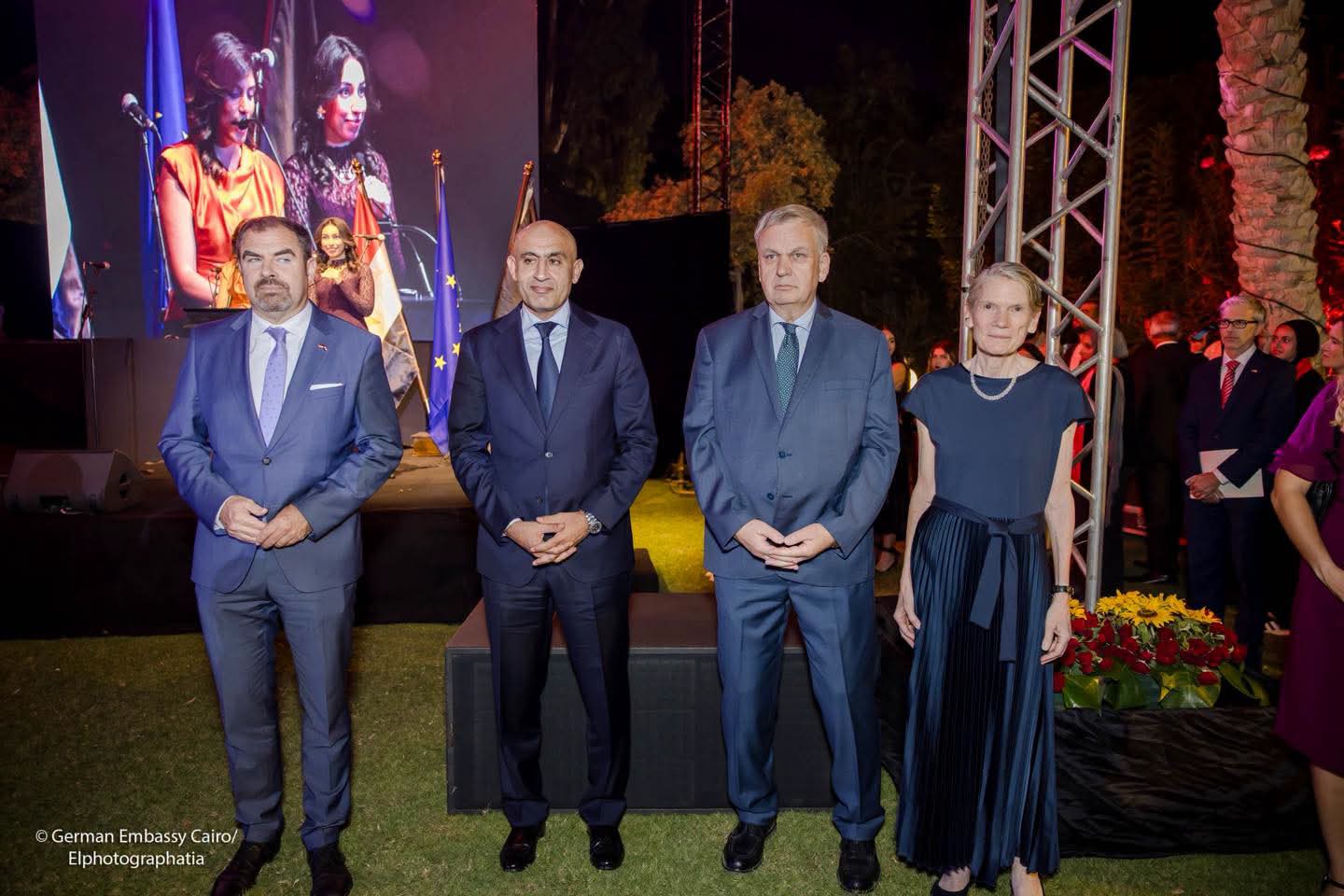
It is this:
Does Europe want a world without walls—or merely a Europe without walls?
From the Berlin Wall to Gaza, from Kyiv to Jerusalem, from Germany’s historical memory to the Palestinian present, the question remains the same:
Are values universal?
Is democracy universal?
Are human rights universal?
Or do human rights, like certain visas, simply have different appointment dates for different peoples?!
What an extraordinary irony:
Germany celebrates the fall of the Berlin Wall…
while the world is still searching for the country capable of bringing down the wall of double standards.