When the Silk Road Embraces the Jordan: Uzbekistan and Jordan Weaving a Bridge Between Central Asia and the Middle East

Chief Research Fellow, Institute for Strategic and Regional Studies under the President of the Republic of Uzbekistan
The evolving landscape of international relations is opening new horizons for cooperation between neighboring regions, making partnerships between Central Asia and the Middle East increasingly significant. In this changing geopolitical environment, the value of international partnerships is no longer measured merely by trade volumes and investment figures, but increasingly by their ability to foster industrial integration, technological advancement, sustainable development, and the preservation of shared cultural and spiritual heritage.
Against this backdrop, the Hashemite Kingdom of Jordan occupies a distinctive place in Uzbekistan’s foreign policy priorities. Since establishing diplomatic relations in February 1993, Tashkent and Amman have steadily transformed their relationship into a multifaceted partnership, reflecting shared interests and an expanding vision of regional cooperation.
Political Dialogue: A Partnership Anchored in Leadership and Trust
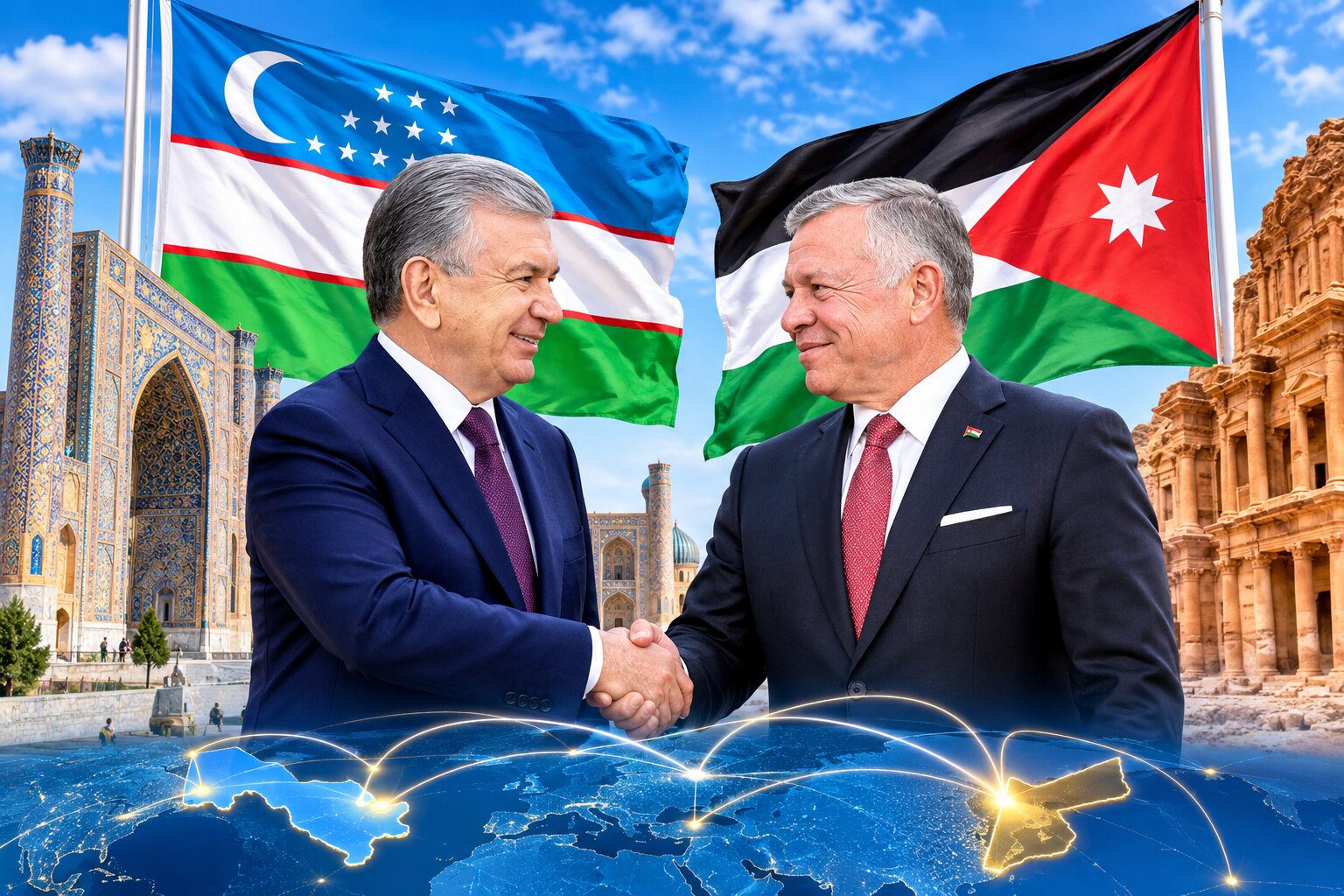
The steady advancement of Uzbek-Jordanian relations owes much to the political will of President of Uzbekistan Shavkat Mirziyoyev and King Abdullah II ibn Al Hussein of Jordan. Their sustained dialogue and mutual trust have provided the political foundation for elevating bilateral relations to a more strategic level.
A defining milestone came with King Abdullah II’s state visit to Uzbekistan on August 25–26, 2025. The summit in Samarkand marked a new chapter in relations, elevating them to the level of a comprehensive partnership. The two countries issued a Joint Statement and signed 15 bilateral agreements and documents covering investment, trade, agriculture, education, and other priority sectors.
Beyond bilateral cooperation, the summit underscored the importance of coordinating positions within the United Nations, the Organization of Islamic Cooperation, and other international platforms.
Uzbekistan has also consistently supported Jordan’s international peace and security initiatives, particularly the Aqaba Process, launched by King Abdullah II in 2015 to strengthen international cooperation against terrorism and extremism through experience-sharing and coordinated security efforts.
This engagement gained further momentum in November 2026, when President Mirziyoyev participated in the meeting of Central Asian leaders on artificial intelligence security, held in Astana within the framework of the Aqaba Process. He proposed hosting one of its forthcoming sessions in Samarkand.
Political contacts have continued through meetings on the sidelines of the United Nations General Assembly in September 2025, as well as parliamentary and foreign-policy consultations throughout 2026.
Jordan is increasingly positioned as a gateway for Uzbekistan’s engagement with the Arab world, while Uzbekistan offers Amman an important strategic partner for expanding its presence across Central Asia. This complementary regional role gives the relationship significance far beyond conventional bilateral diplomacy.
Economic Cooperation: From Trading Partnerships to Industrial Integration
Economic relations between Uzbekistan and Jordan have witnessed remarkable growth. Official figures indicate that bilateral trade turnover increased more than tenfold between 2017 and 2025, reflecting the growing interest of business communities in both countries.
Currently, 18 enterprises with Jordanian capital operate in Uzbekistan, while the Joint Business Council provides an institutional platform for strengthening private-sector engagement and identifying new investment opportunities.
Nevertheless, the next stage of cooperation requires a more ambitious approach. The priority is no longer simply to increase trade figures, but to move toward joint production, technology transfer, industrial investment, and higher-value-added economic activities.
Jordan’s established expertise in pharmaceuticals, chemicals, and services complements Uzbekistan’s expanding industrial capabilities, natural resources, and growing consumer market. This creates opportunities for both countries to develop joint ventures and access markets beyond their immediate geographical boundaries.
These priorities were addressed during the first meeting of the Joint Intergovernmental Commission in April 2026, which focused on industrialization, agro-industrial development, pharmaceuticals, and logistics. Both sides also confirmed the launch of work toward a preferential trade agreement.
The pharmaceutical industry stands out as one of the most promising pillars of cooperation. Jordanian companies possess considerable experience in manufacturing medicines according to international standards, while Uzbekistan seeks to expand domestic production, reduce dependence on imports, and strengthen its pharmaceutical export capacity.
An important example was the September 2025 negotiations between the Uzbek side and Dar Al-Dawa, founded in 1975 and supplying pharmaceutical products to more than 40 countries. Discussions addressed the localization of production and the introduction of advanced quality-control systems.
Such cooperation could transform the pharmaceutical sector from a conventional trade channel into a platform for industrial partnership, technological exchange, and regional export expansion.
Connectivity is another essential dimension. The launch of regular direct flights between Amman and Tashkent in July 2026, operated twice weekly by Royal Jordanian, represents a practical step toward bringing the two business communities and peoples closer together.
Yet the potential extends beyond passenger aviation.
Uzbekistan continues to prioritize the development of alternative transit corridors, and Jordan’s strategic location, particularly the Port of Aqaba, offers promising opportunities. Combined with the Kingdom’s extensive network of trade agreements with Arab countries, Jordan could become an important logistical gateway for Uzbek products seeking access to Middle Eastern and African markets.
Ultimately, the economic relationship could evolve into a broader network connecting Central Asia, the Middle East, and Africa through production, transportation, investment, and trade.
Cultural Diplomacy: Where Shared Heritage Becomes a Bridge of Friendship
Economic and political interests provide the framework for cooperation, but cultural and intellectual ties give it a deeper human dimension.
Uzbekistan and Jordan share a rich Islamic heritage, a longstanding appreciation for knowledge and scholarship, and a commitment to preserving their cultural identities.
These common foundations are increasingly reflected in institutional cooperation. The International Islamic Academy of Uzbekistan and Jordan’s World Islamic Sciences and Education University have established a partnership through a Memorandum of Understanding.
Academic exchanges and joint research initiatives offer opportunities to explore Islamic civilization, history, and Arabic studies, bringing together researchers and academic institutions from both countries.
The importance of this cooperation extends beyond universities: it contributes to presenting the humanistic values of Islamic civilization, promoting intellectual dialogue, and preparing a new generation capable of building bridges between cultures.
Cultural engagement is also gaining momentum through artistic participation. Jordanian artists have taken part in prestigious international festivals of maqom music and traditional applied arts in Uzbekistan.
Further exhibitions, academic conferences, and artistic exchanges could transform these initiatives into a sustainable cultural partnership.
From Tashkent to Amman, shared heritage can become a living bridge connecting generations, strengthening mutual understanding, and turning historical ties into contemporary opportunities for friendship and cooperation.
Water Security: Turning a Shared Challenge into an Opportunity
Among the most promising areas of practical cooperation is water security, a strategic issue for both countries.
Jordan is among the world’s most water-scarce countries. Rising demand, recurrent droughts, and climate change have intensified the need for modern water-management systems, conservation technologies, and sustainable infrastructure.
According to the International Monetary Fund, Jordan’s renewable water resources amount to approximately 60 cubic meters per capita annually, far below the internationally recognized absolute water-scarcity threshold of 500 cubic meters.
The ambitious project to transport desalinated water from Aqaba is designed to provide approximately 300 million cubic meters annually, meeting around 40 percent of the Kingdom’s drinking-water requirements.
Uzbekistan, meanwhile, has been making substantial progress in modernizing its irrigation systems and introducing water-saving technologies.
The area using such technologies has expanded from 28,000 hectares in 2017 to approximately 2.8 million hectares today, representing around 60 percent of the country’s irrigated agricultural land.
Their application enables annual water savings of nearly five billion cubic meters, while Uzbekistan aims to extend water-saving technologies to as much as 80 percent of its irrigated areas by 2028.
These experiences create a valuable foundation for bilateral cooperation.
By combining Jordan’s experience in addressing severe water scarcity with Uzbekistan’s growing expertise in modern irrigation and agricultural water management, the two countries can turn a shared environmental challenge into a practical opportunity for technological cooperation.
Joint pilot projects, technical exchanges, research programs, and investment in water-efficient infrastructure could generate tangible benefits for both societies.
From Diplomatic Commitments to a Sustainable Regional Partnership
The intensification of Uzbek-Jordanian relations during 2025–2026 reflects the emergence of a partnership built on complementary strengths rather than simply the scale of financial resources.
Jordan contributes diplomatic experience, pharmaceutical expertise, healthcare services, and practical knowledge of managing scarce water resources. Uzbekistan offers an expanding market, growing industrial capacity, agricultural potential, and access to the wider economic landscape of Central Asia.
The intersection of these advantages creates a promising agenda for the coming years, including:
- Establishing joint pharmaceutical production facilities and transferring advanced technologies.
- Launching pilot projects in water conservation and modern irrigation.
- Expanding scientific, academic, and educational cooperation.
- Developing transport and logistics links through Jordan’s strategic position and the Port of Aqaba.
- Strengthening coordination in regional and international organizations.
The real measure of this partnership will not be the number of agreements signed, but the ability to translate diplomatic commitments into factories, investment projects, scientific achievements, sustainable infrastructure, and tangible improvements in people’s lives.
Uzbekistan and Jordan possess the essential foundations for a distinctive model of regional cooperation, one that brings together economic integration, political dialogue, cultural diplomacy, technological innovation, and shared responsibility for sustainable development.
Ultimately, the relationship between Tashkent and Amman could become more than a successful bilateral partnership: it could emerge as a strategic bridge linking Central Asia with the Middle East and opening wider horizons toward Africa.
When the Silk Road meets the spirit of the Jordanian land, geography becomes opportunity, shared heritage becomes a source of strength, and diplomacy becomes a bridge toward a more interconnected future.