Poetry: Ashraf AboArafe
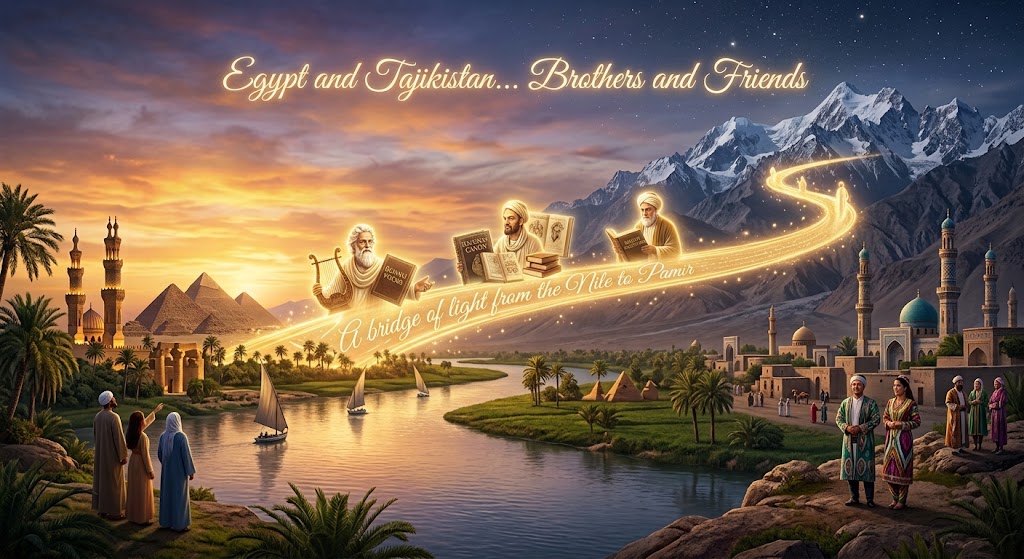
Welcome, Tajikistan, land of lofty heights,
Where glory lives upon the pages of time.
From Egypt I send the Pamirs my rhyme,
While the Nile carries my longing toward the mountains.
Between the Nile and the Pamirs, our spirits meet,
And history finds a language of shared kinship.
Egypt has her place in the chronicles of glory,
And Tajikistan has her own chapter in the book of civilizations.
Here, the ancient Pharaohs raised
The pillars of a civilization whose traces endure.
And there, the Pamirs rise in majesty,
Their peaks proclaiming the eternal call of the heights.
At Al-Azhar, knowledge is a light that never fades,
And in your land, the light of learning continues to burn.
Rudaki, the master of poetry, still lives through his verses,
Flowing like a river of longing and delight.
And Ibn Sina remains a witness to the greatness of knowledge,
His legacy still carrying wonder through the ages.
Al-Bukhari, too, holds an honored place in the history of learning,
His name enduring in the great memory of scholarship.
How much knowledge has crossed our borders,
And how much love has crossed every distance.
No distance between our lands can become a barrier,
For the heart is closer than words can measure.
Friendship needs no wings
When sincerity and noble character embrace.
O Tajikistan, sister of the spirit in a shared human bond,
A land of affection, loyalty, and generous hearts.
From the banks of the Nile, we send you peace,
And from the peaks of the Pamirs comes a tender breeze.
Let a bridge of friendship remain between our peoples,
Carrying shared values toward the future.
Let the river of affection that brought our hearts together remain,
Unbroken as long as the light of hope shines.
Egypt and Tajikistan — a song in the history of nations,
Rising with a legacy that time cannot erase.
Even when the lands beneath our feet are far apart,
The spirit brings us together, and love draws us near.
From the Nile, we send the Pamirs a song,
And from the highest mountain peaks comes the reply.
Egypt and Tajikistan… two rivers in one homeland,
A homeland of love that neither fades nor disappears.