Ashraf AboArafe writes
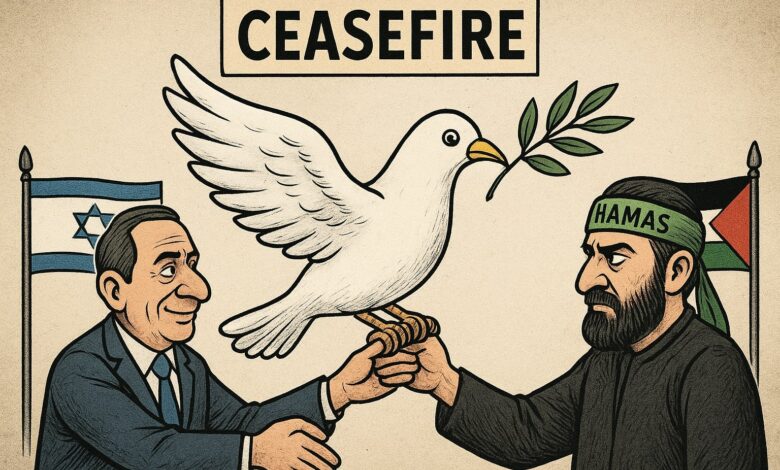
From the ashes of Gaza’s long war, a white dove has taken flight — weary, trembling, yet holding an olive branch. The image is no longer just poetic; it has turned into a political reality as Israel and Hamas announce a ceasefire agreement, marking the first phase of a 20-point U.S.-backed plan to end a devastating two-year conflict that has shaken the region and scarred its conscience.
A Breathing Space — or Just a Pause Between Battles?
Brokered by the United States, Egypt, Qatar, and Turkey, the agreement envisions the exchange of hostages for Palestinian prisoners, a partial withdrawal of Israeli forces from Gaza, and the opening of humanitarian corridors for aid and displaced civilians to return.
Yet beneath the diplomatic applause lies a haunting question: Is this the beginning of an end — or merely another fragile truce written in ink and erased by gunfire?
Politics in the Shadow of Exhaustion
Politically, both sides face difficult calculations. The Israeli government, fractured by internal divisions, must now justify releasing hundreds of Palestinian prisoners to a skeptical public.
Hamas, for its part, fears being lured into a “political trap” — a ceasefire that freezes the humanitarian crisis without truly lifting the siege or restoring Gaza’s dignity.
For Washington, this agreement is not just a diplomatic milestone but an act of self-rescue — a chance to reclaim moral credibility after two years of war that exposed the limits of American influence and eroded its image across the Middle East.
The Human Face of War
Beyond strategy and speeches, the humanitarian picture remains grim. Millions in Gaza are waiting for promises to turn into tangible relief — clean water, functioning hospitals, safe corridors, and a glimpse of normal life amid ruins.
In this light, every ceasefire in the Middle East is, at its heart, a temporary reprieve for humanity, not yet a pathway to peace.
Open Scenarios Ahead
The first phase may yield a fragile calm, but lasting peace requires more than silenced guns. Without a clear roadmap for reconstruction, international monitoring, and mutual guarantees, the truce could collapse under the weight of mistrust.
History reminds us that in this region, truces often die before the ink dries. Only a sustained commitment — political, humanitarian, and moral — can transform this pause into a foundation for something more enduring.
Conclusion
This ceasefire is not a victory — it is a moment of mercy.
A fragile gift to a weary humanity, a dove caught between the flames, still afraid of bullets yet stubbornly choosing to fly.
If it can survive the smoke long enough, perhaps its wings will carry a message the world too often forgets: that peace, even when fragile, begins not with power — but with the courage to stop firing.