 Dr. Suhair Al-Muhandi ✍️
Media Professional and Academic Researcher
In Bahrain, charitable work does not emerge as a passing act of goodwill, but as a deeply rooted pillar of national vision — one that has long recognized that true development cannot exist without a profound human and social dimension.
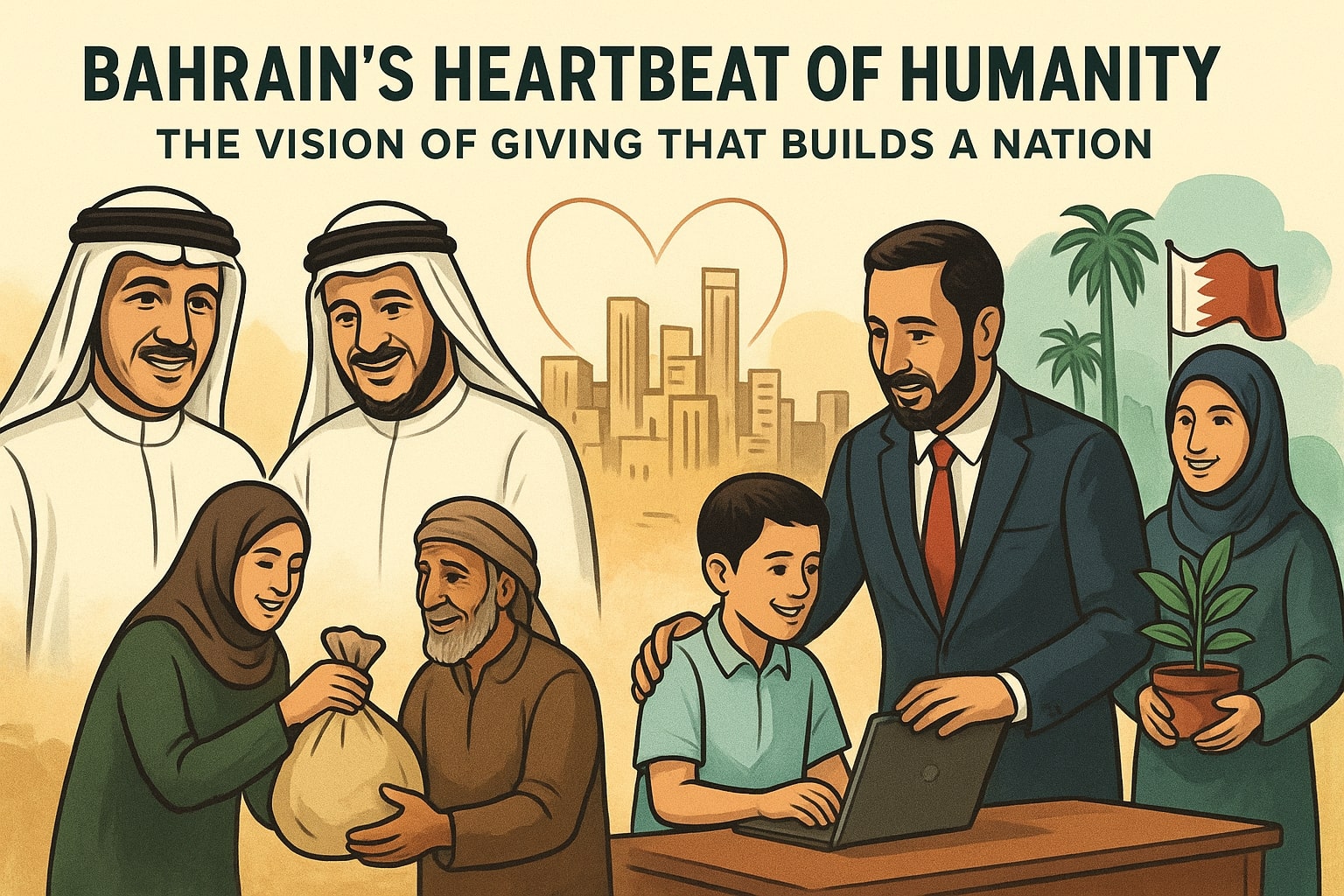
The government’s steadfast support — particularly the patronage of His Royal Highness Prince Salman bin Hamad Al Khalifa, the Crown Prince and Prime Minister, and His Highness Sheikh Nasser bin Hamad Al Khalifa, Representative of His Majesty the King for Humanitarian Work and Youth Affairs — reveals a strategic philosophy that transcends the idea of direct giving. It views philanthropy as an investment in societal stability, cohesion, and resilience in the face of future challenges.
Charitable initiatives in Bahrain were never born of circumstance; rather, they trace their origins to the earliest stages of the nation’s modern renaissance, where the human element has always accompanied the march of progress and construction.
In today’s volatile world, where economic and humanitarian crises surge with unprecedented speed, Bahrain’s unwavering commitment to charity becomes a symbol of resilience — a safeguard against uncertainty and an affirmation that shared giving is a cornerstone of social security. It is a quiet message that Bahrain regards investment in people as the truest guarantee of stability.
Here, leadership demonstrates a vision that unites material progress with moral elevation. The Bahraini charitable model is not limited to financial aid; it extends into education, health, environment, and youth empowerment — fields animated by both governmental and civil initiatives working in harmony.
When compared to broader regional trends, Bahrain’s path reflects an authentic Arab and Islamic ethos that views social solidarity as an extension of enduring civilizational values. Yet Bahrain has infused these values with a modern organizational framework aligned with contemporary development goals. While some societies still confine charity to its traditional realm, Bahrain has redefined it as an integral component of comprehensive national development — seamlessly woven into its economic and social vision. This rare blend of heritage and modernity lends Bahrain’s experience a distinctive identity within the Arab world.
Across multiple initiatives — from supporting underprivileged families and empowering youth, to advancing sustainable environmental projects — Bahrain’s philanthropy proves itself not as seasonal benevolence but as sustained policy. Visionary figures such as His Highness Sheikh Nasser bin Hamad Al Khalifa have shaped this path through humanitarian initiatives that embody Bahrain’s commitment to peace and human security — both domestically and globally.
Such endeavors convey a message of shared destiny: Bahrain does not separate its internal advancement from its contribution to the wider Arab and Islamic sphere. Its prosperity is seen as intertwined with the well-being of its neighbors.
Ultimately, the essence of this vision lies in recognizing that charity in Bahrain is not a fleeting gesture but an institutional, strategic act — one that strengthens the fabric of solidarity and unity, and affirms that a nation’s true strength is not only measured in economic indices, but in the depth of its humanity.
In this light, Bahrain’s charitable movement stands as a living testimony to a genuine human philosophy — a civilizational message radiating from the heart of the Gulf to the world, carrying within it the eternal call for peace, compassion, and the shared building of a more balanced and humane future.