Ashraf AboArafe
Barcelona – 28 November 2025
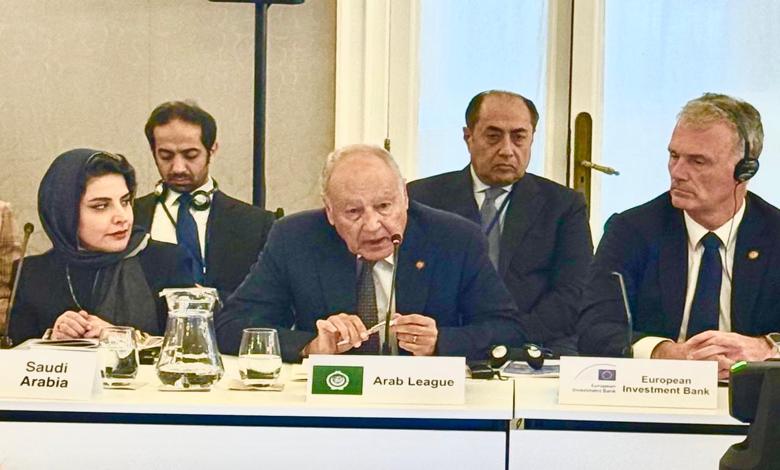
At a critical moment for the Mediterranean region, H.E. Ahmed Aboul Gheit, Secretary-General of the League of Arab States, delivered a forceful and wide-ranging address at the 10th Regional Forum of the Union for the Mediterranean, calling for renewed Arab-European cooperation to confront escalating conflicts from Gaza to Sudan and Libya.
Speaking before ministers and senior officials, Aboul Gheit opened by thanking Spain’s Foreign Minister José Manuel Albares for hosting the forum, and acknowledged EU High Representative Kaja Kallas, Jordan’s Foreign Minister Ayman Safadi, and UfM Secretary-General Nasser Kamel for their leadership in sustaining regional dialogue.
Gaza: “A People Nearly Erased”
Aboul Gheit devoted a significant portion of his speech to the devastation in Gaza, describing the past two years as “the most brutal and destructive since the 1948 Nakba.”
He cited more than 67,000 Palestinian deaths, the majority women and children, and accused Israel of deliberately obstructing humanitarian and reconstruction efforts despite the international framework laid out in the 20-point plan and the UN Security Council Resolution 2803.
“The occupation cannot continue,” he warned. “It is a recipe for endless violence, instability, and the destruction of any peace agenda.”
The Secretary-General praised several European nations for taking “principled and courageous positions,” adding that global public opinion had dramatically shifted after witnessing the scale of destruction in Gaza.
He highlighted the significance of the New York Declaration, adopted unanimously in September, which sets a clear roadmap for the establishment of an independent Palestinian state. A lasting settlement, he argued, is essential not only for the Arab world but also for the broader Mediterranean region.
Sudan: The World’s Worst Humanitarian Crisis
Turning to Sudan, Aboul Gheit described the conflict as “a devastating war threatening the unity of the country,” echoing UN assessments that it constitutes the world’s most severe humanitarian catastrophe.
With 9 million internally displaced and over 3.5 million refugees, he said millions live under the threat of hunger, displacement, and violence.
The Arab League, he stressed, is urging a humanitarian truce as a gateway to a political solution. He welcomed the role of the Arab–U.S. Quad in attempting to halt the conflict.
Libya: Guarded Optimism
On Libya, the Secretary-General expressed support for the UN roadmap aimed at unifying Libyan institutions and moving toward long-delayed national elections.
He described the recently signed Unified Development Program Agreement between the House of Representatives and the High Council of State as a positive step toward broader political reconciliation.
Shared Challenges and a Shared Sea
Aboul Gheit underlined the Mediterranean’s mounting pressures—from climate change, energy insecurity, and food supply challenges to migration, extremism, and prolonged conflict. These, he argued, require collective responses grounded in mutual respect and shared interest.
He reaffirmed the Arab League’s commitment to deepening institutional ties with the European Union, building on the 2015 Memorandum of Understanding, and expressed optimism about the upcoming Sixth Arab–EU Ministerial Meeting and the Second Arab–European Summit.
“May the Mediterranean,” he concluded, “remain what it has always been: a carrier of prosperity, a bridge of civilizations, and an open space for shared growth.”