Poetry: M. Jahangir Khan
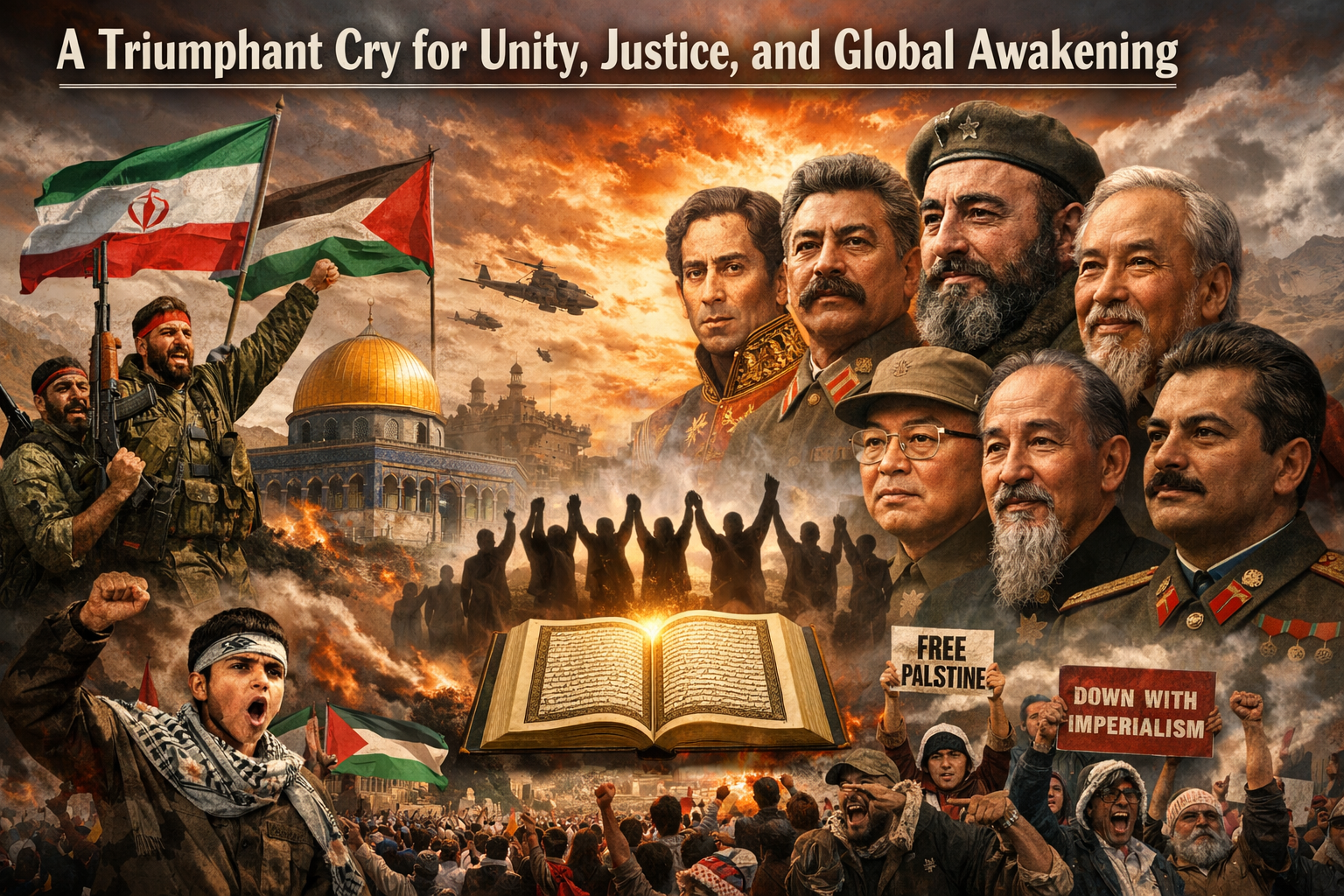
What a resounding proclamation from Revolutionary Iran—framed as a moment of defiance and aspiration. The narrative evokes three bold visions: the easing of sanctions, the imagined rebirth of an independent Palestinian homeland, and the withdrawal of foreign military presence from sovereign lands.
In the name of Islam, the call turns inward—toward the state of the Ummah. It questions not faith itself, but fragmentation within it. The Holy Qur’an reminds believers that the Ummah is one body, bound in brotherhood. Yet reality reflects divergence: competing interpretations, ideological divisions, and fragmented priorities.
There are many paths—political Islam, academic Islam, territorial Islam—yet few that center compassion, character, and justice. Missing, the text argues, is a unifying moral core: an Islam that uplifts the poor, embodies mercy, and resists exploitation.
Instead, it critiques a drift toward capitalist alignment, distancing from the struggles of ordinary people—from Palestinians to marginalized global communities. It asks difficult questions: Is this the truth? Is this faith as it was meant to be?
The vision proposed is not merely religious, but civilizational—a world built on dignity, unity, and justice. A global awakening rooted in popular strength, independence, and shared humanity.
It rejects domination in all forms—political coercion, military intervention, and violence against innocent lives. It calls for an end to hegemonic control and a restoration of people’s sovereignty.
History is invoked as both warning and contrast. From the empires of Ottoman Empire, Alexander the Great, Napoleon Bonaparte, British Empire, Mongol Empire, and Empire of Japan—to the modern projection of United States power—the text contrasts imperial dominance with figures it frames as champions of popular struggle.
Among them: Simón Bolívar, Vladimir Lenin, Joseph Stalin, Ho Chi Minh, Kim Il-sung, and Fidel Castro—figures portrayed here as embodiments of people-centered resistance.
The distinction drawn is stark: between histories of domination and histories of liberation. Whether one agrees or challenges this framing, the underlying message is clear—a call to reexamine power, justice, and unity in shaping the future.
Ultimately, the text becomes less about victory and more about a plea: for coherence within belief, for solidarity among people, and for a world where justice outweighs force.