Dr. Ahmed Moustafa writes
Director & Founder of Asia Center for Studies & Translation
IN the electrified trading halls of London and New York, markets no longer move on numbers alone. Beneath the cascade of red screens and algorithmic panic lies something far less tangible—but far more powerful: narrative.
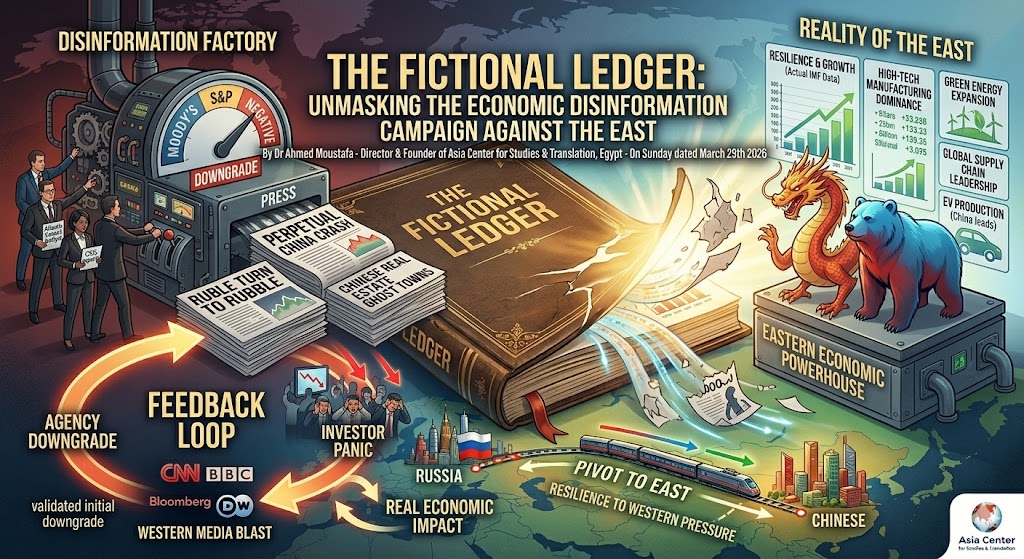
Today, economic reporting has drifted from its traditional role as a neutral ledger of facts. Instead, it has become an instrument of geopolitical influence, where institutions like Bloomberg, CNN, BBC, and Deutsche Welle increasingly operate not merely as observers—but as actors within a broader information battlefield.
Russia: The Collapse That Never Came
Following the outbreak of the Russia–Ukraine War in 2022, a unified chorus echoed across Western media: Russia’s economy was on the brink of total ruin.
Headlines forecasted catastrophe. The ruble would disintegrate. The financial system would implode. The state would default.
Yet reality refused to conform.
Instead of collapse, Russia recalibrated. It redirected trade flows eastward, capitalized on energy exports, and imposed financial controls that stabilized its currency. By 2023, even institutions like the IMF were forced to acknowledge an unexpected outcome: resilience, not ruin.
What followed was not reflection—but recalibration of rhetoric. The narrative shifted seamlessly from “imminent collapse” to “long-term stagnation,” quietly sidestepping the failure of earlier predictions.
This was not merely miscalculation. It revealed something deeper:
a persistent attempt to construct a financial reality through repetition—hoping markets would eventually believe it into existence.
China: The Endless Prediction of Decline
If Russia’s portrayal was defined by urgency, China’s has been shaped by perpetual pessimism.
For decades, Western outlets have forecast the imminent fall of the Chinese economy—turning “China’s collapse” into a recurring media industry. Coverage of crises such as the Evergrande debt saga exemplifies this pattern: legitimate economic concerns magnified into systemic doomsday scenarios.
Narratives of “ghost cities,” demographic decline, and the so-called “Peak China” theory dominate headlines, often overshadowing key realities:
- China’s leadership in green energy and electric vehicles
- Its expanding influence across global supply chains
- Its deepening economic ties with the Global South
By amplifying vulnerabilities while muting structural strengths, the message becomes clear:
China is not just risky—it is “uninvestable.”
But this is less analysis than it is strategic storytelling aligned with geopolitical priorities.
The Invisible Hand: Rating Agencies as Power Brokers
Behind the media narrative stands another layer of influence: global rating agencies such as Moody’s, S&P Global, and Fitch Ratings.
Their decisions shape borrowing costs, investor confidence, and economic trajectories. Yet their role is far from neutral.
When Moody’s revised China’s outlook to “negative” in 2023, the move reverberated instantly across global media. Headlines transformed a technical adjustment into a narrative of systemic decline, reinforcing investor anxiety.
In Russia’s case, downgrades and exclusions from rating frameworks functioned as economic sanctions by other means, severing access to Western capital markets.
Thus emerges a powerful feedback loop:
Downgrade → Media amplification → Investor panic → Economic pressure → Narrative validation
What is presented as objective analysis often mirrors the strategic posture of Western financial and political institutions.
The Manufactured Consensus of “Experts”
Public perception is further shaped by a tightly curated ecosystem of think tanks and analysts.
Organizations such as the Atlantic Council, Center for Strategic and International Studies, and Peterson Institute for International Economics dominate media commentary.
Their experts—frequent guests on major networks—carry authority, but also institutional alignments often tied to governments, defense sectors, or financial interests.
Predictions of Russian collapse or Chinese fragmentation have repeatedly failed to materialize. Yet these voices remain central, rarely challenged, and seldom contextualized.
The result is not debate—but echo.
The Strategic Cost of Narrative Warfare
This sustained campaign of economic framing carries profound consequences.
First, it erodes trust. Investors—particularly across the Global South—are increasingly aware of the widening gap between media portrayal and material reality.
Second, it amplifies geopolitical risk. By depicting rival economies as fragile or desperate, such narratives may embolden policymakers toward escalatory strategies built on flawed assumptions.
Conclusion: A Ledger Written in Power, Not Numbers
Economic reporting, at its core, should measure reality:
prices, production, trade, and value.
But in the evolving contest between global powers, it has become something else entirely:
a battlefield of perception.
Through coordinated narratives, amplified by major media institutions and reinforced by rating agencies, a fictional economic ledger has emerged—one not designed to reflect the world as it is, but to shape it as desired.
In this new era, markets do not merely react to facts.
They react to stories.
And increasingly, those stories are written not in spreadsheets—
but in strategy.