Ashraf AboArafe criticizes
THE controversy deepens when one confronts an uncomfortable asymmetry—one that critics argue lies at the heart of the global nuclear order.
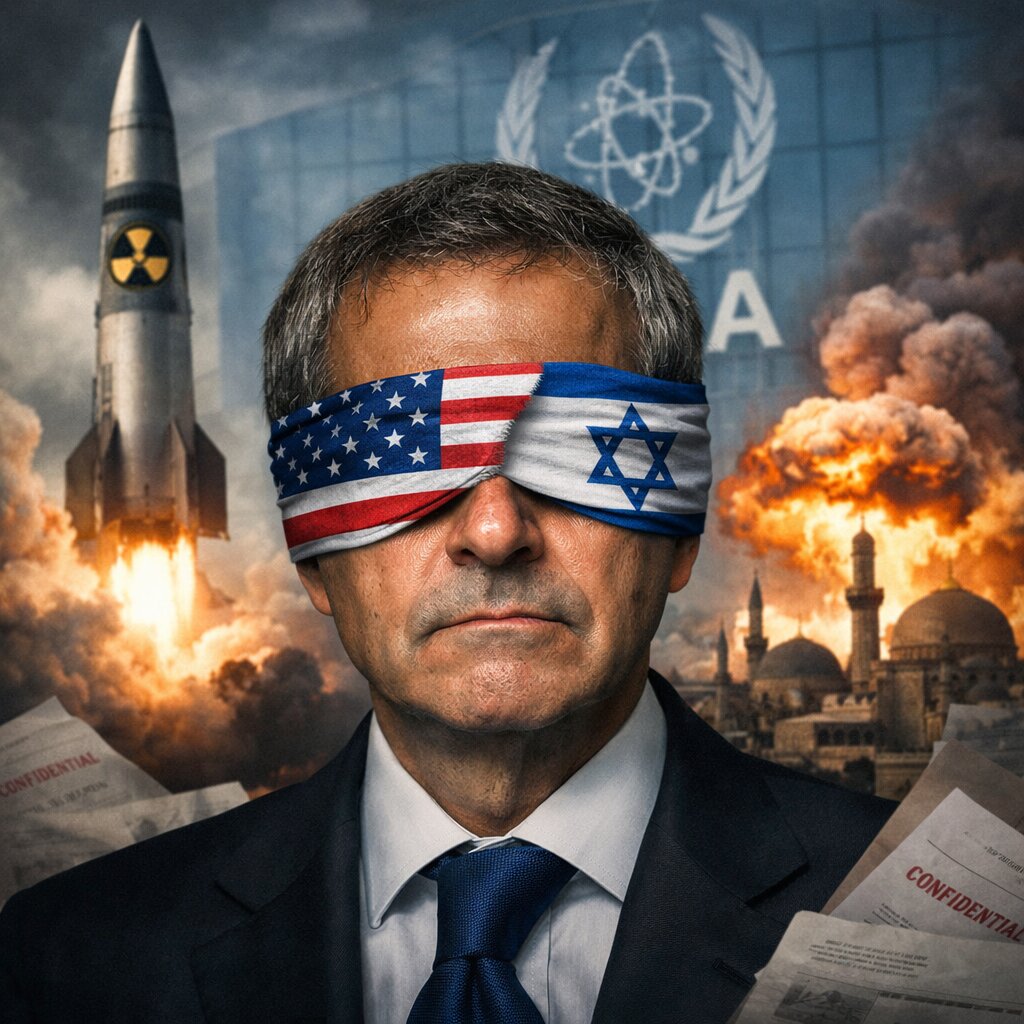
The outrage is not merely about what Rafael Grossi said—but what his institution has long normalized through silence.
A Double Standard Etched in Warheads
Let’s confront the stark imbalance:
- The United States possesses over 5,000 nuclear warheads, forming the backbone of the world’s most advanced nuclear arsenal.
- Israel—though undeclared— is widely believed to hold 200–400 nuclear warheads, outside the framework of the Non-Proliferation Treaty (NPT).
Yet the global discourse—led in part by the International Atomic Energy Agency—has remained overwhelmingly focused on one country:
- Iran, which does not possess nuclear weapons.
This is where the accusation of selective enforcement gains traction.
The Architecture of Nuclear Inequality
The modern nuclear order is not neutral—it is hierarchical.
- Some states are legitimized nuclear powers
- Others operate in strategic ambiguity
- And some are permanently suspected
This hierarchy raises a fundamental contradiction:
If nuclear weapons are the ultimate threat to humanity,
why is possession tolerated for some—and preemptively punished for others?
Grossi’s recent remarks—that the war extends beyond nuclear concerns—do not just expand the debate.
They inadvertently validate long-standing criticisms that the nuclear issue has been selectively weaponized in political narratives.
From Oversight to Perception of Bias
The role of the IAEA was designed to be technical, impartial, and verification-based.
Yet perception now matters as much as procedure.
To critics, the agency appears:
- Hyper-vigilant toward Iran
- Muted toward undeclared arsenals
- Detached from the broader nuclear imbalance
This perception—fair or not—erodes credibility.
Because neutrality is not only about what is said.
It is about what is consistently scrutinized—and what is not.
The Strategic Silence
The silence surrounding Israel’s nuclear capability, in particular, is not accidental—it is geopolitical.
- Israel is not a signatory to the NPT
- Its policy of ambiguity avoids formal accountability
- Western powers largely shield this ambiguity diplomatically
Meanwhile, Iran remains under one of the most intrusive inspection regimes in modern history.
This asymmetry fuels a powerful narrative:
The issue is not nuclear weapons themselves—
but who is allowed to possess them.
Final Reflection
Grossi’s “confession” does not stand alone anymore.
It now collides with a broader, more uncomfortable truth:
The global nuclear conversation is not just about security—
it is about power, privilege, and selective accountability.
And in that world, the question is no longer:
Who has nuclear weapons?
But rather:
Who is allowed to keep them—and who is not allowed to even approach them?