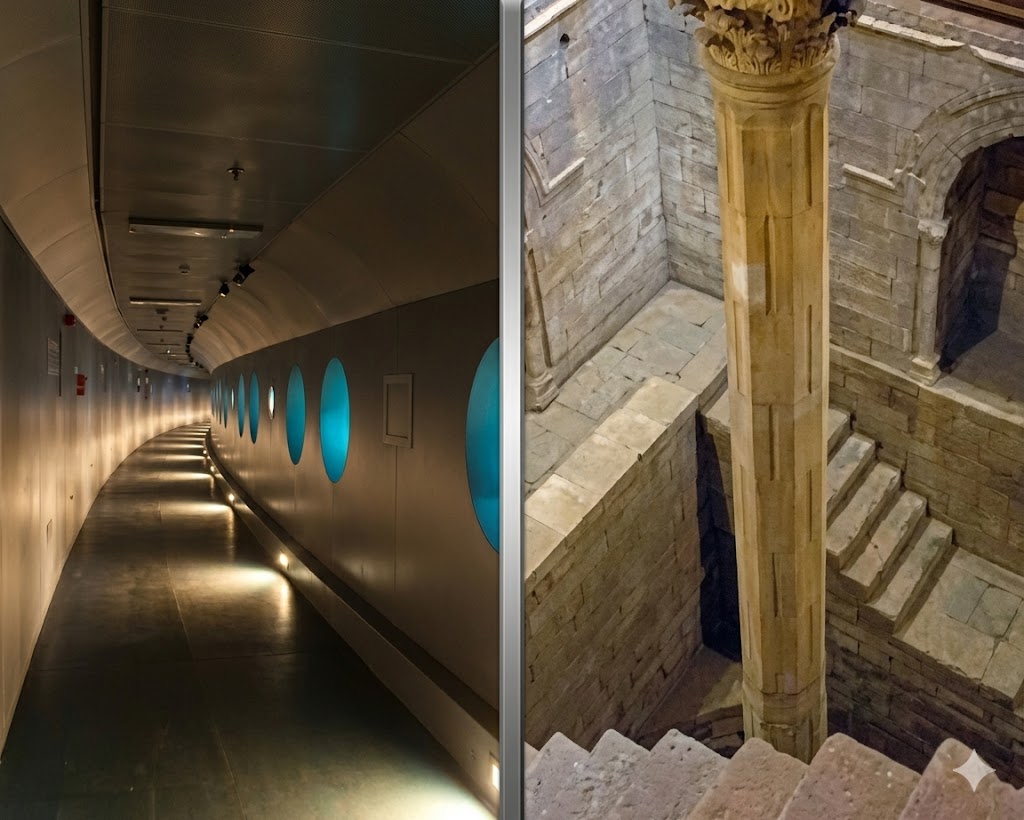
The Egyptian Nilometer (Right) & The Inscriptions of Baiheliang (Left)
 Ashraf AboArafe writes ✍️
COMMENTING on an article by the author in the prestigious Chinese newspaper Global Times—panned by the journalist Mr. Liu Xuandi, or if you prefer, dear reader, Mr. Osama S. Katrani—under the title “When Baiheliang Meets Nilometer: A Lesson for Civilization Exchanges,” we find ourselves before a profound intellectual document. It does not merely document hydraulic engineering; rather, it shapes a new philosophy for a shared human consciousness. What the author has written is not a simple comparison between two water monuments, but an archaeological unearthing of the shared “genetic code” governing the minds of our ancestors on the banks of the Nile and the Yangtze.
An Awakening of Awareness and Mirror-Image Wisdom
The brilliance of the thesis brought to us by Liu Xuandi / Osama.. Osama S. Katrani begins with that spontaneous wonder that struck the Egyptian expert in the heart of Chongqing when he recognized in the “Baiheliang” inscriptions a Chinese mirror image of Egypt’s Rawda Island Nilometer. This exclamation was not just the recognition of an antiquity; it was a spiritual embrace between two riverbanks separated by geography but united by the genius of time and space.
This remarkable similarity between the Nilometer and the Baiheliang inscriptions sends a core message to the contemporary world:
-
Dialogue Over Confrontation: While certain Western philosophies have long attempted to paint history as a theater for power struggles framed within mere decades or centuries, Egypt and China—with their deep wells of thousands of years—prove that great rivers were not created to divide humanity, but to teach us how to listen to one another.
-
Coexistence with Nature: The ancestors in both lands did not seek to “conquer” or exploit nature. Instead, they innovated precise hydrological tools to understand its cycles, looking forward to establishing a harmonious life that ensures sustainability and survival.
The Millennial Long View and Governance of the Future
Among the deepest points raised in the article, which the Egyptian expert reflected upon, is the “millennial long view” that uniquely characterizes both the Egyptian and Chinese mindsets. We do not look at the movement of history through the narrow lens of decades; rather, we read the future through the pages of past centuries. This deep historical awareness explains why both nations invested massive efforts into protecting these two aquatic heritages through innovative museums and meticulous conservation, long after their practical utility ceased following the construction of modern mega-dams like the High Dam and the Three Gorges Dam. Preserving the monument here is preserving the living memory of the nation.
The ongoing coordination in 2026 to submit a joint nomination for Egypt’s Rawda Island Nilometer and China’s Baiheliang Ancient Hydrological Inscription to the UNESCO World Heritage list is not merely a procedural step. It is a political and cultural declaration of a “covenant of shared destiny.”
Rock-Solid Bonds Extending Into Tomorrow
This cultural fusion finds fertile ground in rock-solid diplomatic relations dating back to 1956, when Egypt became the first Arab and African nation to extend a hand of friendship to Beijing. Today, this harmony is vividly reflected in the alignment of national agendas. The cultural and developmental dimensions of “Egypt Vision 2030” intersect seamlessly with China’s “15th Five-Year Plan,” together mapping out the features of the “Global Civilization Initiative” through tangible, practical steps.
In Conclusion..
We affirm alongside what was stated in the original article by the author that “cultural heritage is a testament to the ancient ties that bind our two historical nations.” The Nilometer and the Baiheliang inscriptions are not silent stones; they are two hearts beating with wisdom, whispering to humanity from the depths of the waters: that the authenticity of the past is the ultimate guardian for the safety of the future, and that the wisdom of rivers will always run deeper than any currents of division or dispute.