By Dr. Ahmed Moustafa
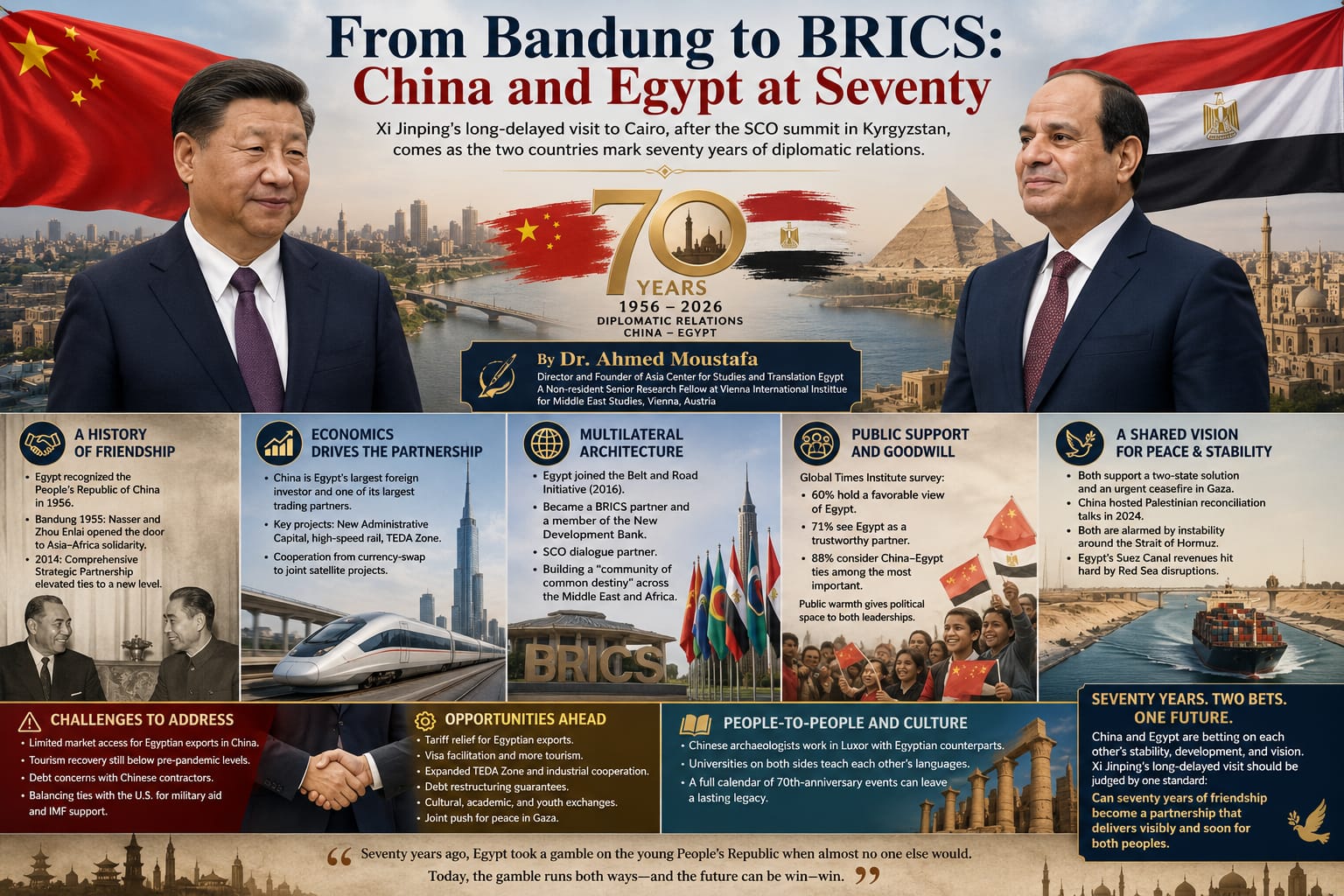
When Chinese President Xi Jinping lands in Cairo after the Shanghai Cooperation Organization leaders’ summit in Kyrgyzstan, he will bring more than an anniversary champagne. His first visit to Egypt since 2016 coincides with the two countries marking 70 years of diplomatic relations. Both governments need this visit to deliver substance, not mere ceremony.
Egypt recognized the People’s Republic of China in 1956, a year after Gamal Abdel Nasser and Zhou Enlai met at Bandung, making Cairo Beijing’s first gateway to the Arab world and Africa. For most of the next half-century, however, the relationship ran on solidarity more than strategy. That changed in 2014, when President Abdel Fattah el-Sisi elevated ties to a comprehensive strategic partnership and began traveling to Beijing more often than to any Western capital, holding up China as a template for Egypt’s development drive.
Today economics does the heavy lifting. China has become one of Egypt’s largest trading partners. Chinese contractors helped build the towers of the new administrative capital, including the tallest building in Africa and the electric rail line linking it to greater Cairo. The China-Egypt TEDA zone on the Suez Canal has drawn billions of dollars and created tens of thousands of jobs, anchoring Cairo at a critical point in the Maritime Silk Road. Cooperation now extends from a renminbi currency-swap line that helped Cairo through its dollar droughts to a jointly built Egyptian satellite.
The multilateral aspect is newer still. Egypt signed on to the Belt and Road Initiative in 2016, participated in the Kazan BRICS Summit for the first time as a full BRICS member, and joined the New Development Bank. It is a dialogue partner of the very organization whose summit Xi is attending in Kyrgyzstan. For Beijing, Cairo anchors its architecture for a “community of shared future” across the Middle East and Africa. For Cairo, the calculus is elemental: capital, markets and diplomatic ballast at a moment when the Western-led order looks both unreliable and overstretched.
Notably, the public mood tracks the official one. In the Global Times Institute’s most recent survey of how Chinese citizens view Egypt, Egypt ranked among the most favorably regarded countries in the Middle East and Africa: (60 percent) of respondents said they held a favorable view of Egypt, (71 percent) called it a friendly country or strategic partner. In a country where the state shapes sentiment but does not fully manufacture it, that warmth matters – it gives both leaderships political space to go further and faster.
The timing sharpens the visit’s significance. War in Gaza has strained every relationship in the region; Cairo and Beijing, at least, read from the same page. Both insist on a two-state solution and an urgent ceasefire – Beijing hosted rival Palestinian factions for reconciliation talks in 2024 – and both are alarmed by escalation around the Strait of Hormuz, through which the bulk of China’s imported oil flows. Egypt’s stake is as much fiscal as it is strategic: Attacks on Red Sea shipping had once cut Suez Canal revenues by more than half, delivering a body blow to an economy already on an IMF program. Few pairings share a stronger interest in quiet seas and a durable Palestinian settlement.
Yet gaps remain, and this visit presents a chance to close them. Chinese tourism to Egypt, held up as a future gold mine, has yet to recover to previous levels. Egypt must also keep Washington on side, for its military aid and its IMF seal of approval alike, which caps how far any eastern pivot can run. Success should be measured in deliverables, not communiqués: tariff relief for Egyptian agricultural and industrial exports, visa facilitation, an expanded TEDA, debt-rescheduling guarantees, cultural and academic exchange – and a credible joint push for peace in Gaza.
Culture, too, deserves more than boilerplate. Chinese archaeologists now excavate alongside their Egyptian counterparts at Luxor; Egyptian universities are adding Putonghua programs as Chinese universities add Arabic; and a well-funded 70th-anniversary calendar of events can do quiet but lasting work.
Seventy years ago, Egypt extended its recognition to the young People’s Republic of China at a time when few regional counterparts were willing to do so. This forward-looking choice has since rewarded Cairo with expanded diplomatic access and greater regional influence. Today, this mutual strategic alignment runs both ways. China places its confidence in a resilient Egypt, believing the nation can achieve stability, sustained development and balanced diplomatic positioning despite ongoing regional headwinds. For its part, Egypt sees China’s capital support, vast market potential and steady global vision as a more reliable path forward amid the West’s shifting focus and inconsistent global leadership. President Xi’s upcoming visit is set to further deepen the two nations’ 70-year friendship into a dynamic partnership that brings concrete progress and shared prosperity to both peoples.
The author is Director and Founder of Asia Center for Studies and Translation Egypt, and a Non-resident Senior Research Fellow at Vienna International Institute for Middle East Studies, Vienna, Austria. He regularly writes for international media outlets including the Global Times.