 Editor-in-Chief’s View
AT first glance, it sounds like a simple question. But in the age of American sanctions, it has become almost a question requiring an international transit permit!
Washington appears to be telling Tehran: No flights, no fuel, no services, and no landing—unless the rules set by the United States are followed!
And the strangest part?
These rules do not come from the United Nations Security Council or the International Civil Aviation Organization. They come from unilateral American measures, while other countries are then expected to treat them as though they were a new universal law of aviation.
And that is where the political comedy begins.
Has the national airport become an extension of the U.S. Treasury Department?!
Before allowing an aircraft to land, must an airport control tower now ask:
“Has Washington approved it?!”
And must a pilot, before lowering the landing gear, make sure the aircraft is not carrying an American sanctions violation?!
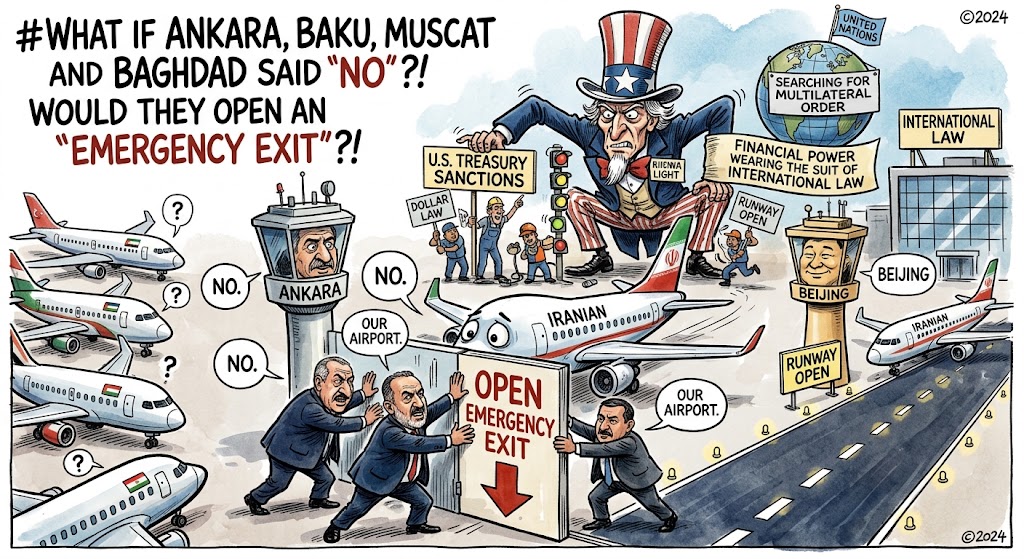
China has entered the scene through the main gate.
Beijing has opposed the American sanctions imposed on Iran, maintaining its longstanding position against unilateral sanctions that lack authorization from the Security Council.
At the same time, Iranian flights have continued to operate to China, creating a scene in which aviation speaks more clearly than diplomatic statements sometimes do:
Washington says: “No landing”… while Beijing says: “The runway is open.”
But what if the scene becomes larger?
What if Ankara says: “This is a Turkish airport”?
What if Baku says: “This is an Azerbaijani airport”?
What if Muscat says: “This is an Omani airport”?
And what if Baghdad says: “This is an Iraqi airport”?
Would the world then be facing an aviation crisis…
Or a sovereignty crisis?!
After all, an aircraft does not understand politics.
It understands the airport, the runway, the control tower and the fuel supply.
Sanctions, however, are created by human beings.
And that is where the paradox lies:
How can a sanction imposed by one country become a rule governing airports belonging to other sovereign states?
If the answer is: “Because the dollar can make it happen,” then we are no longer talking about international law in the traditional sense.
We are talking about financial power wearing the suit of international law!
And that is the dark comedy of the whole affair.
After decades of talking about national sovereignty, multilateralism, international law and the United Nations Charter, the world may suddenly find itself facing a new scene:
An Iranian aircraft is waiting on the runway…
And the control tower asks:
“Are we allowed to let it land?”
Then comes the obvious question:
“Who owns the airport?”
If the airport is in Ankara, Ankara decides.
If it is in Baku, Baku decides.
If it is in Muscat, Muscat decides.
If it is in Baghdad, Baghdad decides.
If the answer becomes something else, perhaps we will need to rewrite the definition of “sovereignty” in the international dictionary!
Therefore, the real question is not simply:
Will Iranian aircraft continue to fly?
The bigger question is:
Will states remain the authorities over their own airports, or will national airports become another map of American sanctions?
If the four capitals say “No,” they will not merely have opened an alternative route for an aircraft.
They may have opened an “emergency exit” to a much bigger question:
Who sets the rules of the international system?
And here the paradox becomes even more amusing.
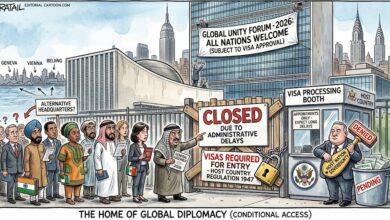
The United Nations may be meeting in New York to discuss peace and international order, while an aircraft somewhere on a runway waits to discover whether Washington has allowed it to land!
What a paradox!
The United Nations searches for a multilateral international order, while aircraft search for a unilateral clearance window!
But perhaps the aircraft is more intelligent than politics itself.
It does not ask:
“Who has the power?”
It asks only:
“Where is the runway that is open?!”
And that is where the “emergency exit” comes in.
It is not merely an escape route for an aircraft facing sanctions. It may also become a political opening through which states seek to preserve their national decision-making space, rather than allowing unilateral sanctions to become global rules.
So, what if Ankara, Baku, Muscat and Baghdad say:
“No”?!
Perhaps then it will not be the Iranian aircraft searching for an alternative route…
Perhaps the international system itself will be searching for a new runway!