 Editor -in- chief writes
EGYPTIAN-UZBEK relations have witnessed significant diplomatic momentum in recent years, reflecting a shared desire to expand cooperation and establish a stronger strategic partnership. Yet, despite the political warmth and the promising opportunities available to both countries, the economic and trade dimensions of this relationship remain below their considerable potential.
This raises a fundamental question: Why has the diplomatic momentum between Cairo and Tashkent not yet translated into a substantial economic partnership? And why does Jordan appear to be moving more rapidly in developing its relationship with Uzbekistan, while Egypt—with its strategic location, major ports, the Suez Canal and extensive access to Arab and African markets—has yet to fully capitalize on its advantages?
From the 2018 Presidential Visit to the Comprehensive Partnership
Egyptian-Uzbek relations entered a new phase with President Abdel Fattah El-Sisi’s visit to Uzbekistan on September 5, 2018, the first visit by an Egyptian president to the Central Asian country. The visit represented an important political milestone and opened new prospects for cooperation in trade, investment, education, tourism and cultural exchange.
The momentum continued with Uzbek President Shavkat Mirziyoyev’s visit to Cairo on February 20–21, 2023. The two presidents agreed to elevate bilateral relations to the level of a comprehensive partnership, reflecting the strategic importance both sides attach to their relationship.
However, the central challenge remains the gap between political declarations and tangible economic achievements. Diplomatic visits and signed agreements acquire their real value only when they generate investment, expand trade, create employment and establish sustainable mechanisms of cooperation.
Trade Figures: A Partnership Still Below Its Potential
According to statements attributed to the Uzbek Ambassador in Cairo and published in March 2026, bilateral trade exceeded US$47 million by the end of 2025. Although this figure reflects an existing economic relationship, it remains modest when measured against the size of the Egyptian and Uzbek economies and the opportunities available to both countries.
The resumption of the Egyptian-Uzbek Joint Governmental Committee in December 2024, following an interruption of approximately fifteen years since its previous meeting in 2009, was an important step. Nevertheless, the real test is whether this mechanism can meet regularly, monitor the implementation of agreements and remove obstacles facing businesses and investors.
The Uzbek Ambassador also referred to more than thirty meetings with Egyptian institutions and entities during 2025. This indicates an active diplomatic effort to promote cooperation. Yet the number of meetings should ultimately be measured by the projects, contracts and commercial results that follow them.
Why Is the Jordanian Partnership Moving Faster?
Jordan’s growing engagement with Uzbekistan deserves serious attention, not as a reason for competition or political sensitivity, but as a practical example of how diplomatic initiatives can be translated into economic opportunities.
During the Jordanian engagement with Uzbekistan in Samarkand in August 2025, the two sides signed fifteen cooperation documents. Subsequent developments during 2026 included renewed work on joint governmental cooperation, business-sector engagement, direct flights between Amman and Tashkent, and discussions concerning the establishment of a commercial and logistical presence in Aqaba.
These steps demonstrate the importance of connecting diplomacy with specific economic instruments: direct transport links, business councils, trade facilitation and logistical infrastructure.
The question for Egypt is not why Jordan is cooperating with Uzbekistan, but why Egypt has not yet moved with comparable speed to transform its own strategic advantages into practical initiatives. Jordan’s progress should be viewed as a useful model rather than a zero-sum competition.
Egypt: A Strategic Gateway Waiting to Be Fully Utilized
Egypt possesses geographical and economic advantages that could make it one of Uzbekistan’s most important gateways to regional and international markets.
These advantages include:
- The Suez Canal, one of the world’s most important maritime trade routes connecting Asia, Europe and Africa.
- Egyptian ports on the Mediterranean and Red Seas, offering access to major international shipping networks.
- The Suez Canal Economic Zone, which could host Uzbek industrial, commercial and logistics projects serving regional markets.
- Egypt’s extensive Arab and African relations, providing opportunities for Uzbek products and investments to reach markets beyond Egypt.
- A substantial domestic market and diversified industrial and agricultural base, creating opportunities for joint manufacturing, food security projects and technology exchange.
Egypt is therefore not merely a destination for Uzbek exports. It can become a production, distribution and logistics platform through which Uzbek companies reach Arab, African and other international markets.
Developments in 2026: Positive Signals That Require Follow-Through
Several developments during 2026 have offered renewed opportunities to advance bilateral relations. These include Uzbek Foreign Minister Bakhtiyor Saidov’s visit to Cairo in June and his talks with Egyptian Foreign Minister Dr. Badr Abdelatty and Prime Minister Mostafa Madbouly.
The two sides also pursued a cooperation programme between their foreign ministries for 2026–2028, discussed negotiations on a preferential trade agreement, and explored ways to facilitate the registration of Egyptian pharmaceutical products in Uzbekistan.
Cooperation has also extended to agriculture and water-related issues, including a memorandum of understanding on water research discussed in October 2026. Tourism, education and cultural exchange offer further opportunities to broaden relations beyond traditional diplomatic channels.
These developments are encouraging, but they must be followed by clear implementation schedules, measurable targets and responsible institutions. Agreements should not remain declarations of intent; they should become operational programmes with visible outcomes.
What Is Holding Back the Economic Partnership?
The modest level of trade and investment suggests that several structural and practical obstacles still need to be addressed. Among the most important are:
- Irregular institutional coordination: The long interruption in the work of the joint governmental committee weakened continuity and delayed the implementation of bilateral priorities.
- The absence of a completed preferential trade framework: Progress in negotiations must be accelerated to make trade more competitive and predictable.
- Market-access and registration procedures: Difficulties facing pharmaceutical and other products can restrict opportunities for Egyptian exporters.
- Transport and logistics: Limited direct connectivity and the need for more efficient shipping and cargo arrangements can increase costs and reduce competitiveness.
- Insufficient private-sector engagement: Business communities need permanent channels to identify partners, exchange information and conclude commercial agreements.
- The gap between agreements and implementation: The relationship needs more joint ventures and completed projects, rather than relying primarily on diplomatic meetings and memoranda.
These challenges should be examined jointly and addressed through a practical bilateral agenda. The objective should be to turn political goodwill into an economic relationship that serves the interests of both peoples.
A Practical Roadmap: From Diplomatic Understanding to Strategic Partnership
Egypt and Uzbekistan have the opportunity to move beyond conventional bilateral cooperation and establish a more ambitious economic partnership. The following initiatives could provide a practical starting point:
- Regular presidential and ministerial engagement: Maintain high-level political momentum through reciprocal visits and clearly defined economic priorities.
- Revitalize the Joint Governmental Committee: Ensure regular meetings, implementation reviews and measurable objectives, with active participation from the relevant ministries and business communities.
- Accelerate the preferential trade agreement: Set a clear timetable for negotiations and address barriers affecting the movement of goods and services.
- Establish a joint Egyptian-Uzbek Business Council: Create a permanent platform connecting investors, manufacturers, exporters and chambers of commerce.
- Explore an Uzbek commercial and industrial presence in the Suez Canal Economic Zone: Such a project could help Uzbek companies manufacture, store and distribute products through Egypt to regional markets.
- Consider an Egyptian trade and investment centre in Tashkent: This could promote Egyptian products, facilitate business contacts and provide practical information to investors.
- Expand pharmaceutical and healthcare cooperation: Simplify registration procedures and explore joint manufacturing and distribution opportunities.
- Develop agricultural and water cooperation: Promote research, modern irrigation, food security and the exchange of technical expertise.
- Strengthen transport and tourism links: Examine more efficient air and maritime connections, while encouraging tourism programmes in both directions.
- Expand educational and cultural exchange: Build on the historical and intellectual links between Egypt and Central Asia, including cooperation with Egyptian universities and Al-Azhar.
A joint investment forum in Cairo or Tashkent could bring these proposals together, allowing companies from both countries to identify specific projects and move directly towards implementation.
Questions for the Egyptian Foreign Ministry and the Uzbek Embassy in Cairo
In the interest of constructive dialogue and greater transparency, several questions deserve clear answers from the Egyptian Ministry of Foreign Affairs and the Embassy of Uzbekistan in Cairo:
- How do both sides assess the development of Egyptian-Uzbek relations since President El-Sisi’s visit to Uzbekistan in September 2018 and President Mirziyoyev’s visit to Cairo in February 2023?
- What concrete agreements and projects have been implemented as a result of the two presidential visits?
- What were the reasons behind the long interruption in the work of the Joint Egyptian-Uzbek Governmental Committee, and how will both sides guarantee its regular meetings in the future?
- What is the current status of negotiations on the preferential trade agreement, and is there a specific timetable for its conclusion?
- What are the priorities for increasing bilateral trade beyond the level of US$47 million recorded by the end of 2025?
- Has the possibility of establishing an Uzbek commercial, industrial or logistics centre in the Suez Canal Economic Zone been formally discussed?
- What measures are being considered to facilitate the registration of Egyptian pharmaceutical products and expand their access to the Uzbek market?
- What lessons can Egypt draw from the recent acceleration of Jordanian-Uzbek cooperation, particularly in transport, trade and logistics?
- Does Uzbekistan view Egypt as a potential regional platform for reaching Arab and African markets, and what practical steps would be required to realize this objective?
- Would both governments support organizing a joint investment forum to bring together public institutions, chambers of commerce and private-sector representatives?
Egypt and Uzbekistan: A Partnership That Needs Economic Ambition
Egyptian-Uzbek relations possess a strong political foundation and considerable opportunities for expansion. The two countries share an interest in strengthening economic cooperation, diversifying international partnerships and opening new horizons for trade, investment, education and cultural exchange.
Yet the time has come to move from the language of potential to the discipline of implementation. Egypt should make more effective use of its geographical position, the Suez Canal, its ports and its access to Arab and African markets. Uzbekistan, in turn, can benefit from Egypt as a strategic partner and a gateway to wider regional opportunities.
Jordan’s progress demonstrates that focused diplomacy, direct connectivity and practical business mechanisms can produce tangible results. Egypt has even broader geographical and economic assets, but these advantages will not translate into influence automatically. They require initiative, coordination and a clear vision.
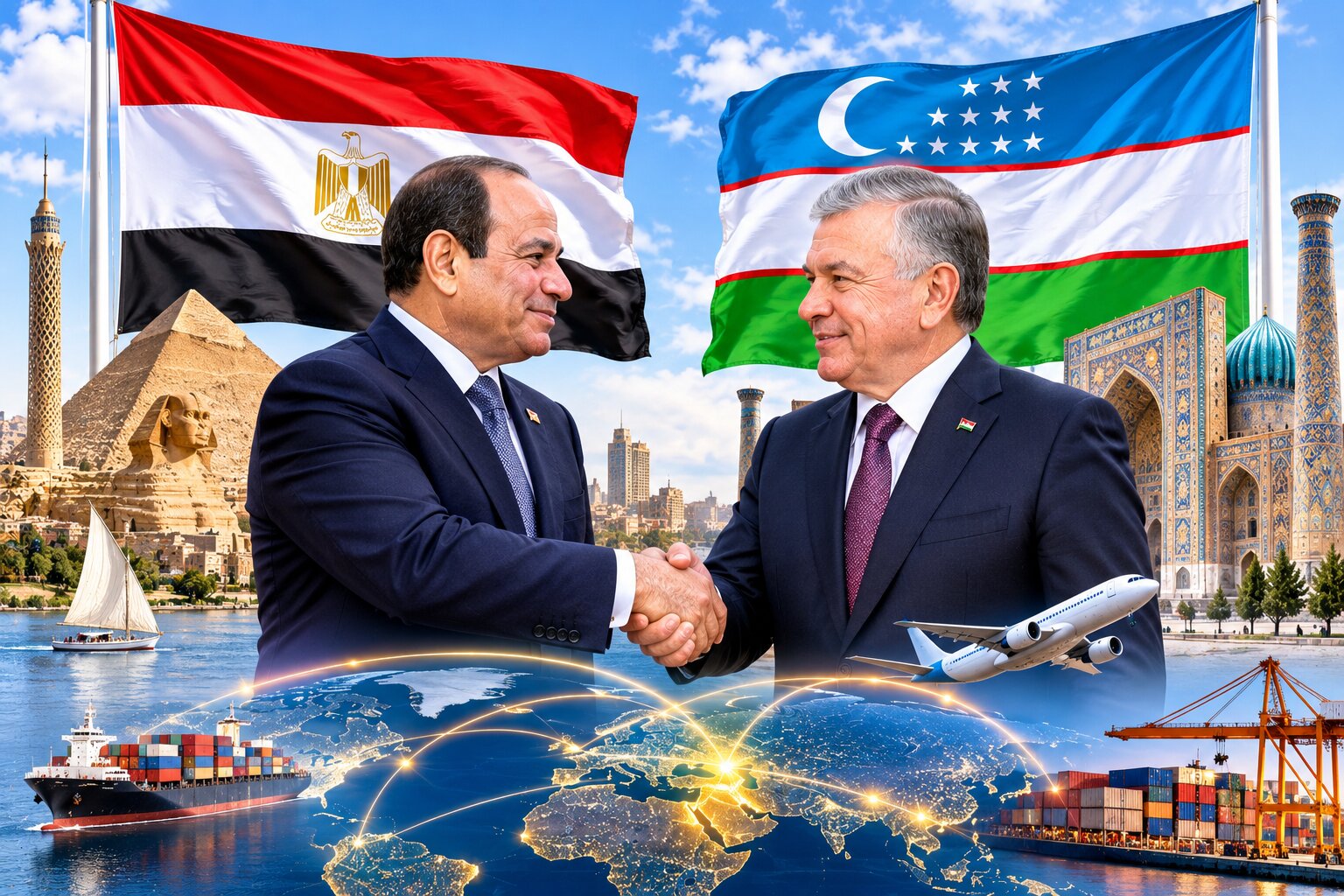
Egypt is not merely a potential gateway for Uzbekistan; it is a partner with the geographical, economic and logistical capabilities to help build a trade and investment corridor extending from Samarkand to the Suez Canal, and from there to Arab, African and international markets.
From Cairo to Tashkent, the road is open. The real question is: Who will take the initiative to turn this road into a highway of shared interests and mutual prosperity?