 Editor -in-chief writes
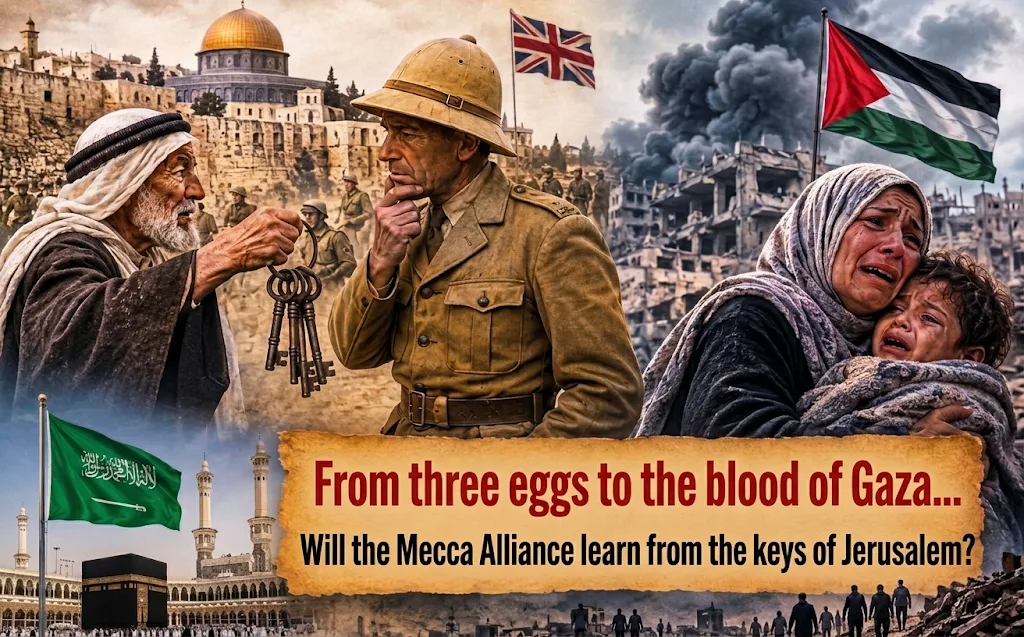
SOME historical stories may initially sound humorous, yet conceal the tragedies of entire nations. Among the strangest is the account recounted by the late Egyptian writer and journalist Mohamed Hassanein Heikal about the surrender of Jerusalem’s keys to British forces in 1917. It was a scene in which historical irony collided with the bitterness of political and military defeat, to the point that Heikal summarized the story in three eggs!
During his televised interview with journalist Lamis El Hadidy on CBC, Heikal recalled a story he had long felt reluctant to write about and publish abroad. He even spoke of declining a publishing opportunity with the international publishing house HarperCollins, reportedly giving up hundreds of thousands of dollars rather than documenting that particular chapter of history.
According to Heikal’s account, Jerusalem’s notables, having realized that Ottoman forces were withdrawing before the advancing British army under General Edmund Allenby, sent one of the city’s sheikhs to surrender the keys to the approaching forces, hoping to spare the city further fighting and destruction.
But the sheikh carrying the keys to the holy city did not speak English, while the British soldier he encountered did not understand Arabic. A British officer reportedly wanted eggs for breakfast and sent a soldier to obtain them. The soldier then encountered the sheikh, who was trying to hand over the keys to Jerusalem, while the soldier understood only that the man was asking for eggs!
Thus, in one of history’s most painful ironies, one man was presenting the keys to a sacred city while the other was thinking about breakfast.
Three eggs in Heikal’s account, and the keys of Jerusalem in the hands of an occupying army!
Historically, the story has parallels in British memoirs, including Major Vivian Gilbert’s The Romance of the Last Crusade, although details differ among accounts. Jerusalem surrendered on December 9, 1917, and General Allenby formally entered the city on December 11 of that year.
But the real issue was never the eggs or the keys. The question that must remain before us is: How did Jerusalem reach that moment? And how did it fall under British occupation after centuries of Ottoman rule?
The Ottoman Caliphate: When Influence Declines, Sovereignty Is Lost
Heikal reflected on the historical accusations directed at the Ottoman Caliphate because of its declining ability to protect vast parts of the Islamic world. He cited the fall of Egypt to Napoleon, French expansion in North Africa, and the loss of control over other strategic territories.
The fall of Jerusalem, however, cannot be attributed solely to Ottoman weakness. The circumstances of the First World War, colonial agreements, European rivalry, the Arab Revolt, and conflicting regional interests all played significant roles.
Nevertheless, one lesson cannot be ignored: state decline, internal divisions, and the absence of a common strategic vision open the door to foreign intervention and the loss of sovereignty.
British forces entered Jerusalem, followed by the British Mandate in Palestine. A new chapter of colonial history began, eventually leading to the Palestinian Nakba of 1948 and the subsequent decades of occupation, displacement, and conflict.
Remembering history, therefore, is not merely an exercise in nostalgia. It is essential to understanding the present and preventing the repetition of past mistakes.
Gaza: From the Keys of Jerusalem to the Keys of the Border Crossings
More than a century later, the Palestinian tragedy remains painfully present, although the tools, actors, and circumstances have changed.
Today, Gaza faces an immense humanitarian catastrophe following years of blockade and military assaults, widespread destruction, killings, and displacement. Serious allegations of genocide have become the subject of proceedings before the International Court of Justice in the case brought by South Africa against Israel.
In its report dated November 18, 2026, the United Nations reported continuing strikes and gunfire in populated areas, restrictions on humanitarian operations, shortages of essential supplies and equipment, and damage to shelters and basic services caused by rainfall and flooding.
Here lies one of the greatest political and humanitarian contradictions: the world speaks about humanitarian assistance while its delivery to those who need it remains subject to Israeli restrictions and procedures.
Humanitarian aid alone, when presented as a solution to the Palestinian question, is nothing more than a major political deception. Providing food, medicine, water, and fuel to save lives, however, is an urgent humanitarian obligation that cannot be postponed.
Who can compel the occupation authorities to open the crossings? Who can guarantee the entry of sufficient aid without obstruction? And who can protect hospitals, medical facilities, schools, and shelters for displaced families?
The lives of millions of Palestinians cannot remain hostage to permits, restrictions, and procedures imposed by the occupying power. Nor should relief convoys become a political cover for the continuation of the tragedy.
A people cannot be fed indefinitely while living under bombardment. Tents cannot replace a homeland, and humanitarian assistance must never become an alternative to ending the aggression, ending the occupation, and restoring Palestinian rights.
The allegations of genocide before the International Court of Justice also place a legal and moral responsibility on the international community. It is important, however, to distinguish between the provisional measures already issued by the Court and a final judgment on the merits, which has not yet been delivered.
Türkiye: Is It Time to Correct the Mistakes of History?
Türkiye now emerges as an important regional actor, not as the heir to an empire that must be restored, but as an influential state with strategic geography, considerable political, economic, and military capabilities, and a long historical connection to the region.
The Ottoman era has ended, and the modern Turkish Republic has emerged. Yet Palestine remains unliberated, Jerusalem has not regained its full rights, and the Levant continues to face profound security and political challenges.
Correcting the mistakes of history does not mean restoring empires or imposing guardianship over peoples. Rather, it means respecting state sovereignty, supporting peoples’ right to self-determination, confronting occupation and settlement expansion, and working to restore legitimate rights.
Ankara has already taken practical steps in this direction. These include suspending all direct trade transactions with Israel on May 2, 2024, following earlier restrictions on exports of 54 product groups in April of the same year. The Turkish government linked the continuation of these measures to allowing sufficient and sustained humanitarian assistance to reach Gaza.
Türkiye has also expressed support for the legal proceedings concerning Palestine before the International Court of Justice and reaffirmed, in its official positions, its support for Syria’s unity and sovereignty and its rejection of Israeli violations on Syrian territory.
Yet a fundamental question remains: How can political positions be transformed into a regional framework capable of protecting peoples, deterring aggression, ending occupation, and preventing history’s tragedies from recurring?
The Mecca Alliance: From Collective Defence to the Protection of Rights
In this context, an important strategic development deserves attention: the Mecca Agreement on Mutual Defence, signed by Saudi Arabia, Türkiye, and Pakistan on August 7, 2026, during a trilateral summit hosted by the holy city of Makkah.
Choosing Makkah as the venue carries considerable symbolic significance because of its central place in the hearts of Muslims worldwide. The three participating countries also possess substantial political, military, and economic weight, alongside shared strategic interests.
The agreement provides for strengthening collective deterrence and defence cooperation. It establishes the principle that an external armed attack against any one of the three countries shall be regarded as an attack against all three, while promoting cooperation in military, defence, and security fields.
The agreement has moved beyond a political declaration. The Turkish Parliament approved it on November 5, 2026, and the law authorizing its ratification was published in Türkiye’s Official Gazette on November 14, 2026.
This raises a larger strategic question: Will the Mecca Agreement remain a framework for protecting the three signatory states, or could it become the starting point for broader Arab and Islamic coordination to safeguard regional security and the rights of its peoples?
Of course, the agreement does not provide for automatic military intervention to liberate Palestine, nor does it make Palestinian territories a party to the agreement. Nevertheless, it offers an opportunity to develop political, defence, and strategic coordination among the three countries in ways that could contribute to regional stability and strengthen the capacity to confront aggression.
The real test of the Mecca Alliance will not be measured by the number of armies, weapons, or agreements. Rather, it will be measured by its ability to contribute to a more secure regional environment, uphold international law, protect civilians, support Palestinian rights, and prevent expansionism and violations of state sovereignty.
Can Makkah become more than the venue for a mutual defence agreement and emerge as the starting point of a broader project for effective Islamic solidarity, with Palestine at the heart of its political and humanitarian priorities?
Egypt: The Essential Link in the Arab and Islamic Security Equation
No serious discussion about the future of regional security, or any project aimed at protecting Palestine and the Levant, can overlook Egypt.
Egypt is not merely a neighbouring country to Palestine. It shares a direct border with the Gaza Strip, possesses considerable historical, political, and military weight, and has played a central role in the Palestinian question for decades. It also bears a significant responsibility for Arab national security.
Therefore, Egyptian-Saudi-Turkish-Pakistani coordination could provide an important foundation for developing a common regional vision, provided that it is based on respect for national sovereignty, adherence to international law, and non-interference in the internal affairs of states.
The participation of other Arab countries in any framework for coordination and cooperation, based on clear understandings and mutual interests, could broaden its influence and strengthen the region’s ability to confront shared challenges.
We do not need another struggle for regional influence or new empires. We need genuine partnerships that protect Egypt, Türkiye, Saudi Arabia, Pakistan, and all Arab and Islamic countries, while placing Palestine and the rights of its people at the forefront of their priorities.
From Palestine to the Levant: Shared Destiny and Respect for Sovereignty
What is happening in Palestine cannot be separated from the security of Syria, Lebanon, and Jordan, or from the future of the entire Levant.
An attack on a state’s sovereignty, the occupation of part of its territory, or the exploitation of internal crises to expand external influence threatens the stability of the entire region.
Accordingly, the Turkish role should be based on supporting Syria’s unity and independent decision-making, respecting Lebanon’s sovereignty, protecting Jordan’s security, supporting Palestinian rights, and coordinating with Egypt and Arab countries to address common challenges.
Any discussion of liberating Palestine and other occupied Arab territories must be grounded in legitimate national rights, international law, relevant United Nations resolutions, and peoples’ right to self-determination, far removed from projects of guardianship or the forcible alteration of borders.
Shared destiny does not mean imposed guardianship. Solidarity does not mean abolishing the independence of states. Real strength lies not in imposing one’s will on others, but in protecting their rights and sovereignty.
The Final Lesson: We Do Not Want New Keys or Another Three Eggs
Revisiting Mohamed Hassanein Heikal’s story is not simply an attempt to recall a humorous historical episode. It is an effort to understand an enduring tragedy that began with the collapse of political and military balances in the region and whose consequences continue to be paid by its peoples.
In 1917, the keys of Jerusalem symbolized the end of one era and the beginning of another under occupation. In 2026, Gaza stands before the world, asking neither for keys nor privileges, but for its right to life, security, freedom, and independence.
Between these two moments, the Mecca Agreement on Mutual Defence represents a strategic development worth close attention and a test of the ability of Islamic countries to overcome their differences and build genuine mechanisms of cooperation.
Türkiye is called upon to turn its regional position, historical experience, and political positions into a sustained effort for Palestine, in cooperation with Egypt, Saudi Arabia, Pakistan, and Arab and Islamic countries, rather than limiting itself to condemnations or crisis management.
Egypt, in turn, must continue its pivotal role in protecting the Palestinian cause, strengthening Arab coordination, and preventing the liquidation of Palestinian rights or the imposition of solutions at the expense of the Palestinian people.
The Arab and Islamic world must recognize that Palestine is not the responsibility of one country alone. Protecting Jerusalem, Gaza, and the Levant requires more than slogans. It demands coordinated political, economic, and diplomatic action, together with legitimate deterrence mechanisms that respect international law.
We do not want to wake up a hundred years from now to tell another story about a city whose keys were surrendered, nor discover that the children of Gaza paid the price for the world’s failure while everyone was negotiating the number of food and medicine trucks allowed to enter.
From Jerusalem to Gaza, from Damascus to Beirut, and from Cairo to Ankara, Riyadh, Islamabad, and the holy city of Makkah, the message remains the same:
Land is not protected by nostalgia for history, but by awareness, sovereignty, unity of purpose, and the ability to make decisions.
Will the Mecca Alliance mark the beginning of correcting history’s mistakes, or will we wait until history writes another story about lost keys, shed blood, and three more eggs?