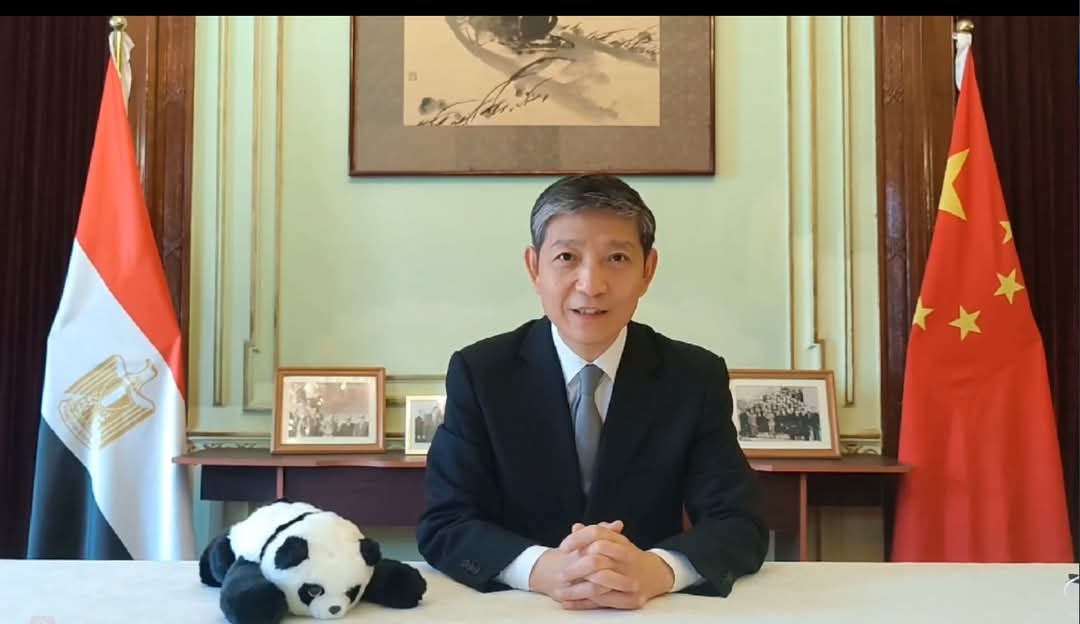
By amb. Liao Liqian
Chinese Ambassador to Egypt
1. Diplomatic Significance and Timing
Premier Li Qiang’s official visit to Egypt on July 9–10 marks a pivotal moment in Sino-Egyptian relations. It is not only his first visit to the country, but also the highest-level Chinese delegation to visit Egypt in recent years. The visit represents a key step in implementing the strategic consensus between President Xi Jinping and President Abdel Fattah El-Sisi. Against the backdrop of regional instability and global realignment, this high-level diplomatic gesture carries profound political weight, signaling China’s growing engagement with the Arab world through Egypt.
2. Four Pillars of the China–Egypt Partnership
The ambassador presents the bilateral relationship through four distinct dimensions:
a. Political Companionship and Strategic Trust
- The personal rapport between Presidents Xi and El-Sisi has been central to guiding bilateral ties.
- Both countries provide mutual support on core sovereignty issues — Egypt upholds the One-China principle, while China supports Egypt’s sovereignty and security.
- High-level exchanges have deepened, enhancing intergovernmental, legislative, and party-level coordination.
b. Economic and Developmental Partnership
- China is Egypt’s largest trading partner and top source of imports, as well as one of its major foreign investors.
- The TEDA Suez Economic and Trade Cooperation Zone stands out as a symbol of industrial cooperation.
- Chinese investments span key sectors: renewable energy, textiles, white goods, and modern construction materials — helping Egypt transform its geographic advantage into a growth engine.
- Financial innovation and development-oriented cooperation have bolstered Egypt’s pursuit of sustainable growth, driven by China’s modernization model.
c. Cultural Affinity and People-to-People Bonds
- 2023 was marked as the “China-Egypt Year of Partnership”, with numerous cultural events and exchanges.
- Direct flights and educational exchanges (notably growing interest in Chinese language learning in Egypt) have brought the two societies closer.
- Joint archaeological missions, such as the recent unveiling of a temple in ancient Egyptian ruins, and the display of Egyptian antiquities in China have become symbols of civilizational reciprocity.
d. Shared Global Vision and Strategic Alignment
- Sino-Egyptian relations are portrayed as a “living model of new-type international relations”, transcending bilateralism.
- The two countries coordinate closely in multilateral forums such as the UN, BRICS, the Forum on China–Africa Cooperation (FOCAC), and the China–Arab States Cooperation Forum.
- Both sides advocate for political resolutions to global crises (Palestine, Ukraine, Iran nuclear issue), promoting stability and multipolarity.
- China fully supports Egypt’s plan for the reconstruction of Gaza and the joint Arab-Islamic ministerial statement calling for a ceasefire and renewed negotiations on Iran’s nuclear file.
3. Broader Arab Context and Strategic Expansion
The ambassador expands the bilateral frame into a regional vision:
- Sino-Arab relations are at their historical peak, with both sides striving to build a China–Arab community of shared future.
- Trade exceeded $400 billion in 2024, and the Belt and Road Initiative now includes all 22 Arab countries.
- China positions itself as a long-term development partner to the Arab world, blending infrastructure investment with political non-intervention.
4. Looking Ahead: Egypt as a Gateway to China’s Arab Strategy
- The 70th anniversary of diplomatic relations in 2026 will coincide with the second China–Arab Summit in China — a symbolic and strategic juncture.
- Premier Li’s visit is expected to further consolidate this momentum, pushing the bilateral relationship toward the shared goal of a “Community of Shared Future” in the new era.
Critical Assessment
- Coherent and Soft-Power Oriented Rhetoric: The ambassador skillfully blends strategic, economic, and cultural language to present China as a benevolent partner.
- Symbolic Framing: References to friendship, “brotherhood,” and civilizational ties help soften China’s growing presence in the region.
- Omission of Challenges: The statement lacks discussion of potential frictions — such as Egypt’s balancing act between China, the West, and Gulf states, or competition over African influence.
- Smart Deployment of Soft Power Tools: Cultural diplomacy, archaeological collaboration, and educational exchanges are increasingly central to China’s MENA strategy.
- Multipolarity as a Narrative Frame: China positions itself as a champion of multipolar stability, subtly critiquing Western interventionism without direct confrontation.
Conclusion
China–Egypt relations exemplify a “smart alliance” model — one that is multidimensional, mutually beneficial, and increasingly central to both countries’ foreign policy visions. Premier Li Qiang’s visit is likely to catalyze deeper cooperation and place Egypt in a key position within China’s broader Arab and African engagement strategies. The visit is more than ceremonial — it is a reaffirmation of a strategic partnership rooted in political trust, economic synergy, cultural dialogue, and shared global aspirations.