Ashraf AboArafe
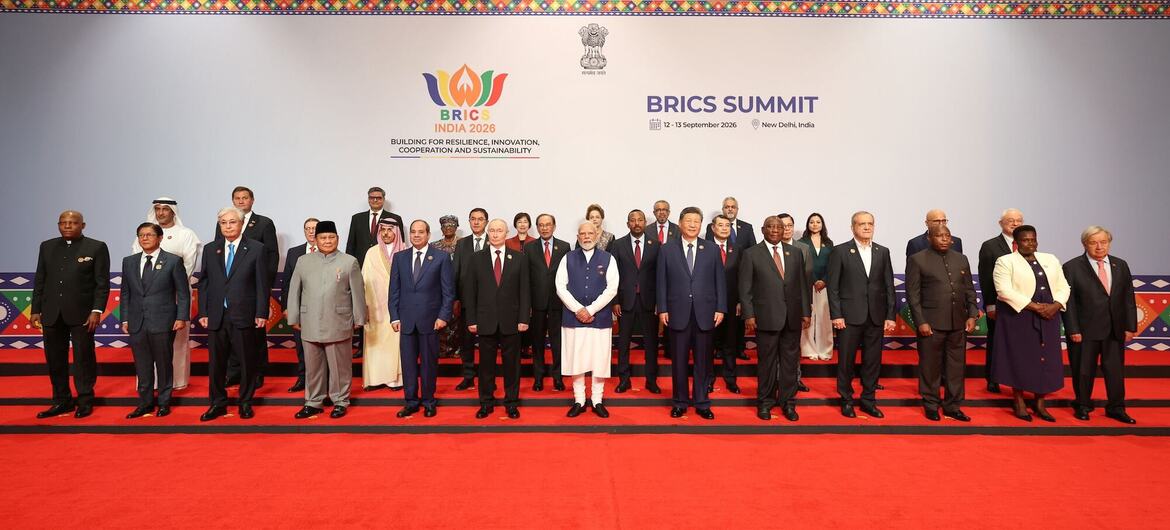
UNITED Nations Secretary-General António Guterres’s address to the 18th BRICS Summit in New Delhi goes far beyond a conventional diplomatic appeal. At its core is a recognition that the political, economic and demographic architecture of the world has moved far beyond the institutional structures created in 1945.
His central message is therefore both simple and profound: a multipolar world cannot be governed indefinitely through institutions designed for a different era.
From a Changing World to a Changing Order
Guterres’s assertion that the world is moving irreversibly toward multipolarity is perhaps the most consequential element of his speech. Multipolarity, in his formulation, should not merely mean the emergence of several competing centers of power. Properly managed, it can produce greater balance, representation and fairness in international institutions.
This places the reform of the UN Security Council and the Bretton Woods financial system at the heart of the discussion.
The issue is not simply that new powers have emerged. It is that the distribution of economic weight, population, technological capacity and geopolitical influence has changed dramatically, while decision-making structures have not kept pace.
The resulting gap feeds perceptions of historical injustice—particularly across the developing world.
Development Finance: The Missing Foundation
Guterres rightly places development finance at the center of the sustainable-development agenda.
Developing countries are being asked to meet enormous challenges—poverty reduction, climate adaptation, infrastructure, energy transition and technological modernization—while often facing high borrowing costs, debt burdens and limited access to capital.
His call for stronger multilateral development banks is therefore strategically important. The objective should not merely be to increase the volume of lending, but to create a financial system capable of mobilizing private investment while expanding affordable financing for countries that need it most.
A more representative international financial architecture would also give developing countries greater influence over decisions that directly affect their economic futures.
In this sense, financial reform is not charity; it is a question of global economic justice and stability.
The AI Divide Could Become the New Development Divide
Perhaps the most forward-looking part of the speech concerns artificial intelligence.
Guterres recognizes AI as a potential accelerator capable of compressing decades of development into years. But he simultaneously warns that its benefits are becoming concentrated among a relatively small number of countries and corporations.
That creates a dangerous possibility: the world could move from a digital divide to an AI sovereignty divide.
Countries lacking computing capacity, data, infrastructure and skilled professionals may find themselves permanently dependent on those controlling the technology.
The consequences would extend well beyond economics—to income, security, opportunity, scientific independence and national sovereignty.
Guterres’s support for international scientific cooperation and global AI-governance mechanisms is therefore significant. The question is no longer whether AI will transform development; it is who will have the capacity to participate in that transformation.
BRICS, with its considerable human resources, markets and technological capabilities, could become an important platform for narrowing this gap—provided technological cooperation is translated into real access to infrastructure, knowledge and capacity-building for developing nations.
Climate Justice: Beyond Promises
The climate section of the speech connects environmental responsibility with the broader question of fairness.
The countries most vulnerable to climate change are frequently not those that contributed most to historical emissions. Consequently, climate justice cannot be reduced to emissions targets alone.
It must also address finance, adaptation, loss and damage, technology transfer and access to early-warning systems.
Guterres’s emphasis on the energy transition, methane reduction and protection of nature reflects the urgency of the challenge. Yet his demand that developed countries fulfill their financial commitments highlights the persistent credibility gap between climate diplomacy and climate delivery.
The management of critical minerals is equally important. The green transition itself could create new geopolitical inequalities if resource-rich developing countries remain merely suppliers of raw materials while higher-value processing, technology and industrial benefits accumulate elsewhere.
Peace and International Law: The Final Test
The fourth pillar—peace—gives the entire speech its political gravity.
From Gaza and the wider Middle East to Ukraine and Sudan, Guterres argues that the international system cannot function effectively without respect for the UN Charter, sovereignty, territorial integrity, political independence, peaceful settlement of disputes and international humanitarian and human-rights law.
This is particularly significant in a multipolar environment.
Multipolarity without rules can become competition among powers. Multilateralism without legitimacy can become an institution without trust.
The challenge, therefore, is to build a system in which power is balanced by law and sovereignty is accompanied by responsibility.
BRICS and the Emerging Architecture
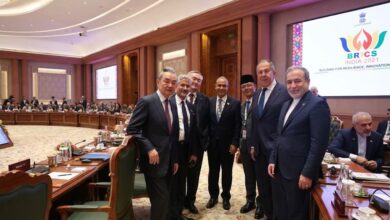
The deeper significance of Guterres speaking at BRICS lies in the venue itself.
BRICS increasingly represents an important expression of the Global South’s demand for greater representation in global governance, financial institutions and international decision-making.
Yet its growing influence also brings responsibility. If BRICS seeks a more balanced world order, its contribution cannot stop at criticism of existing institutions. It must demonstrate that greater multipolarity can coexist with cooperation, international law and collective solutions to global problems.
That is where the summit’s theme—resilience, innovation, cooperation and sustainability—acquires genuine meaning.
The Larger Message
Guterres’s speech can ultimately be read as a warning against trying to govern a 21st-century world with 20th-century institutions.
The world is becoming more multipolar. Technology is transforming power. Climate change is redrawing the boundaries of vulnerability. Developing countries are demanding a greater voice. And global crises increasingly cross borders that no nation can manage alone.
The choice is therefore not between the old order and chaos.
It is between reforming global governance peacefully—or allowing the widening gap between reality and institutions to deepen instability.
The most powerful line running through the address is consequently not merely a call to reform the Security Council or the financial system.
It is a call to recognize a historical truth:
When the world changes, its institutions must change with it.
And if multipolarity is indeed irreversible, the real question is no longer whether the world will become more plural—but whether its institutions will become more just, representative and capable of serving that new world.